MCQ
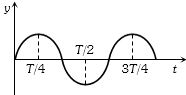
The graph shows the variation of displacement of a particle executing S.H.M. with time. We infer from this graph that
  • A
    The force is zero at time $3T/4$
  • B
    The velocity is maximum at time $T/2$
  • C
    The acceleration is maximum at time T
  • The P.E. is equal to total energy at time $T/2$
Answer

Correct option: D.
The P.E. is equal to total energy at time $T/2$
d
(d)At time $\frac{T}{2};\;v = 0$ $\therefore $Total energy = Potential energy.

Need a full question paper?

Generate a complete, print-ready paper with questions like this in minutes — across 16+ boards, with answer keys.

Start Generating Free

Similar questions

The minimum audible wavelength at room temperature is about
A bullet is dropped from the same height when another bullet is fired horizontally. They will hit the ground
Which of the following is not an example of perfectly inelastic collision
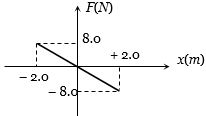
A body of mass $0.01 kg$ executes simple harmonic motion $(S.H.M.)$ about $x = 0$ under the influence of a force shown below : The period of the $S.H.M.$ is .... $s$
A street car moves rectilinearly from station $A$ to the next station $B$ with an acceleration varying according to the law $a=(b-c x)$, where $b$ and $c$ are constants and $x$ is the distance from station $A$. The distance between the two stations and the maximum velocity are
An ice cube at temperature $-20^o C$ is kept in a room at temperature $20^o C$. The variation of temperature of the body with time is given by
Given below are two statements : one is labelled as Assertion $A$ and the other is labelled as Reason $R$.

Assertion $A$ : When a body is projected at an angle $45^{\circ}$, it's range is maximum.

Reason $R$ : For maximum range, the value of $\sin 2 \theta$ should be equal to one.

In the light of the above statements, choose the correct answer from the options given below :

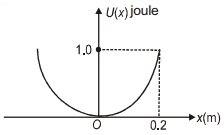
A particle of mass $4 \,kg$ moves simple harmonically such that its $P E(U)$ varies with position $x$, as shown. The period of oscillations is ............
In Jager's method, at the time of bursting of the bubble
If the period of oscillation of mass $m$ suspended from a spring is $2\, sec$, then the period of mass $4m$ will be  .... $\sec$