MCQ
A transverse sinusoidal wave of amplitude $a,$ wavelength $\lambda$ and frequency $n$ is travelling on a stretched string. The maximum speed of any point on the string is $v/10,$ where $v$ is the speed of propagation of the wave. If $a = {10^{ - 3}}\,m$ and $v = 10\,m{s^{ - 1}}$, then $\lambda$ and $n$ are given by
  • A
    $\lambda = 2\pi \times {10^{ - 2}}\,m$
  • B
    $\lambda = {10^{ - 3}}\,m$
  • C
    $n = \frac{{{{10}^3}}}{{2\pi }}Hz$
  • Both $(a)$ and $(c)$

Answer

Correct option: D.
Both $(a)$ and $(c)$
d
(d) ${v_{\max }} = a\omega = \frac{v}{{10}} = \frac{{10}}{{10}} = m/sec$
$ \Rightarrow $$a\omega = a \times 2\pi n = 1$$ \Rightarrow $$n = \frac{{{{10}^3}}}{{2\pi }}$                        $(\because a=10^{-3})$
Since $v = n\lambda \Rightarrow \lambda = \frac{v}{n} = \frac{{10}}{{{{10}^3}/2\pi }} = 2\pi \times {10^{ - 2}}\,m$

Need a full question paper?

Generate a complete, print-ready paper with questions like this in minutes — across 16+ boards, with answer keys.

Start Generating Free

Similar questions

If a body of mass $m$ is carried by a lift moving with an upward acceleration $a$, then the forces acting on the body are

(i) the reaction $R$ on the floor of the lift upwards

(ii) the weight $mg$ of the body acting vertically downwards.

The equation of motion will be given by

Value of round off of numbers $2.745$ and $2.735$ upto $3$ significant digits will be
The vertical height of point $P$ above the ground is twice that of $Q$. A particle is projected downward with a speed of $5 m / s$ from $P$ and at the same time another particle is projected upward with the same speed from $Q$. Both particles reach the ground simultaneously, then
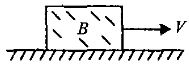
A block $B$ is pushed momentarily along a horizontal surface with an initial velocity $V.$ If $\mu $ is the coefficient of sliding friction between $B$ and the surface, block $B$ will come to rest after a time
A mass $M$, attached to a horizontal spring, executes S.H.M. with amplitude $A_1$. When the mass $M$ passes through its mean position then a smaller mass $m$ is placed over it and both of them move together with amplitude $A_2$. The ratio of $\frac{{{A_1}}}{{{A_2}}}$ is
$List I$ describes thermodynamic processes in four different systems. $List II$ gives the magnitudes (either exactly or as a close approximation) of possible changes in the internal energy of the system due to the process.

$List-I$ $List-II$
($I$) $10^{-3} kg$ of water at $100^{\circ} C$ is converted to steam at the same temperature, at a pressure of $10^5 Pa$. The volume of the system changes from $10^{-6} m ^3$ to $10^{-3} m ^3$ in the process. Latent heat of water $=2250 kJ / kg$. ($P$) $2 kJ$
($II$) $0.2$ moles of a rigid diatomic ideal gas with volume $V$ at temperature $500 K$ undergoes an isobaric expansion to volume $3 V$. Assume $R=8.0 Jmol ^1 K^{-1}$. ($Q$) $7 kJ$
($III$) On mole of a monatomic ideal gas is compressed adiabatically from volume $V=\frac{1}{3} m^3$ and pressure $2 kPa$ to volume $\frac{v}{8}$ ($R$) $4 kJ$
($IV$) Three moles of a diatomic ideal gas whose molecules can vibrate, is given $9 kJ$ of heat and undergoes isobaric expansion. ($S$) $5 kJ$
  ($T$) $3 kJ$

Which one of the following options is correct?

When length is increased on applying force, then strain is called:
A bubble of radius $R$ in water of density $\rho$ is expanding uniformly at speed $v$. Given that water is incompressible, the kinetic energy of water being pushed is
A block of mass M is hanging over a smooth and light pulley through a light string. T he other end of the string is pulled by a constant force F. The kinetic energy of the block increases by 20J in 1s.
Consider the following

$I.$ Waves created on the surfaces of a water pond by a vibrating sources.

$II.$ Wave created by an oscillating electric field in air.

$III.$ Sound waves travelling under water.

Which of these can be polarized