Question
A transverse wave described by$\text{y}=(0.02\text{m})\sin\Big[(1.0\text{m}^{-1})\text{x}+(30\text{s}^{-1})\text{t}\Big]$
propagates on a stretched string having a linear mass density of $1.2 \times 10^{-4}kg/m$. Find the tension in the string.
Answer

m = mass per unit length $=1.2\times10^{-4}\text{kg/mt}$$\text{y}=(0.02\text{m})\sin\Big[(1.0\text{m}^{-1})\text{x}+(30\text{s}^{-1})\text{t}\Big]$
Here, $\text{k}=1\text{m}^{-1}=\frac{2\pi}{\lambda}$$\omega=30\text{s}^{-1}=2\pi\text{f}$
$\therefore\ $velocity of the wave in the stretched string
$\text{v}=\lambda\text{f}=\frac{\omega}{\text{k}}=\frac{30}{\text{I}}=30\text{m/s}$
$\Rightarrow\text{v}=\sqrt{\frac{\text{T}}{\text{m}}}$
$\Rightarrow30\sqrt{\Big(\frac{\text{T}}{1.2}\Big)\times10^{-4}\text{N}}$
$\Rightarrow\text{T}=10.8\times10^{-2}\text{N}$
$\Rightarrow\text{T}=1.08\times10^{-1}\ \text{Newton}$

Need a full question paper?

Generate a complete, print-ready paper with questions like this in minutes — across 16+ boards, with answer keys.

Start Generating Free

Similar questions

A body rotating at 20rad/s is acted upon by a constant torque providing it a deceleration of $2rad/s^2$. At what time will the body have kinetic energy same as the initial value if the torque continues to act?
How many grams of ice at -14°C are needed to cool 200 grams of water from 25°C to 10°C? Take specific heat of ice = 0.5 cal/ g/ °C and latent heat of ice = 80 cal/ g.
Estimate the moment of inertia for a disc of radius R and mass M about an axis passing through its centre and perpendicular to its plane.
A player throws a ball upwards with an initial speed of $29.4m s^{–1}$. Choose the $x = 0m$ and $t = 0s$ to be the location and time of the ball at its highest point, vertically downward direction to be the positive direction of x-axis, and give the signs of position, velocity and acceleration of the ball during its upward, and downward motion.
A thin prism is made of a material having refractive indices 1.61 and 1.65 for red and violet light. The dispersive power of the material is 0.07. It is found that a beam of yellow light passing through the prism suffers a minimum deviation of 4.0° in favourable conditions. Calculate the angle of the prism.
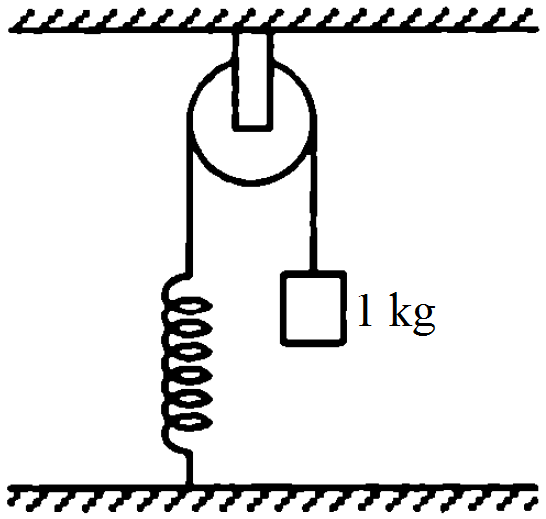
The pulley shown in figure has a radius of 20cm and moment of inertia $0.2kg-m^2$. The string going over it is attached at one end to a vertical spring of spring constant 50N/m fixed from below, and supports a 1kg mass at the other end. The system is released from rest with the spring at its natural length. Find the speed of the block when it has descended through 10cm. Take g $= 10m/s_2$.
Earth can be thought of as a sphere of radius $6400km$. Any object (or a person) is performing circular motion around the axis of earth due to earth’s rotation (period 1 day). What is acceleration of object on the surface of the earth (at equator) towards its centre? what is it at latitude $\theta?$ How does these accelerations compare with $g = 9.8m/ s^2$?
Given below are some examples of wave motion. State in each case if the motion is transverse, longitudinal or a combination of both.
  1. Motion of a kink in a long coil spring produced by displacing one end of the spring sideways.
  2. Wave produced in a cylinder containing water by moving its piston back and forth.
  3. Wave produced by a motorboat sailing in water.
  4. Ultrasonic waves in air produced by a vibrating crystal.
What is the percentage increase in velocity for moon to escape from the gravitational pull of the earth?
A vessel contains two non$-$reactive gases: neon $($monoatomic$)$ and oxygen $($diatomic$)$. The ratio of their partial pressures is $3: 2$. Estimate the ratio of $(i)$ number of molecules, $(ii)$ mass density of neon and oxygen in the vessel. Atomic mass of $\mathrm{Ne}=20.2 \mathrm{u}$, molecular mass of $\mathrm{O}_2=32.0 \mathrm{u}$.