MCQ
A transverse wave is described by the equation $Y = {Y_0}\sin 2\pi \left( {ft - \frac{x}{\lambda }} \right)$. The maximum particle velocity is four times the wave velocity if
  • A
    $\lambda = \frac{{\pi {Y_0}}}{4}$
  • $\lambda = \frac{{\pi {Y_0}}}{2}$
  • C
    $\lambda = \pi {Y_0}$
  • D
    $\lambda = 2\pi {Y_0}$

Answer

Correct option: B.
$\lambda = \frac{{\pi {Y_0}}}{2}$
b
(b) Comparing the given equation with $y = a\sin (\omega t - kx)$,

We get $a = Y_0, \, \omega  = 2\ pi  f, k = \frac{{2\pi }}{\lambda }$.

Hence maximum particle velocity ${({v_{\max }})_{particle}} = a\omega = {Y_0} \times 2\pi f$

and wave velocity ${(v)_{wave}} = \frac{\omega }{k} = \frac{{2\pi f}}{{2\pi /\lambda }} = f\lambda $

$\because \,\,\,{({v_{\max }})_{Particle}} = 4{v_{Wave}}$==> ${Y_0} \times 2\pi f = 4f\lambda $ ==> $\lambda = \frac{{\pi {Y_0}}}{2}$.

Need a full question paper?

Generate a complete, print-ready paper with questions like this in minutes — across 16+ boards, with answer keys.

Start Generating Free

Similar questions

The diagonals of a parallelogram are $2\,\hat i$ and $2\hat j.$What is the area of the parallelogram.........$units$
A projectile is thrown with some initial velocity at an angle $\alpha$ to the horizontal. Its velocity when it is at the highest point is $(2 / 5)^{1 / 2}$ times the velocity when it is at height half of the maximum height. Find the angle of projection $\alpha$ with the horizontal.
Initial pressure and volume of a gas are $P$ and $V$ respectively. First it is expanded isothermally to volume $4V$ and then compressed adiabatically to volume $V$ . The final pressure of gas will be (given $\gamma = 3/2$ ) 
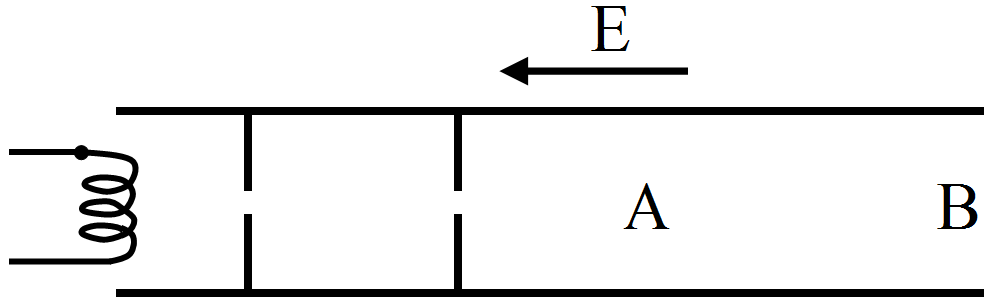
Electrons are emitted by a hot filament and are accelerated by an electric field, as shown in the figure. The two stops at the left ensure that the electron beam has a uniform cross-section.
Work done per mol in an isothermal change is
A wave is reflected from a rigid support. The change in phase on reflection will be
The planet Mars has two moons, if one of them has a period $7\, hours,\, 30\, minutes$ and an orbital radius of $9.0 \times 10^{3}\, {km} .$ Find the mass of Mars.

$\left\{\operatorname{Given} \frac{4 \pi^{2}}{G}=6 \times 10^{11} {N}^{-1} {m}^{-2} {kg}^{2}\right\}$

The potential energy of a $1\ kg$ particle free to move along the $x-$axis is given by : $U\left( x \right) = \left( {\frac{{{x^4}}}{4} - \frac{{{x^2}}}{2}} \right)$ $J $ The total mechanical energy of the particle is $2\ J$. Then, the maximum speed(in $m/s$) is
A vertical tank, open at the top, is filled with a liquid and rests on a smooth horizontal surface.$A$ small hole is opened at the centre of one side of the tank. The area of cross-section of the tank is $N$ times the area of the hole, where $N$ is a large number. Neglect mass of the tank itself. The initial acceleration of the tank is 
A whistle of frequency $500 Hz$ tied to the end of a string of length $1.2 m$ revolves at $400 \,rev/min$. A listener standing some distance away in the plane of rotation of whistle hears frequencies in the range (speed of sound $= 340 m/s$)