MCQ
A wave is reflected from a rigid support. The change in phase on reflection will be
  • A
    $\pi /4$
  • B
    $\pi /2$
  • $\pi$
  • D
    $2\pi $

Answer

Correct option: C.
$\pi$
c
(c)After reflection from rigid support, a wave suffers a phase change of $\pi$.

Need a full question paper?

Generate a complete, print-ready paper with questions like this in minutes — across 16+ boards, with answer keys.

Start Generating Free

Similar questions

If there is no external force acting on a nonrigid body, which of the following quantities must remain constant?
  1. Angular momentum.
  2. Linear momentum.
  3. Kinetic energy.
  4. Moment of inertia.
A particle moves along a straight line such that its displacement at any time $t$ is given by $s = (t^3 -3t^2 + 2)\,m$ The displacement when the acceleration becomes zero is........$m$
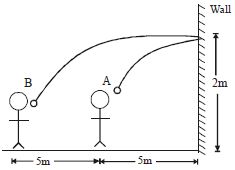
Two persons $A$ & $B$ are throwing ball of $200\  g$ on wall as shown in figure. Balls strike wall perpendicularly at same point height $2\ m$ from ground. Ball strike wall elastically at same time and returns back to $A$ & $B$, at same time. They again repeat the same. What is the average force on wall ..................... $\mathrm{N}$ (take $g = 10\  m/s^2$)
body radiates energy $5W$ at a temperature of ${127^o}C$. If the temperature is increased to ${927^o}C$, then it radiates energy at the rate of ...... $W$
A spherical planet has a mass $M_p$ and diameter $D_p$. A particle of mass $m$ falling freely near the surface of this planet will experience an acceleration due to gravity, equal to:
A man measures time period of a pendulum $(T)$ in stationary lift. If the lift moves upward with acceleration $\frac{g}{4},$ then new time period will be
An electromagnetic wave going through vacuum is described by $\text{E}=\text{E}_0\sin(\text{kx}-\omega\text{t}),\text{ B}=\text{B}_0\sin(\text{kx}-\omega\text{t})$ Then:
If the water falls from a dam into a turbine wheel $19.6\, m$ below, then the velocity of water at the turbine is ............. $\mathrm{m/s}$ $(g = 9.8\,m/{s^2})$
An aluminium piece of mass $50 \,g$ initially at $300^{\circ} C$ is dipped quickly and taken out of $1 \,kg$ of water, initially at $30^{\circ} C$. If the temperature of the aluminium piece immediately after being taken out of the water is found to be $160^{\circ} C$, the temperature of the water ............ $^{\circ} C$ Then, specific heat capacities of aluminium and water are $900 \,Jkg ^{-1} K ^{-1}$ and $4200 \,Jkg ^{-1} K ^{-1}$, respectively.
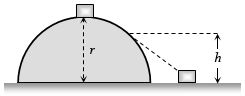
A small body of mass $m$ slides down from the top of a hemisphere of radius $r$. The surface of block and hemisphere are frictionless. The height at which the body lose contact with the surface of the sphere is