MCQ
A transverse wave is travelling along a string from left to right. The adjoining figure represents the shape of the string at a given instant. At this instant, among the following, choose the wrong statement.
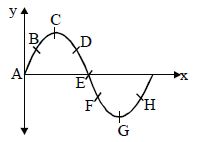
  • A
    Points $D, E$ and $F$ have upwards positive velocity
  • B
    Points $A, B$ and $H$ have downwards negative velocity
  • C
    Points $C$ and $G$ have zero velocity
  • Points $A$ and $E$ have minimum velocity
Answer

Correct option: D.
Points $A$ and $E$ have minimum velocity
d
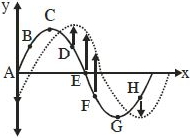
Particle velocity $, \frac{\mathrm{dy}}{\mathrm{dt}}=-v\left(\frac{\mathrm{dy}}{\mathrm{dx}}\right)$

or $\frac{\mathrm{dy}}{\mathrm{dt}}=-$ wave velocity $\times$ slope of the wave

$(1)$ For upward velocity, $v_{\mathrm{Pa}}=+\mathrm{ve},$ so slope must be negative which is at the points $D,$ $\mathrm{E}$ and $\mathrm{F}$

$(2)$ For downward velocity, $v_{\mathrm{Pa}}=-\mathrm{ve},$ so slope must be positive which is at the points $A, B$ and $\mathrm{H}$

$(3)$ For zero velocity, slope must be zero which is at $\mathrm{C}$ and $\mathrm{G}$

$(4)$ For maximum magnitude to velocity. $|$ slope $|=$ maximum, which is at $A$ and $\mathrm{E}$. Hence, alternative is wrong.

Need a full question paper?

Generate a complete, print-ready paper with questions like this in minutes — across 16+ boards, with answer keys.

Start Generating Free

Similar questions

An observer is approaching with a speed $v$, towards a stationary source emitting sound waves of wavelength $\lambda_0$. The wavelength shift detected by the observer is (Take $c=$ speed of sound)
A Carnot engine operates between ${227^o}C$ and ${27^o}C.$ Efficiency of the engine will be
The wavelength of maximum energy, released during an atomic explosion, was $2.93 × 10$$^{-{10}}$ m. Given that the Wien's constant is $2.93 × 10$$^{-{3}}$ m K, the maximum temperature attained must be of the order of
Consider a thin square sheet of side $\mathrm{L}$ and thickness $\mathrm{t}$, made of a material of resistivity $\rho$. The resistance between two opposite faces, shown by the shaded areas in the figure is
An isolated rail car of mass $M$ is moving along a straight, frictionless track at an initial speed $v_0$. The car is passing under a bridge when $a$ crate filled with $N$ bowling balls, each of mass $m$, is dropped from the bridge into the bed of the rail car. The crate splits open and the bowling balls bounce around inside the rail car, but none of them fall out. Is the momentum of the rail car $+$ bowling balls system conserved in this collision?
Two particle executing $S.H.M.$ of same amplitude of $20 \,cm$ with same period along the same line about same equilibrium position. The maximum distance between the two is $20 \,cm$. Their phase difference in radian is equal to
Assertion : The air bubble shines in water.

Reason : Air bubble in water shines due to refraction of light.

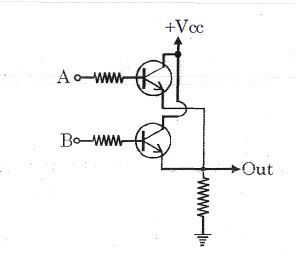
The circuit shown here can be used as a  logic gate. The logic gate is 
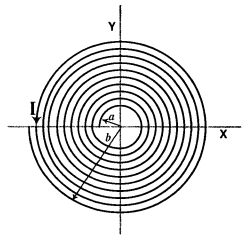
A long insulated copper wire is closely wound as a spiral of ' $N$ ' turns. The spiral has inner radius ' $a$ ' and outer radius ' $b$ '. The spiral lies in the $X-Y$ plane and a steady current ' $I$ ' flows through the wire. The $Z$-component of the magnetic field at the center of the spiral is 
In Vander Waal’s equation $a$ and $b$ represent $\left( {P + \frac{a}{{{V^2}}}} \right)\,(V - b) = RT$