Question
A travelling harmonic wave on a string is described by
$\text{y}(\text{x, t})=7.5\sin\Big(0.0050\text{x}+12\text{t}+\frac{\pi}{4}\Big)$
What are the displacement and velocity of oscillation of a point at x = 1cm, and t = 1s? Is this velocity equal to the velocity of wave propagation?
Answer

The given harmonic wave is:
$\text{y}(\text{x, t})=7.5\sin\Big(0.0050\text{x}+12\text{t}+\frac{\pi}{4}\Big)$
For x = 1cm and t = 1s,
$\text{y}=(1,1)=7.5\sin\Big[0.0050+12+\frac{\pi}{4}\Big]$
$=7.5\sin\Big[12.0050+\frac{\pi}{4}\Big]$
$=7.5\sin\theta$
Where, $\theta=12.0050+\frac{\pi}{4}=12.0050+\frac{3.14}{4}=12.79\text{ rad}$
$=\frac{180}{3.14\times12.79}=732.81^\circ$
$\therefore\ \text{y}=(1,1)=7.5\sin[732.81^\circ]$
$=7.5\sin(90\times8+12.81^\circ)$
$=7.5\sin(12.81^\circ)$
$=7.5\times0.2217$
$=1.6629\approx1.663\text {cm}$
The velocity of the oscillation at a given point and time is given as:
$\text{v}=\frac{\text{d}}{\text{dt}}\text{y}(\text{x, t})=\frac{\text{d}}{\text{dt}}\Big[7.5\sin\big(0.0050\text{x}+12\text{t}+\frac{\pi}{4}\big)\Big]$
$=7.5\times12\cos\Big(0.0050\text{x}+12\text{t}+\frac{\pi}{4}\Big)$
At x = 1cm and t = 1s:
$\text{v}=\text{y}(1, 1)=90\cos\Big(12.005+\frac{\pi}{4}\Big)$
$=90\cos(732.81^\circ)=90\cos(90\times8+12.81^\circ)$
$=90\cos(12.81^\circ)$
$=90\times0.975=87.75\text{cm/s}$
Now, the equation of a propagating wave is given by:
$\text{y}(\text{x, t})=\text{a}\sin(\text{kx}+\text{wt}+\phi)$
Where,
$\text{k}=\frac{2\pi}{\lambda}$
$\therefore\ \lambda=\frac{2\pi}{\text{k}}$
And $\omega=2\pi\text{ v}$
$\therefore\ \text{v}=\frac{\omega}{2\pi}$
Speed $=\text{v}=\text{v}\lambda=\frac{\omega}{\text{k}}$
Where
$\omega=12\text{ rad/s}$
$\text{k}=0.0050\text{m} ^{-1}$
$\therefore\ \text{v}=\frac{12}{0.0050}=2400\text{cm/s}$
$\therefore$ Hence, the velocity of the wave oscillation at x = 1cm and t = 1s is not equal to the velocity of the wave propagation.

Need a full question paper?

Generate a complete, print-ready paper with questions like this in minutes — across 16+ boards, with answer keys.

Start Generating Free

Similar questions

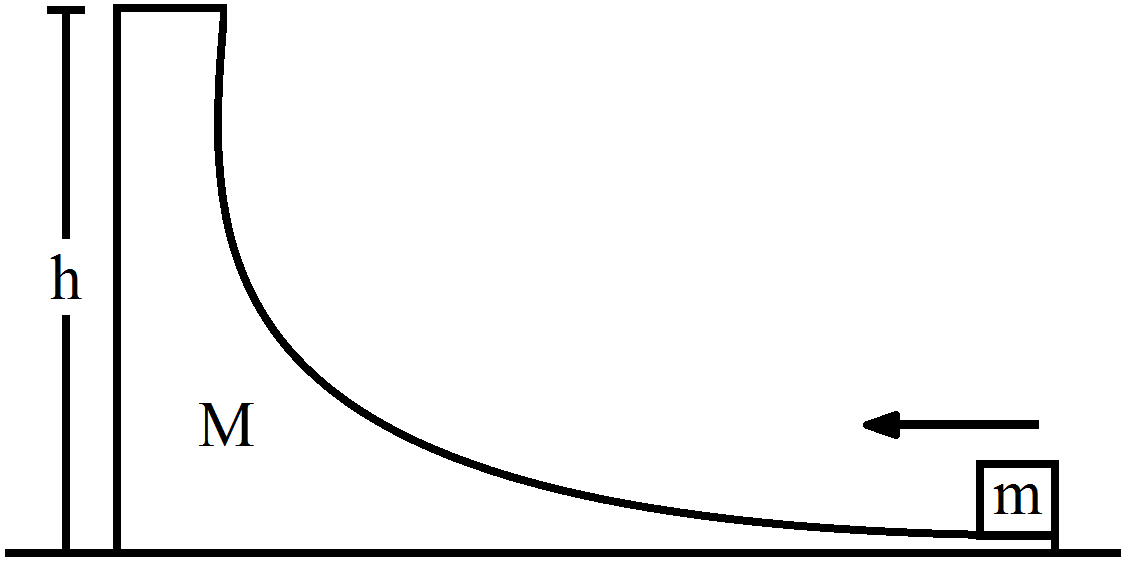
Figure shows a small body of mass m placed over a larger mass $M$ whose surface is horizontal near the smaller mass and gradually curves to become vertical. The smaller mass is pushed on the longer one at a speed v and the system is left to itself. Assume that all the surfaces are frictionless.
  1. Find the speed of the larger block when the smaller block is sliding on the vertical part.
  2. Find the speed of the smaller mass when it breaks off the larger mass at height h.
  3. Find the maximum height (from the ground) that the smaller mass ascends.
  4. Show that the smaller mass will again land on the bigger one. Find the distance traversed by the bigger block during the time when the smaller block was in its flight under gravity.
Find the value of $\frac{\text{t}}{\tau}$ for which the current in an LR circuit builds up to:
  1. 90%,
  2. 99%
  3. 99·9% of the steady-state value.
Find the height of the geostationary satellite from the earth's surface by finding the formula for the height of the satellite from the earth's surface and also find the value of orbital velocity of the geostationary satellite.
Explain fluid pressure.
Discuss the variation of g with depth. Derive an expression for it. What is the value of g at the centre of earth?
The escape speed of a projectile on the earth’s surface is $11.2km s^{-1}$. A body is projected out with thrice this speed. What is the speed of the body far away from the earth? Ignore the presence of the sun and other planets.
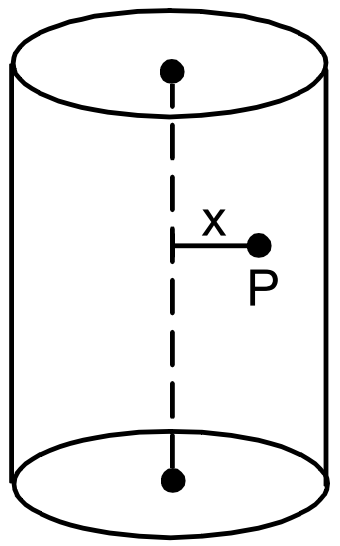
A long cylindrical volume contains a uniformly distributed charge of density $\rho.$ Find the electric field at a point P inside the cylindrical volume at a distance x from its axis (figure).
A particle on a stretched string supporting a travelling wave, takes 5.0ms to move from its mean position to the extreme position. The distance between two consecutive particles, which are at their mean positions, is 2.0cm. Find the frequency, the wavelength and the wave speed.
Consider the de Broglie wavelength of an electron and a proton. Which wavelength is smaller if the two particles have.
  1. The same speed.
  2. The same momentum.
  3. The same energy?.
If the linear momentum is increased by 50%, what is the change in its kinetic energy?