Question
Explain fluid pressure.

Answer

SELF

Need a full question paper?

Generate a complete, print-ready paper with questions like this in minutes — across 16+ boards, with answer keys.

Start Generating Free

Similar questions

A cricketer can throw a ball to a maximum horizontal distance of 100m. How much high above the ground can the cricketer throw the same ball?
A block of mass $2.0kg$ moving at $2.0m/s$ collides head on with another block of equal mass kept at rest.
  1. Find the maximum possible loss in kinetic energy due to the collision.
  2. If the actual loss in kinetic energy is half of this maximum, find the coefficient of restitution.
A plane is in level flight at constant speed and each of its two wings has an area of $25m^2$. If the speed of the air is $180km/ h$ over the lower wing and $234km/ h$ over the upper wing surface, determine the plane’s mass. (Take air density to be $1kg m^{–3}$).
Establish a formula for converting the magnitude of a physical quantity from one unit system to another through the dimensional method. Convert one horse power to watts using the formula.
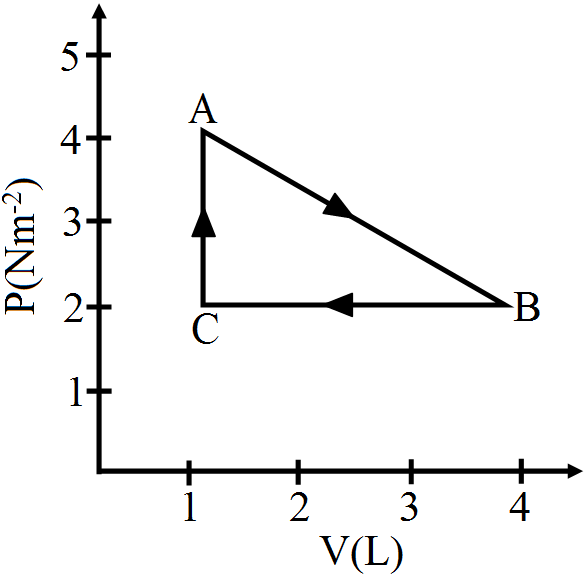
The P-V diagram for a cyclic process is a triangle ABC drawn in order. The co-ordinates of A, B, C are $(4,1),(2,4)$ and $(2,1)$. The co-ordinates are in the order ( $\mathrm{P}-\mathrm{V}$ ). Pressure is in $\mathrm{Nm}^{-2}$ and volume is in litre. Calculate work done during the process from A to $\mathrm{B}, \mathrm{B}$ to C and C to A . Also, calculate work done in the complete cycle.
A great physicist of this century (P.A.M. Dirac) loved playing with numerical values of Fundamental constants of nature. This led him to an interesting observation. Dirac found that from the basic constants of atomic physics (c, e, mass of electron, mass of proton) and the gravitational constant G, he could arrive at a number with the dimension of time. Further, it was a very large number, its magnitude being close to the present estimate on the age of the universe (~15 billion years). From the table of fundamental constants in this book, try to see if you too can construct this number (or any other interesting number you can think of). If its coincidence with the age of the universe were significant, what would this imply for the constancy of fundamental constants?
Estimate the mean free path and collision frequency of a nitrogen molecule in a cylinder containing nitrogen at 2.0 atm and temperature 17°C. Take the radius of a nitrogen molecule to be roughly $1.0\mathring{\text{A}}$ Compare the collision time with the time the molecule moves freely between two successive collisions (Molecular mass of $N^2 = 28.0u$).
A circular loop of string rotates about its axis on a frictionless horizontal plane at a uniform rate so that the tangential speed of any particle of the string is v. If a small transverse disturbance is produced at. a point of the loop, with what speed (relative to the string) will this disturbance travel on the string?
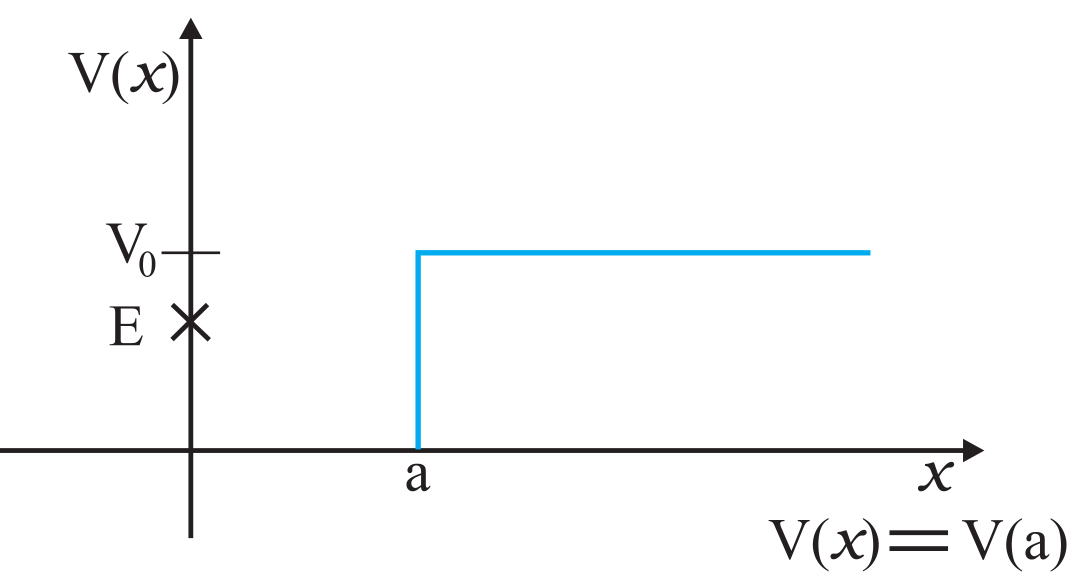
Given in are examples of some potential energy functions in one dimension. The total energy of the particle is indicated by a cross on the ordinate axis. In each case, specify the regions, if any, in which the particle cannot be found for the given energy. Also, indicate the minimum total energy the particle must have in each case. Think of simple physical contexts for which these potential energy shapes are relevan.
A 50-turn circular coil of radius 2.0cm carrying a current of 5.0A is rotated in a magnetic field of strength 0.20T.
  1. What is the maximum torque that acts on the coil?
  2. In a particular position of the coil, the torque acting on it is half of this maximum. What is the angle between the magnetic field and the plane of the coil?