Question
A travelling wave is produced on a long horizontal string by vibrating an end up and down sinusoidally. The amplitude of vibration is 1.0cm and the displacement becomes zero 200 times per second. The linear mass density of the string is 0.10kg/m and it is kept under a tension of 90N.
  1. Find the speed and the wavelength of the wave.
  2. Assume that the wave moves in the positive x-direction and at t = 0, the end x = 0 is at its positive extreme position. Write the wave equation.
  3. Find the velocity and acceleration of the particle at x - 50cm at time t = 10ms.
Answer

Amplitude, $\text{A}=1\text{cm},$ Tension $\text{T}=90\text{N}$

Frequency, $\text{f}=\frac{200}{2}=100\text{Hz}$

Mass per unit length, $\text{m}=0.1\text{kg/mt}$

  1. $\Rightarrow\text{v}=\sqrt{\frac{\text{T}}{\text{m}}}=30\text{m/s}$

$\lambda=\frac{\text{v}}{\text{f}}=\frac{30}{100}=0.3\text{m}=30\text{cm}$

  1. The wave equation $\text{y}=(1\text{cm})\cos2\pi\Big(\frac{\text{t}}{0.01\text{s}}\Big)-\Big(\frac{\text{x}}{30}\text{cm}\Big)$

[because at x = 0, displacement is maximum]

  1. $\text{y}=1\cos2\pi\Big(\frac{\text{x}}{30}-\frac{\text{t}}{0.01}\Big)$

$\Rightarrow\text{v}=\frac{\text{dy}}{\text{dt}}=\Big(\frac{1}{0.01}\Big)\sin2\pi\Big\{\big(\frac{\text{x}}{30}\big)-\big(\frac{\text{t}}{0.01}\big)\Big\}$

$\text{a}=\frac{\text{dv}}{\text{dt}}=-\Big\{\frac{4\pi^2}{(0.01)^2}\Big\}\cos2\pi\Big\{\big(\frac{\text{x}}{30}\big)-\big(\frac{\text{t}}{0.01}\big)\Big\}$

When, $\text{x}=50\text{cm},\ \text{t}=10\text{ms}=10\times10^{-3}\text{s}$

$\text{x}=\Big(\frac{2\pi}{0.01}\Big)\sin2\pi\Big\{\big(\frac{5}{3}\big)-\big(\frac{0.01}{0.01}\big)\Big\}$

$=\Big(\frac{\text{p}}{0.01}\Big)\sin\bigg(\frac{2\pi}{\frac{2}{3}}\bigg)=\Big(\frac{1}{0.01}\Big)\sin\Big(\frac{4\pi}{3}\Big)\\=-200\pi\sin\Big(\frac{\pi}{3}\Big)=-200\pi\text{x}\Big(\frac{\sqrt{3}}{2}\Big)$

$=544\text{cm/s}=5.4\text{m/s}$

Similarly

$\text{a}=\Big\{\frac{4\pi^2}{(0.01)^2}\Big\}\cos2\pi\Big\{\big(\frac{5}{3}\big)-1\Big\}$

$=4\pi^2\times10^4\times\frac{1}{2}$

$\Rightarrow2\times10^5\text{cm/s}^2$

$\Rightarrow2\text{km/s}^2$

Need a full question paper?

Generate a complete, print-ready paper with questions like this in minutes — across 16+ boards, with answer keys.

Start Generating Free

Similar questions

An LR circuit having a time constant of 50ms is connected with an ideal battery of emf $\in.$ Find the time elapsed before:
  1. The current reaches half its maximum value.
  2. The power dissipated in heat reaches half its maximum value.
  3. The magnetic field energy stored in the circuit reaches half its maximum value.
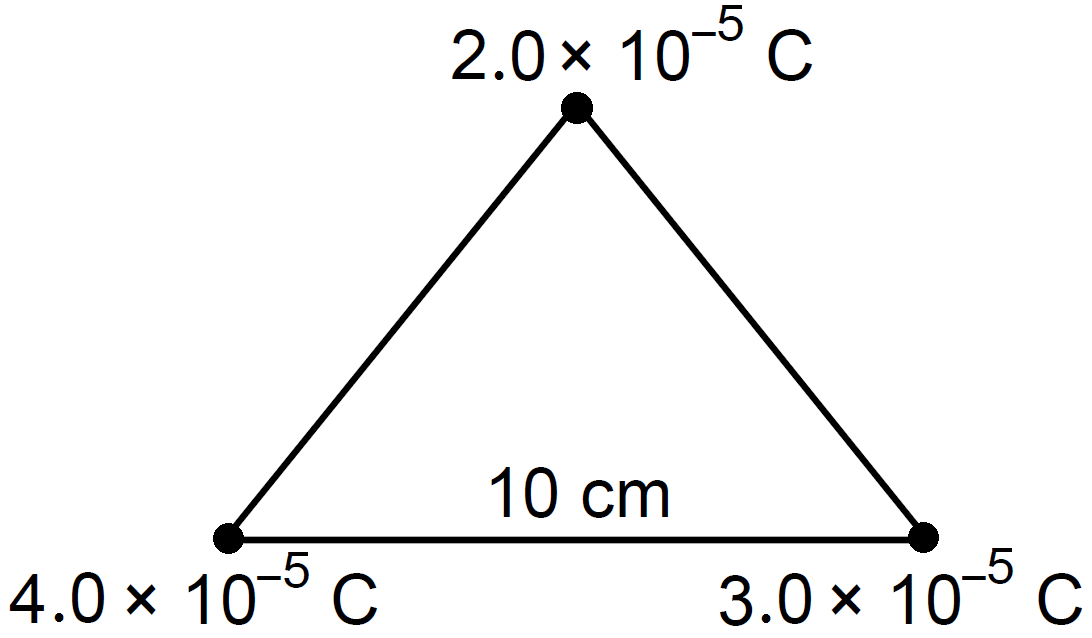
How much work has to be done in assembling three charged particles at the vertices of an equilateral triangle as shown in figure?

A heavy but uniform rope of length L is suspended from a ceiling.
  1. Write the velocity of a transverse wave travelling on the string as a function of the distance from the lower.
  2. If the rope is given a sudden sideways jerk at the bottom, how long will it take for the pulse to reach the ceiling?
  3. A particle is dropped from the ceiling at the instant the bottom end is given the jerk. Where will the particle meet the pulse ?
Two particles A and B, having opposite charges 2.0 × 10-6C and 2.0 × 10-6C, are placed at a separation of 1.0cm.
  1. Write down the electric dipole moment of this pair.
  2. Calculate the electric field at a point on the axis of the dipole 1.0m awa.y from the centre.
  3. Calculate the electric field at a point on the perpendicular bisector of the dipole and 1.0m away from the centre.
The amplifiers X, Y and Z are connected in series. If the voltage gains of X, Y and Z are 10, 20 and 30, respectively and the input signal is 1 mV peak value, then what is the output signal voltage (peak value):
  1. If dc supply voltage is 10V?
  2. If dc supply voltage is 5V?
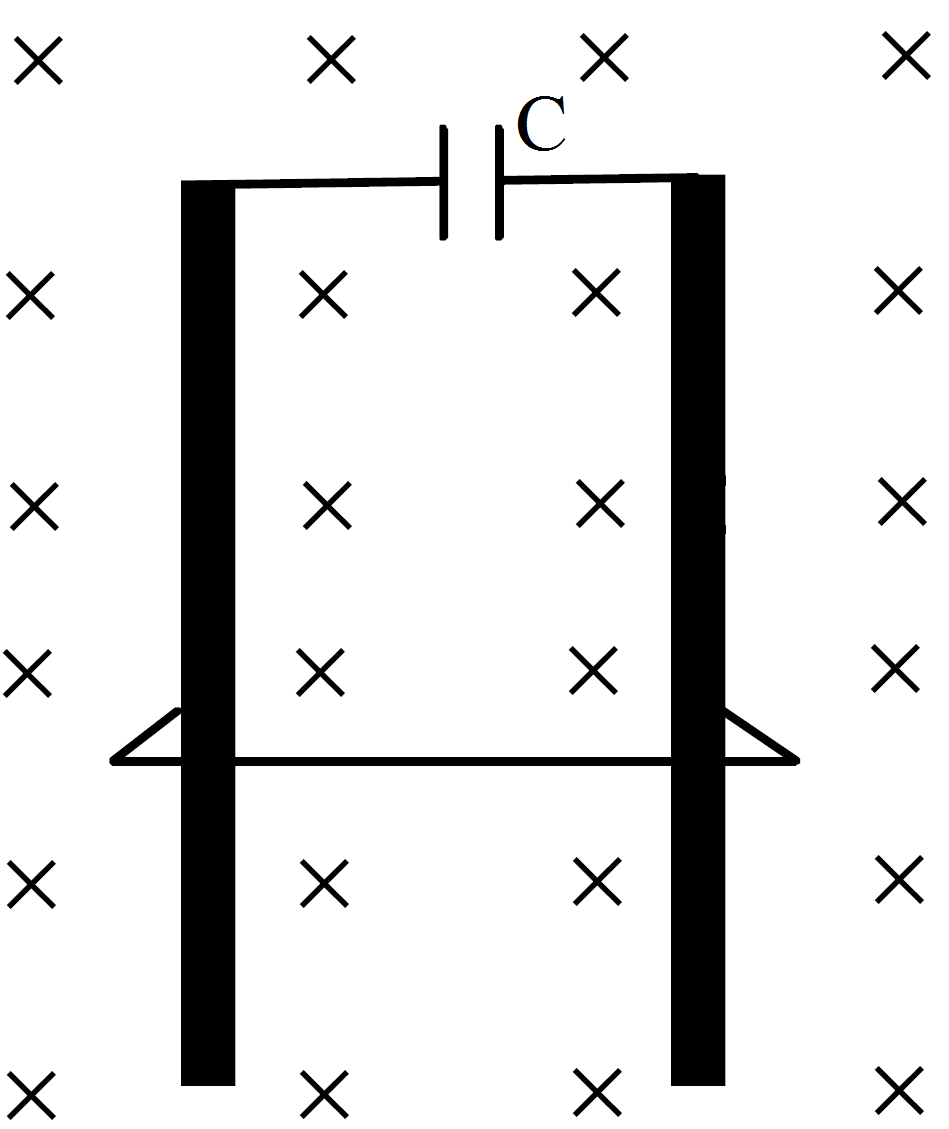
A wire of mass m and length l can slide freely on a pair of smooth, vertical rails (figure). A magnetic field B exists in the region in the direction perpendicular to the plane of the rails. The rails are connected at the top end by a capacitor of capacitance C. Find the acceleration of the wire neglecting any electric resistance.

Do permeability and relative permeability have the same dimensions?
  1. With the help of a suitable ray diagram, derive the mirror formula for a concave mirror.
  2. The near point of a hypermetropic person is 50 cm from the eye. What is the power of the lens required to enable the person to read clearly a book held at 25 cm from the eye?
In an agricultural experiment, a solution containing 1 mole of a radioactive material $\Big(\text{t}_{\frac{1}{2}}=14.3\text{ days}\Big)$ was injected into the roots of a plant. The plant was allowed 70 hours to settle down and then activity was measured in its fruit. If the activity measured was $1\mu\text{Ci},$ what per cent of activity is transmitted from the root to the fruit in steady state?
A car moving at 108km/h finds another car in front of it going in the same direction at 72km/h. The first car sounds a horn that has a dominant frequency of 800Hz. What will be the apparent frequency heard by the driver in the front car? Speed of sound in air = 330m/s.