Question
Do permeability and relative permeability have the same dimensions?

Answer

Magnetic permeability $(\mu)$ is the ratio of magnatic flux density (B) to the megnatising field strength (H).
$\mu=\frac{\text{B}}{\text{H}}$
In CGS (centimeter-gram-second) dimension of B and H is same. Hence, magnetic permeability is dimensionless. But in SI unit, dimension of B and H is not same. Thus, permeability is not dimensionless.
Relative ​permeability is defined as the ratio of magnetic permeability of any medium to the permeability of the vaccum. Hence, it is dimensionless. Thus, permeability and relative permeability have the same dimensions in CS system.

Need a full question paper?

Generate a complete, print-ready paper with questions like this in minutes — across 16+ boards, with answer keys.


Start Generating Free

Similar questions

  1. Draw the ray diagram of an astronomical telescope when the final image is formed at infinity. Write the expression for the resolving power of the telescope.
  2. An astronomical telescope has an objective lens of focal length 20m and eyepiece of focal length 1cm.
  1. Find the angular magnification of the telescope.
  2. If this telescope is used to view the Moon, find the diameter of the image formed by the objective lens. Given the diameter of the Moon is 3.5 × 10⁶m and radius of lunar orbit is 3.8 × 10⁸m.
The friction coefficient between a road and the tyre of a vehicle is $\frac{4}{3}.$ Find the maximum incline the road may have so that once hard brakes are applied and the wheel starts skidding, the vehicle going down at a speed of 36km/hr is stopped within 5m.
Suppose a 'n' - type wafer is created by doping Si crystal having 5 × 1028 atoms/m3 with 1ppm concentration of As. On the surface 200 ppm Boron is added to create ‘P’ region in this wafer. Considering ni = 1.5 × 1016m-3.
  1. Calculate the densities of the charge carriers in the n & p regions.
  2. Comment which charge carriers would contribute largely for the reverse saturation current when diode is reverse biased.
  1. Explain the formation of depletion layer and potential barrier in a p-n junction.
  2. In the figure given below the input waveform is converted into the output waveform by a device ‘X’. Name the device and draw its circuit diagram.

  1. Identify the logic gate represented by the circuit as shown and write its truth table.

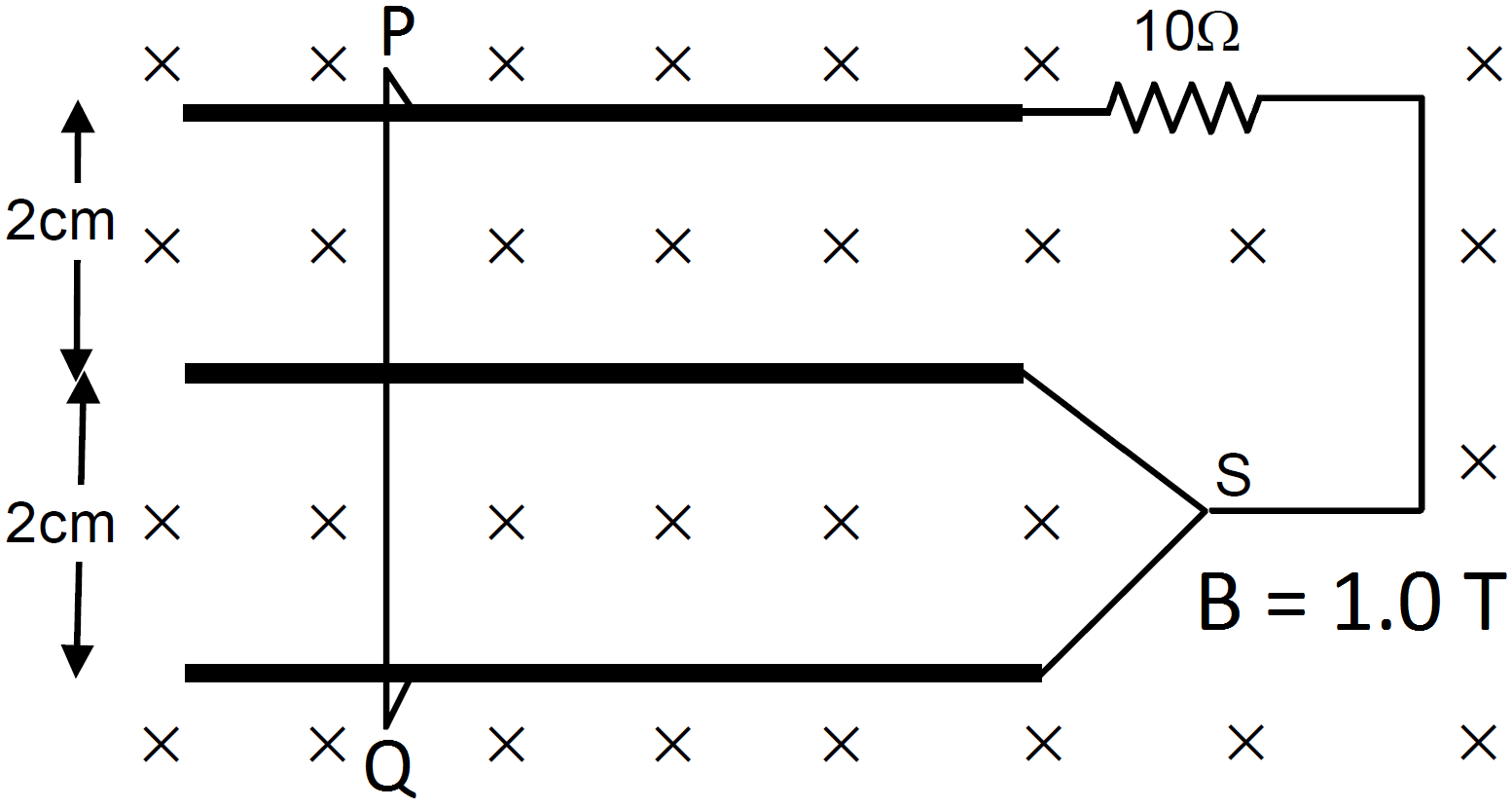
Consider the situation shown in figure. The wire PQ has a negligible resistance and is made to slide on the three rails with a constant speed of 5cm/s. Find the current in the $10\Omega$ resistor when the switch S is thrown to:
  1. The middle rail.
  2. The bottom rail.

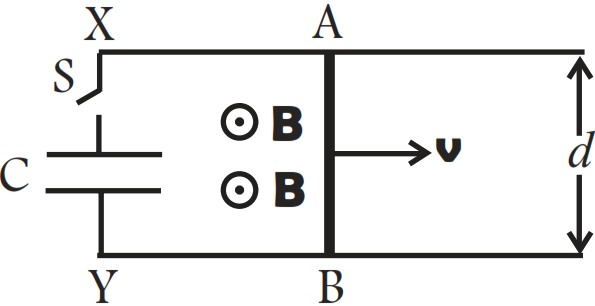
Find the current in the sliding rod AB (resistance = R) for the arrangement shown in Fig. B is constant and is out of the paper. Parallel wires have no resistance. v is constant. Switch S is closed at time t = 0.

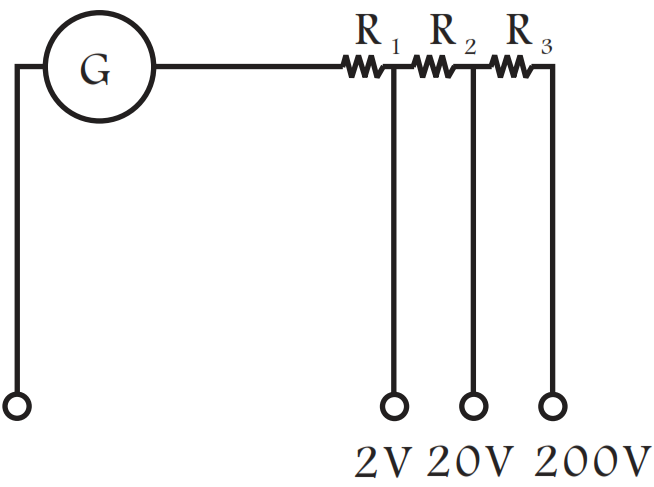
A multirange voltmeter can be constructed by using a galvanometer circuit as shown in Fig. We want to construct a voltmeter that can measure 2V, 20V and 200V using a galvanometer of resistance 10Ω and that produces maximum deflection for current of 1mA. Find R1, R2 and R3 that have to be used.

A long, straight wire carries a current i. Let B1, be the magnetic field at a point Pat a distance d from the wire. Consider a section of length l of this wire such that the point P lies on a perpendicular bisector of the section. Let B2 be the magnetic field at this point due to this section only. Find the value of $\frac{\text{d}}{\text{l}}$ so that B2 differs from B1, by 1%.
The frequency of vibration of a string depends on the length L between the nodes, the tension F in the string and its mass per unit length m. Guess the expression for its frequency from dimensional analysis.
The temperatures of equal masses of three different liquids A, B and C are 12°C, 19°C and 28°C respectively. The temperature when A and B are mixed is 16°C, and when B and C are mixed, it is 23°C. What will be the temperature when A and C are mixed?