Question
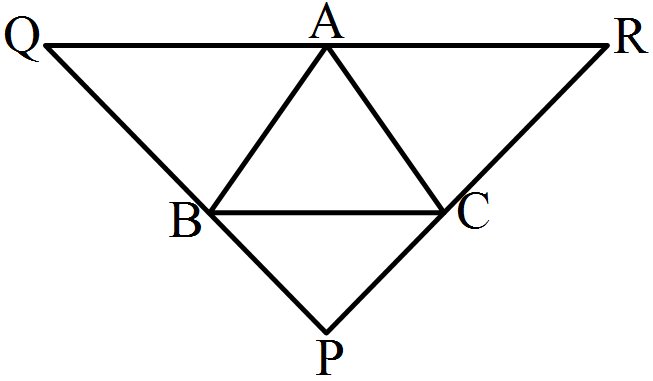
A $\triangle\text{ABC}$ is given. If lines are drawn through $A, B, C,$ parallel respectively to the sides $BC, CA$ and $AB$, forming $\triangle\text{PQR},$ as shown in the adjoining figure, show that $\text{BC}=\frac{1}{2}\text{QR}.$
Answer

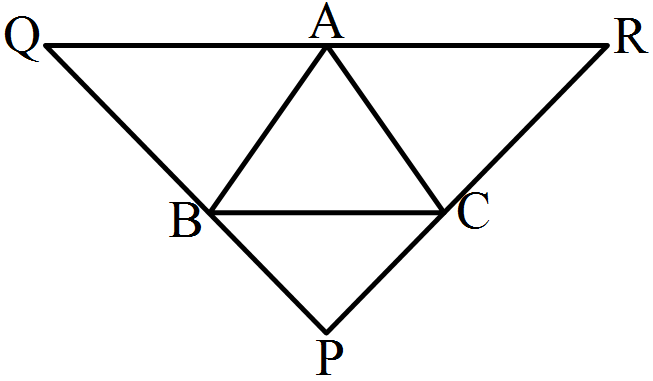
Given: A $\triangle\text{ABC}$ in which through points $A, B$ and $C$, line $QR, QP$ and $RP$ are drawn parallel to $BC, CA$ and $AB$.
To prove: $\text{BC}=\frac{1}{2}\text{QR}$
Proof: Since $AR\ ||\ BC$ and $AB\ ||\ RC$ [Given]
So, $ABCR$ is a parallelogram. Therefore $AR = BC ...(i)$
Also, $AQ\ ||\ BC$ and $QB\ ||\ AC$
So, $AQBC$ is a parallelogram.
Therefore $QA = BC ...(ii)$
Adding both side of $(i)$ and $(ii)$,
we get $AR + QA = BC + BC$
$\Rightarrow QR = 2BC$
$\Rightarrow\text{BC}=\frac{\text{QR}}{2}$
$\therefore\text{BC}=\frac{1}{2}\text{QR}$

Need a full question paper?

Generate a complete, print-ready paper with questions like this in minutes — across 16+ boards, with answer keys.
Start Generating Free

Similar questions

If x is a positive real number and exponents are rational numbers, simplify $\left(\frac{x^b}{x^c}\right)^{b+c-a} \cdot\left(\frac{x^c}{x^a}\right)^{c+a-b} \cdot\left(\frac{x^a}{x^b}\right)^{a+b-c}$.
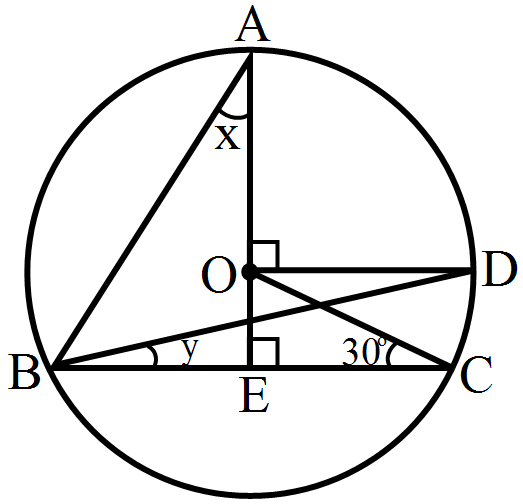
In the given figure, $O$ is the centre of the circle and $\angle\text{BCO}=30^\circ.$ Find $x$ and $y$.
Draw the graph of the lines $2x + y = 6$ and $2x - y + 2 = 0$. Shade the region bounded by these lines and the $x$-axis. Find the area of the shaded region.
A diagonal of a parallelogram divides it into two congruent triangles.
A rectangular sheet of paper $30\ cm \times 18\ cm$ can be transformed into the curved surface of a right circular cylinder in two ways namely, either by rolling the paper along its length or by rolling it along its breadth. Find the ratio of the volumes of the two cylinders, thus formed.
A rhombus-shaped sheet with perimeter $40\ cm$ and one diagonal $12\ cm$, is painted on both sides at the rate of $₹ 5$ per $cm^2$. Find the cost of painting.
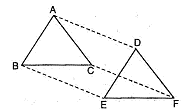
In $\triangle ABC$ and $\triangle DEF, AB = DE, AB \| DE, BC = EF$ and $BC \| EF.$ Vertices $A, B$ and $C$ are joined to vertices $D, E$ and $F$ respectively.

Show that:
$i.$ Quadrilateral $\text{ABED}$ is a parallelogram
$ii.$ Quadrilateral $\text{BECF}$ is a parallelogram
$iii.  AD \| CF$ and $AD = CF$
$iv.$ quadrilateral $\text{ACFD}$ is a parallelogram
$v. AC = DF$
$vi. \triangle ABC \cong \triangle DEF.$
The difference between the sides at right angles in a right$-$angled triangle is $14 \ cm .$ The area of the triangle is $120 \ cm^2$. Calculate the perimeter of the triangle.
Given below are the seats won by different political parties in the polling outcome of a state assembly elections:
Political party $A$ $B$ $C$ $D$ $E$ $F$
Seats won $75$ $55$ $37$ $29$ $10$ $37$
$i.$ Draw a bar graph to represent the polling results.
$ii.$ Which political party won the maximum number of seats$?$
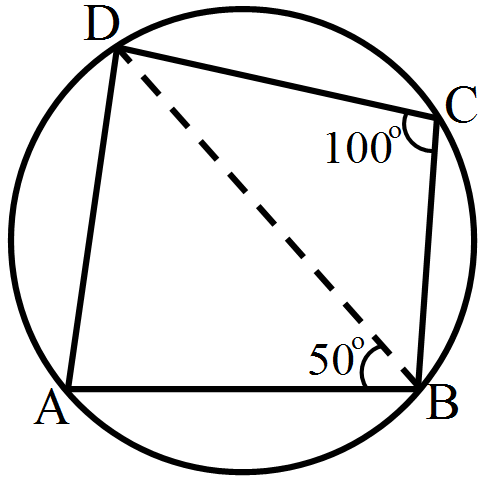
In the adjoining figure, $ABCD$ is a cyclic quadrilateral in which $\angle\text{BCD}=100^\circ$ and $\angle\text{ABD}=50^\circ.$ Find $\angle\text{ADB}.$