Question
A diagonal of a parallelogram divides it into two congruent triangles.
Answer

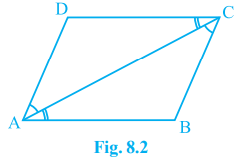
Proof : Let $\mathrm{ABCD}$ be a parallelogram and $\mathrm{AC}$ be a diagonal (see Fig. 8.2). Observe that the diagonal $\mathrm{AC}$ divides parallelogram $\mathrm{ABCD}$ into two triangles, namely, $\triangle \mathrm{ABC}$ and $\triangle \mathrm{CDA}$. We need to prove that these triangles are congruent.
Image
In $\triangle \mathrm{ABC}$ and $\triangle \mathrm{CDA}$, note that $\mathrm{BC} \| \mathrm{AD}$ and $\mathrm{AC}$ is a transversal.
So, $\quad \angle \mathrm{BCA}=\angle \mathrm{DAC}$ (Pair of alternate angles)
Also, $\mathrm{AB} \| \mathrm{DC}$ and $\mathrm{AC}$ is a transversal.
So, $\quad \angle \mathrm{BAC}=\angle \mathrm{DCA}$ (Pair of alternate angles)
and $\mathrm{AC}=\mathrm{CA} \quad$ (Common)
So, $\triangle \mathrm{ABC} \cong \triangle \mathrm{CDA} \quad$ (ASA rule)
or, diagonal $\mathrm{AC}$ divides parallelogram $\mathrm{ABCD}$ into two congruent triangles $\mathrm{ABC}$ and $\mathrm{CDA}$.
Now, measure the opposite sides of parallelogram $A B C D$. What do you observe?
You will find that $\mathrm{AB}=\mathrm{DC}$ and $\mathrm{AD}=\mathrm{BC}$.
This is another property of a parallelogram stated below:

Need a full question paper?

Generate a complete, print-ready paper with questions like this in minutes — across 16+ boards, with answer keys.
Start Generating Free

Similar questions

If $\left(x^3+a x^2+b x+6\right)$ has $(x-2)$ as a factor and leaves a remainder $3$ when divided by $(x-3)$, find the values of $a$ and $b$.
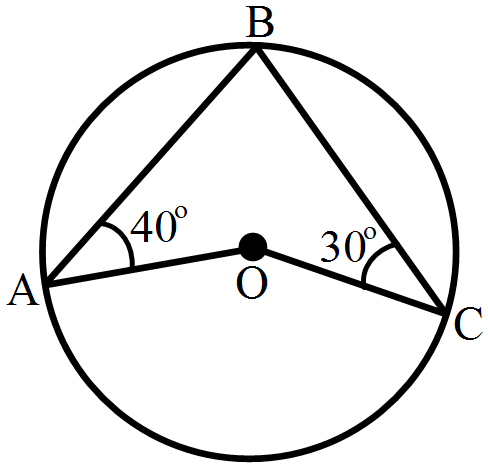
$i.$ In Figure $(1), O$ is the centre of the circle. If $\angle\text{OAB}=40^\circ$ and $\angle\text{OCB}=30^\circ,$ find $\angle\text{AOC}.$
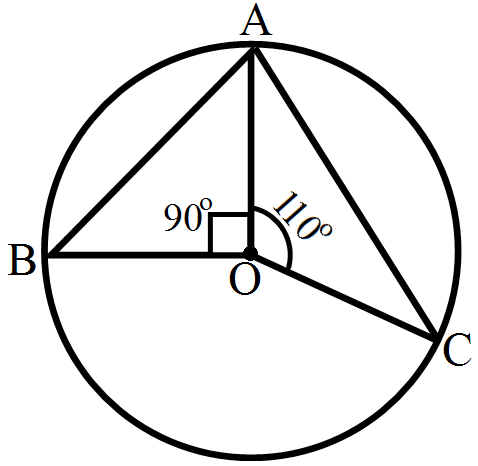
$ii.$ In Figure $(2), A, B$ and $C$ are three points on the circle with centre $O$ such that $\angle\text{AOB}=90^\circ$ and $\angle\text{AOC}=110^\circ.$ Find $\angle\text{BAC}.$
The heights of $75$ students in a school are given below:
Height (in cm)
$130-136$
$136-142$
$142-148$
$148-154$
$154-160$
$160-166$
Number of students
$9$
$12$
$18$
$23$
$10$
$3$
Draw a histogram to represent the above data.
Find the area of the triangle whose sides are $42 \ cm, 34 \ cm$ and $20 \ cm$ in length. Hence, find the height corresponding to the longest side.
If two lines intersect, prove that the vertically opposite angles are equal.
A rectangular sheet of paper $30\ cm \times 18\ cm$ can be transformed into the curved surface of a right circular cylinder in two ways namely, either by rolling the paper along its length or by rolling it along its breadth. Find the ratio of the volumes of the two cylinders, thus formed.
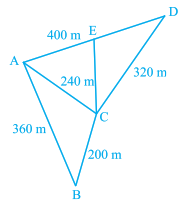
Kamla has a triangular field with sides $240 \ m, 200 \ m, 360 \ m$, where she grew wheat. In another triangular field with sides $240 \ m, 320 \ m, 400 \ m$ adjacent to the previous field, she wanted to grow potatoes and onions.
She divided the field in two parts by joining the mid-point of the longest side to the opposite vertex and grew potatoes in one part and onions in the other part. How much area (in hectares) has been used for wheat, potatoes and onions? [$1$ hectare $= 1000 m^2,$ $\sqrt{2} = 1.41]$
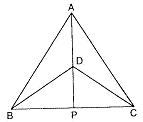
$\triangle ABC$ and $\triangle DBC$ are two isosceles triangles on the same base $BC$ and vertices $A$ and $D$ are on the same side of $BC$ . If $A D$ is extended to intersect $B C$ at $P$, show that :
$1. \triangle ABD \cong \triangle ACD$
$2. \triangle ABP \cong \triangle ACP$
$3. AP$ bisects $\angle A$ as well as $\angle D$
$4. AP$ is the perpendicular bisector of $BC.$

Draw a frequency polygon for the following frequency distribution:
Class interval
$1-10$
$11-20$
$21-30$
$31-40$
$41-50$
$51-60$
Frequency
$8$
$3$
$6$
$12$
$2$
$7$
$(x + y)^3 - (x - y)^3$ can be factorized as: