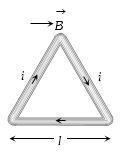
A triangular loop of side $l$ carries a current $I$. It is placed in a magnetic field $B$ such that the plane of the loop is in the direction of $B$. The torque on the loop is
A$Zero$
B$IBl$
C$\frac{{\sqrt 3 }}{2}I{l^2}{B^2}$
D$\frac{{\sqrt 3 }}{4}IB{l^2}$
Medium
Download our app for free and get started
D$\frac{{\sqrt 3 }}{4}IB{l^2}$
d (d) Since $\theta$ = $ 90°$
Hence $\tau = NIAB = 1 \times I \times \left( {\frac{{\sqrt 3 }}{4}{l^2}} \right)\,B$
$ = \frac{{\sqrt 3 }}{4}{l^2}B$
Download our app
and get started for free
Experience the future of education. Simply download our apps or reach out to us for more information. Let's shape the future of learning together!No signup needed.*
An alternating electric field, of frequency $f$, is applied across the dees $(\, radius \,\approx\, R)$ of a cyclotron that is being used to accelerate protons $(\,mass \,\approx \, m).$ The operating magnetic field $(B)$ used in the cyclotron and the kinetic energy $(K)$ of the proton beam, produced by it, are given by
An ammeter of $5\, ohm$ resistance can read $5 \,mA$. If it is to be used to read $100\, volts$, how much resistance is to be connected in series ............... $\Omega $
The magnetic field on the axis of a circular loop of radius $100\,cm$ carrying current $I=\sqrt{2}\,A$, at point $1\,m$ away from the centre of the loop is given by
Two very long straight parallel wires, parallel to $y-$ axis,carrycurrents $4I$ and $I,$ along $+y$ directionand$-y$ direction, respectively. The wires are passes through the $x-$axis at the points $(d, 0, 0)$ and $(- d, 0, 0)$ respectively.The graph of magnetic field $z-$component as one moves along the $x-$axis from $x=- d$ to $x= +d,$ is best given by
Equal currents are flowing in three infinitely long wires along positive $x, y$ and $z$ direction. The magnetic field at a point $(0, 0, -a)$ would be ( $i =$ current in each wire)
Two identical conducting wires $A$ and $B$ of same dimensions and same material are bent in the form of circular coil. Wire $A$ consists of single turn whereas wire $B$ consists of $2\, turns$. Both these wires are then suspended in a uniform magnetic field with their planes parallel to the one another and same current is passed through them. Which statement is correct ?
Two toroids $1$ and $2$ have total number of tums $200$ and $100 $ respectively with average radii $40\; \mathrm{cm}$ and $20 \;\mathrm{cm}$ respectively. If they carry same current $i,$ the ratio of the magnetic flelds along the two loops is
Two $10 \; cm$ long, straight wires, each carrying a current of $5 \; A$ are kept parallel to each other. If each wire experienced a force of $10^{-5} \; N$, then separation between the wires is $\dots \; cm$.