MCQ
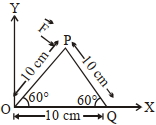
A triangular plate is shown. A force $\overrightarrow{ F }=4 \hat{ i }-3 \hat{ j }$ is applied at point $P$. The torque at point $P$ with respect to point $'O'$ and $'Q'$ are
  • $-15-20 \sqrt{3}, 15-20 \sqrt{3}$
  • B
    $15+20 \sqrt{3}, 15-20 \sqrt{3}$
  • C
    $15-20 \sqrt{3}, 15+20 \sqrt{3}$
  • D
    $-15+20 \sqrt{3}, 15+20 \sqrt{3}$

Answer

Correct option: A.
$-15-20 \sqrt{3}, 15-20 \sqrt{3}$
a
$\overrightarrow{ F }=4 \hat{ i }-3 \hat{ j }$

$\overrightarrow{ r }_{1}=5 \hat{ i }+5 \sqrt{3} \hat{ j } \& \overrightarrow{ r }_{2}=-5 \hat{ i }+5 \sqrt{3} \hat{j}$

Torque about $'O'$

$\vec{\tau}_{0}=\overrightarrow{ r }_{1} \times \overrightarrow{ F }=(-15-20 \sqrt{3}) \hat{ k }=(15+20 \sqrt{3})(-\hat{ k })$

Torque about $'Q'$

$\vec{\tau}_{Q}=\overrightarrow{ r }_{2} \times \overrightarrow{ F }=(-15+20 \sqrt{3}) \hat{ k }=(15-20 \sqrt{3})(-\hat{ k })$

Need a full question paper?

Generate a complete, print-ready paper with questions like this in minutes — across 16+ boards, with answer keys.

Start Generating Free

Similar questions

For a refrigerator, heat absorbed from source is $800\, J$ and heat supplied to sink is $500\, J$ then the coefficient of performance is
A block of mass $10\, kg$ is placed on a rough horizontal surface having coefficient of friction $\,\mu  = 0.5$. If a horizontal force of $100\, N$ is acting on it, then acceleration of the block will be ....... $m/s^2$
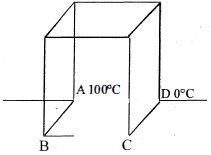
Find Temperature difference between $B$ and $C$ ? (All rods are identical)
Particle $A$ makes a perfectly elastic collision with another particle $B$ at rest. They fly apart in opposite direction with equal speeds. If their masses are $m_A$ and $m_B$ respectively, then
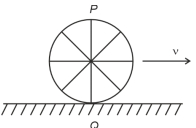
A wheel of a bullock cart is rolling on a level road as shown in the figure below. If its linear speed is $v$ in the direction shown, which one of the following options is correct ( $P$ and $Q$ are any highest and lowest points on the wheel, respectively)?
The radii of two planets $A$ and $B$ are $R$ and $4 R$ and their densities are $\rho$ and $\rho / 3$ respectively. The ratio of acceleration due to gravity at their surfaces $\left(g_A: g_B\right)$ will be
The specific heat of an ideal gas is
The velocity at the maximum height of a projectile is $\frac{\sqrt{3}}{2}$ times its initial velocity of projection $(u)$. Its range on the horizontal plane is .............
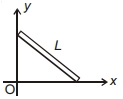
A rod of length $L$ leans against a smooth vertical wall while its other end is on a smooth floor. The end that leans against the wall moves uniformly vertically downward. Select the correct alternative
A body initially at rest is moving with uniform acceleration $a$ . Its velocity after $n$ seconds is $v$ . The displacement of the body in last $2\,s$ is