MCQ
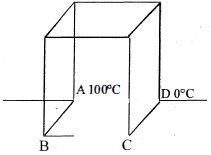
Find Temperature difference between $B$ and $C$ ? (All rods are identical)
  • A
    $\frac{{600}}{{13}}\ ^oC$
  • $\frac{{500}}{{7}}\ ^oC$
  • C
    $\frac{{400}}{{13}}\ ^oC$
  • D
    $\frac{{700}}{{6}}\ ^oC$

Answer

Correct option: B.
$\frac{{500}}{{7}}\ ^oC$
b
Resistance of all rods $=\mathrm{R}$

$\Delta \mathrm{T}=100^\circ \mathrm{C}$

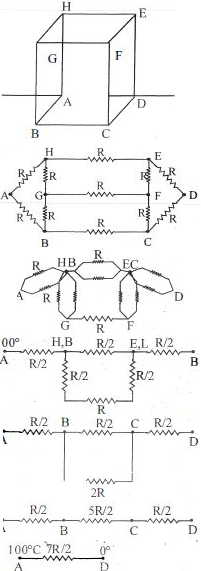
Expanding it on a plan

$\text { By symmetry } \quad \mathrm{T}_{\mathrm{H}}=\mathrm{T}_{\mathrm{B}}$

$\mathrm{T}_{\mathrm{C}}=\mathrm{T}_{\mathrm{E}}$

$\Rightarrow$ Points $\mathrm{B}$ and $\mathrm{H} \& \mathrm{E}$ and $\mathrm{C}$ coule

ai ned toget her.

olving it like normal current circuit

Temp. difference across $\mathrm{BC}$

$\frac{{{{100}^ \circ } - {0^ \circ }C}}{{\frac{{7R}}{2}}} \times \frac{{5R}}{2} = \frac{{100}}{7} \times 5 = \frac{{500}}{7}{\,^ \circ }C$
Need a full question paper?

Generate a complete, print-ready paper with questions like this in minutes — across 16+ boards, with answer keys.

Start Generating Free

Similar questions

A particle moves with constant angular velocity in circular path of certain radius and is acted upon by a certain centripetal force $F$. if the centripetal force $F$ is kept constant but the angular velocity is doubled, the new radius of the path (original radius $R$ ) will be
In an experiment with Vernier callipers of least count $0.1\,mm$, when two jaws are joined together the zero of Vernier scale lies right to the zero of the main scale and $6^{\text {th }}$ division of Vernier scale coincides with the main scale division. While measuring the diameter of a spherical bob, the zero of vernier scale lies in between $3.2\,cm$ and $3.3\,cm$ marks, and $4^{\text {th }}$ division of vernier scale coincides with the main scale division. The diameter of bob is measured as $.......\,cm$
A person of mass $M$ is, sitting on a swing of length $L$ and swinging with an angular amplitude $\theta_0$. If the person stands up when the swing passes through its lowest point, the work done by him, assuming that his centre of mass moves by a distance $l\, ( l < < L)$, is close to
The speed of sound in air is independent from its
If the maximum velocity and maximum acceleration of a particle executing $SHM$ are equal in magnitude, the time period will be .... $\sec$
An object of mass $0.5\, {kg}$ is executing simple harmonic motion. Its amplitude is $5\, {cm}$ and time period (T) is $0.2\, {s} .$ What will be the potential energy of the object at an instant $t=\frac{T}{4}$ s starting from mean position. Assume that the initial phase of the oscillation is zero. (In ${J}$)
The time taken by an object to slide down $45^{\circ}$ rough inclined plane is $n$ times as it takes to slide down a perfectly smooth $45^{\circ}$ incline plane. The coefficient of kinetic friction between the object and the incline plane is
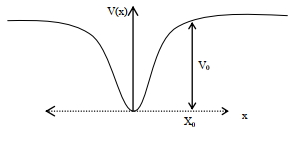
When a particle of mass $m$ moves on the $x$-axis in a potential of the form $V(x)=\mathrm{kx}^2$ it performs simple harmonic motion. The corresponding time period is proportional to $\sqrt{\frac{\mathrm{m}}{\mathrm{k}}}$, as can be seen easily using dimensional analysis. However, the motion of a particle can be periodic even when its potential energy increases on both sides of $\mathrm{x}=0$ in a way different from $\mathrm{kx}^2$ and its total energy is such that the particle does not escape to infinity. Consider a particle of mass $\mathrm{m}$ moving on the $x$-axis. Its potential energy is $V(x)=\alpha x^4(\alpha>0)$ for $|x|$ near the origin and becomes a constant equal to $\mathrm{V}_0$ for $|x| \geq X_0$ (see figure). $Image$

$1.$ If the total energy of the particle is $E$, it will perform periodic motion only if

$(A)$ $E$ $<0$ $(B)$ $E$ $>0$ $(C)$ $\mathrm{V}_0 > \mathrm{E}>0$ $(D)$ $E > V_0$

$2.$ For periodic motion of small amplitude $\mathrm{A}$, the time period $\mathrm{T}$ of this particle is proportional to

$(A)$ $\mathrm{A} \sqrt{\frac{\mathrm{m}}{\alpha}}$ $(B)$ $\frac{1}{\mathrm{~A}} \sqrt{\frac{\mathrm{m}}{\alpha}}$ $(C)$ $\mathrm{A} \sqrt{\frac{\alpha}{\mathrm{m}}}$ $(D)$ $\mathrm{A} \sqrt{\frac{\alpha}{\mathrm{m}}}$

$3.$ The acceleration of this particle for $|\mathrm{x}|>\mathrm{X}_0$ is

$(A)$ proportional to $\mathrm{V}_0$

$(B)$ proportional to $\frac{\mathrm{V}_0}{\mathrm{mX}_0}$

$(C)$ proportional to $\sqrt{\frac{\mathrm{V}_0}{\mathrm{mX}_0}}$

$(D)$ zero

Give the answer qustion $1,2$ and $3.$
Match List$-I$ with List$-II.$

List$-I$ List$-II$
$(a)$ Torque $(i)$ ${MLT}^{-1}$
$(b)$ Impulse $(ii)$ ${MT}^{-2}$
$(c)$ Tension $(iii)$ ${ML}^{2} {T}^{-2}$
$(d)$ Surface Tension $(iv)$ ${MI} {T}^{-2}$

Choose the most appropriate answer from the option given below :
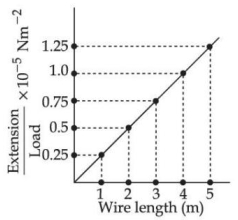
In an experiment to determine the Young's modulus, steel wires of five different lengths $(1,2,3,4$ and $5\,m )$ but of same cross section $\left(2\,mm ^{2}\right)$ were taken and curves between extension and load were obtained. The slope (extension/load) of the curves were plotted with the wire length and the following graph is obtained. If the Young's modulus of given steel wires is $x \times 10^{11}\,Nm ^{-2}$, then the value of $x$ is