MCQ
A triode whose mutual conductance is $2.5 m$$ A/volt$  and anode resistance is $20 kilo ohm$, is used as an amplifier whose amplification is $10$. The resistance connected in plate circuit will be.....$k\Omega$
  • A
    $1 $
  • $5$
  • C
    $10$
  • D
    $20 $

Answer

Correct option: B.
$5$
b
(b)$\mu = {r_P} \times {g_m} = 20 \times 2.5 = 50$
From $A = \frac{{\mu \,{R_L}}}{{{r_P} + {R_L}}}$==> ${r_P} + {R_L} = \frac{{\mu \,{R_L}}}{A} = \frac{{50{R_L}}}{{10}} = 5{R_L}$
==> $4{R_L} = {r_p} \Rightarrow {R_L} = \frac{{{r_p}}}{4} = \frac{{20}}{4} = 5k\Omega $

Need a full question paper?

Generate a complete, print-ready paper with questions like this in minutes — across 16+ boards, with answer keys.
Start Generating Free

Similar questions

How can we combine three capacitors of $2 \mu F$ each to get $3 \mu F$ capacitance?
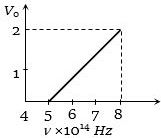
The stopping potential $({V_0})$ versus frequency $(v)$ plot of a substance is shown in figure the threshold wave length is
A charged conducting sphere does not produce an electric field:
Two particles each of mass $m$ and charge $q$ are separated by distance $r_1$ and the system is left free to move at $t = 0$. At time $t$ both the particles are found to be separated by distance $r_2$. The speed of each particle is
Let ${\lambda _\alpha }$, ${\lambda _\beta }$ and ${\lambda '_\alpha }$ denote the wavelengths of the $X-$ rays of the ${K_\alpha },\,{K_\beta }$ and ${L_\alpha }$ lines in the characteristic $X-$ rays for a metal
The magnetic flux through a circuit of resistance $R$ changes by an amount $\Delta \phi $ in time $\Delta t$, Then the total quantity of electric charge $Q$, which passing during this time through any point of the circuit is given by
In the grid circuit of a triode a signal $E=2 \sqrt{2} \cos \omega t$ is applied. If $m=14$ and $r_p=10 kW$ then root mean square current flowing through $R _{ L }=12 k \Omega$ will be
A particle is projected with a velocity ( $10\ m/s$ ) along $y-$ axis from point $(2, 3)$ . Magnetic field of $\left( {3\hat i + 4\hat j} \right)$ Tesla exist uniformly in the space. Its speed when particle passes through $y-$ axis for the third time is : (neglect gravity)
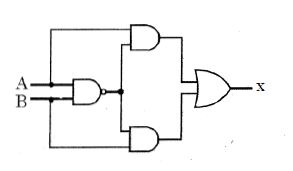
Give the truth table for the circuit shown in figure 
Identify the $WRONG$ statement