Question
A trolley of mass $300kg$ carrying a sandbag of $25kg$ is moving uniformly with a speed of $27km/h$ on a frictionless track. After a while, sand starts leaking out of a hole on the floor of the trolley at the rate of $0.05 kgs^{-1}$. What is the speed of the trolley after the entire sand bag is empty?
Answer

As the trolley carrying the sand bag is moving uniformly, therefore, external force on the system = 0. When the sand leaks out, it does not lead to the application of any external force on the trolley. Hence, the speed of the trolley shall not change.

Need a full question paper?

Generate a complete, print-ready paper with questions like this in minutes — across 16+ boards, with answer keys.

Start Generating Free

Similar questions

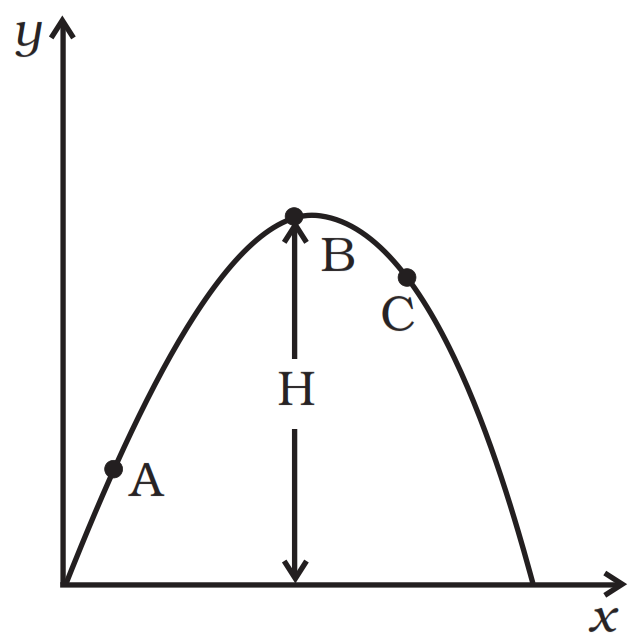
A particle is projected in air at some angle to the horizontal, moves along parabola as shown in Fig., where x and y indicate horizontal and vertical directions, respectively. Show in the diagram, direction of velocity and acceleration at points A, B and C.
The radius of gyration of a uniform disc about a line perpendicular to the disc equals its radius. Find the distance of the line from the centre.
A sphere is dropped under gravity through a fluid of viscosity $\eta$. Taking the average acceleration as half of the initial acceleration, show that the time taken to attain the terminal velocity is independent of the fluid density.
An electric fan of mass $2kg$ falls from the ceiling of a lift moving down with uniform speed of $2ms^{-1}$. It hits the floor of the lift (length of the lift = $2m$) and does not rebound. How much heat will be produced by the impact?
Two planets have masses in the ratio $1 : 10$ and radii in the ratio $2 : 5$. Compare:
  1. Their densities.
  2. The acceleration due to gravity on their surface.
  3. Escape velocities from their surfaces.
  4. The periods of revolutions of satellites near to their surfaces.
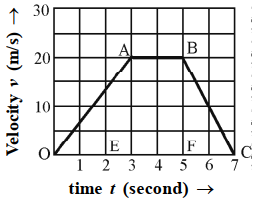
Q. 13. Draw a time graph for a vehicle from the time-velocity graph given in the attached figure.
Image
The parallax of a heavenly body measured from two points diametrically opposite on earth's equator is 60 second. If the radius of earth is $6.4 \times 10^6 \mathrm{~m}$, determine the distance of the heavenly body from the centre of earth. Convert this distance in A.U. Given $1 \mathrm{~A} . \mathrm{U} .=1.5 \times 10^{11} \mathrm{~m}$.
The wheel of a car is rotating at a speed of 20 revolutions/second. If due to acceleration its rotation speed becomes 75 revolutions/second in 10 seconds, then find the angular acceleration and angular displacement after this time
A car start from rest and accelerates to attains a velocity of $30 m / s$ in 12 sec . Then find (i) acceleration of that car, (ii) total distance covered, (iii) velocity after 7 sec
Explain this common observation clearly: If you look out of the window of a fast moving train, the nearby trees, houses etc. seem to move rapidly in a direction opposite to the train’s motion, but the distant objects (hill tops, the Moon, the stars etc.) seem to be stationary. (In fact, since you are aware that you are moving, these distant objects seem to move with you).