Question
A tube of length $L$ is filled completely with an incompressible liquid of mass $M$ and closed at both the ends. The tube is then rotated in a horizontal plane about one of its ends with a uniform angular velocity $\omega$. Determine the force exerted by the liquid at the other end.
Answer

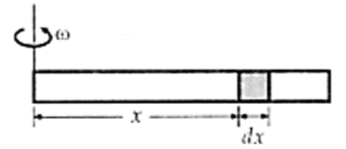
Consider a small element of the liquid of length dx at a distance x from one end. 
Image
Mass of the small element $=\frac{M}{L} d x$
Centripetal force associated with the element
$
d F=\left(\frac{M}{L} d x\right) x \omega^2\left[\because F=m r \omega^2\right]
$
Force exerted by the liquid = Total centripetal force at the other end
$
\begin{aligned}
& F=\int d F=\int_0^L \frac{M}{L} \omega^2 x d x=\frac{M}{L} \omega^2\left[\frac{x^2}{2}\right]_0^L \\
& =\frac{M}{L} \omega^2 \frac{L^2}{2}=\frac{1}{2} M \omega^2 L
\end{aligned}
$

Need a full question paper?

Generate a complete, print-ready paper with questions like this in minutes — across 16+ boards, with answer keys.

Start Generating Free

Similar questions

Two identical pith balls, each carrying a charge q, are suspended from a common point by two strings of equal length l. Find the mass of each ball if the angle between the strings is $2\theta$ in equilibrium.
A biconvex thick lens is constructed with glass $(\mu=1.50)$ Each of the surfaces has a radius of $10cm$ and the thickness at the middle is $5cm$. Locate the image of an object placed far away from the lens.
Find the change in the internal energy of 2kg of water as it is heated from $0^\circ C$ to $4^\circ C$. The specific heat capacity of water is $4200Jkg^{-1} K^{-1}$ and its densities at $0^\circ C$ and $4^\circ C$ are $999.9kgm^{-3}$ and $1000kgm^{-3}$ respectively. Atmospheric pressure = $10^{-6}Pa$.
What do you understand by a driven simple harmonic oscillator? Derive the differential equation of its motion and explain it.
A thin rod having length $L_0$ at $0°C$ and coefficient of linear expansion $\alpha$ has its two ends maintained at temperatures $\theta_1$ and $\theta_2,$ respectively. Find its new length.
A faulty barometer contains certain amount of air and saturated water vapour. It reads 74.0cm when the atmospheric pressure is 76.0cm of mercury and reads 72.10cm when the atmospheric pressure is 74.0cm of mercury. Saturation vapour pressure at the air temperature = 1.0cm of mercury. Find the length of the barometer tube above the mercury level in the reservoir
A particle is projected in air at an angle $\beta$ to a surface which itself is inclined at an angle $\alpha$ to the horizontal (Fig.).
  1. Time of flight.
(Hint: This problem can be solved in two different ways:
  1. Point P at which particle hits the plane can be seen as intersection of its trajectory (parobola) and straight line. Remember particle is projected at an angle $(\alpha+\beta)$ w.r.t. horizontal.
  2. We can take x-direction along the plane and y-direction perpendicular to the plane. In that case resolve g (acceleration due to gravity) in two differrent components, $g_x$ along the plane and $g_y$ perpendicular to the plane. Now the problem can be solved as two independent motions in x and y directions respectively with time as a common parameter.)
A body cools from 80 °C to 50 °C in 5 minutes. Calculate the time it takes to cool from 60°C to 30 °C. The temprature of the surroundings is 20°C.
Figure shows a small body of mass m placed over a larger mass $M$ whose surface is horizontal near the smaller mass and gradually curves to become vertical. The smaller mass is pushed on the longer one at a speed v and the system is left to itself. Assume that all the surfaces are frictionless.
  1. Find the speed of the larger block when the smaller block is sliding on the vertical part.
  2. Find the speed of the smaller mass when it breaks off the larger mass at height h.
  3. Find the maximum height (from the ground) that the smaller mass ascends.
  4. Show that the smaller mass will again land on the bigger one. Find the distance traversed by the bigger block during the time when the smaller block was in its flight under gravity.
A boy riding on a bicycle going at 12km/h towards a vertical wall whistles at his dog on the ground. If the frequency of the whistle is 1600Hz and the speed of sound in air is 330m/s, find
  1. The frequency of the whistle as received by the wall.
  2. The frequency of the reflected whistle as received by the boy.