Question
What do you understand by a driven simple harmonic oscillator? Derive the differential equation of its motion and explain it.

Answer

SELF

Need a full question paper?

Generate a complete, print-ready paper with questions like this in minutes — across 16+ boards, with answer keys.
Start Generating Free

Similar questions

An inductor of inductance 5.0H, having a negligible resistance, is connected in series with a $100\Omega$ resistor and a battery of emf 2.0V. Find the potential difference across the resistor 20ms after the circuit is switched on.
Consider a neutron and an electron bound to each other due to gravitational force. Assuming Bohr's quantization rule for angular momentum to be valid in this case, derive an expression for the energy of the neutron-electron system.
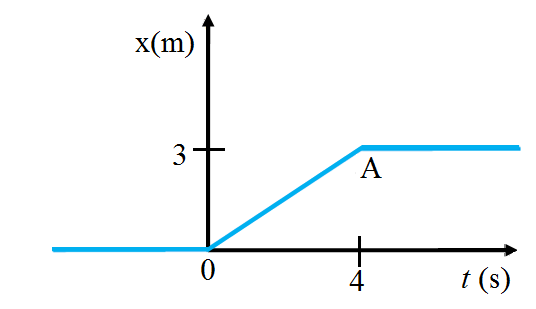
Figure. shows the position-time graph of a particle of mass 4kg. What is the (a) force on the particle for t < 0, t > 4s, 0 < t < 4s? (b) impulse at t = 0 and t = 4s? (Consider one-dimensional motion only).
(i) What is oscillatory or vibratory motion? Explain this with explanation. Write difference between oscillatory and harmonic motion.
(ii) Write the definition of period and frequency and establish the relationship between them.
What is meant by viscosity? Explain by giving examples. Describe the effect of temperature on viscosity.
Figure shows a smooth track which consists of a straight inclined part of length $1$ joining smoothly with the circular part. A particle of mass $m$ is projected up the incline from its bottom.
  1. Find the minimum projection$-$speed $v_0$, for which the particle reaches the top of the track.
  2. Assuming that the projection$-$speed is $2v_0$ and that the block does not lose contact with the track before reaching its top, find the force acting on it when it reaches the top.
  3. Assuming that the projection$-$speed is only slightly greater than $v_0$, where will the block lose contact with the track?
An oxygen cylinder of volume 30 litres has an initial gauge pressure of 15 atm and a temperature of 27°C. After some oxygen is withdrawn from the cylinder, the gauge pressure drops to 11 atm and its temperature drops to 17°C. Estimate the mass of oxygen taken out of the cylinder ($R = 8.31J ~mol^{-1}K^{-1}$, molecular mass of $O_2 = 32u$).
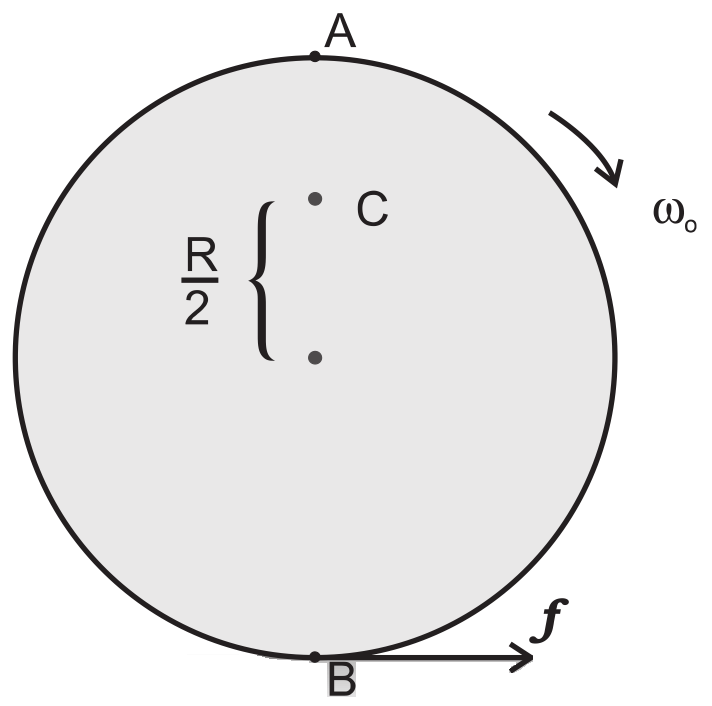
A disc rotating about its axis with angular speed $\omega_0$ is placed lightly (without any translational push) on a perfectly frictionless table. The radius of the disc is R. What are the linear velocities of the points A, B and C on the disc shown in will the disc roll in the direction indicated?
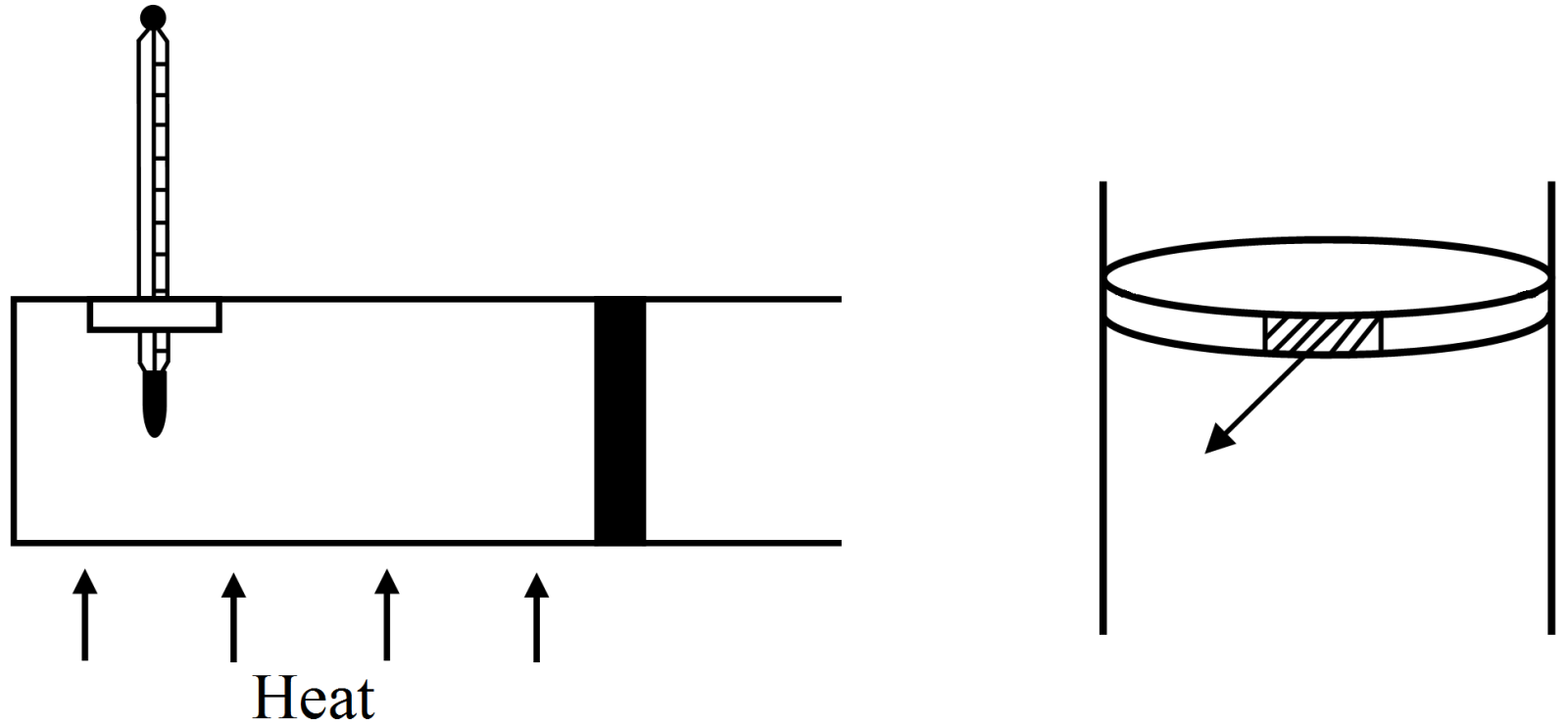
Figure. shows a cylindrical tube of radius 5cm and length 20cm. It is closed by a tight-fitting cork. The friction coefficient between the cork and the tube is 0.20. The tube contains an ideal gas at a pressure of 1 atm and a temperature of 300K. The tube is slowly heated and it is found that the cork pops out when the temperature reaches 600K Let dN denote the magnitude of the normal contact force exerted by a small length dl of the cork along the periphery (see the figure). Assuming that the temperature of the gas is uniform at any instant, calculate $\frac{\text{dN}}{\text{dl}}.$
Consider an ideal gas with following distribution of speeds.
Speed m/s
200
400
600
800
1000
% of molecules
10
20
40
20
10
Calculate $V_{rms}$ and hence T. $(m = 3.0 \times 10^{-26}kg)$