Question
A tungsten cathode and a thoriated-tungsten cathode have the same geometric dimensions and are operated at the same temperature. The thoriated-tungsten cathode gives 5000 times more current than the other cathode. Find the operating temperature. Take relevant data from the previous problem.
Answer

Pure tungsten:
$\phi=4.5\text{eV}$
$\text{A}=60\times10^{4}\text{A/m}^2-\text{k}^2$
$\text{i}=\text{AST}^2\text{e}^{\frac{\phi}{\text{KT}}}$
Thoriated tungsten:
$\phi=2.6\text{eV}$
$\text{A}=3\times10^{4}\text{A/m}^2-\text{k}^2$
$\text{i}_{\text{Thoriated Tungsten}}=5000\text{i}_{\text{Tungsten}}$
So, $5000\times\text{S}\times60\times10^{4}\times\text{T}_2\times\text{e}^{\frac{-4.5\times1.6\times10^{-19}}{1.38\times\text{t}\times10^{-23}}}$
$\Rightarrow\text{S}\times3\times10^{4}\times\text{T}^2\times\text{e}^{\frac{-2.56\times1.6\times10^{-19}}{1.38\times\text{T}\times10^{-23}}}$
$\Rightarrow3\times10^{8}\times\text{e}^{\frac{-4.5\times1.6\times10^{-19}}{1.38\times\text{t}\times10^{-23}}}=\text{e}^{\frac{-2.56\times1.6\times10^{-19}}{1.38\times\text{T}\times10^{-23}}}\times3\times10^4$
Taking 'in'
$\Rightarrow9.21\text{T}=220.29$
$\Rightarrow\text{T}=\frac{22029}{9.21}=2391.856\text{K}$

Need a full question paper?

Generate a complete, print-ready paper with questions like this in minutes — across 16+ boards, with answer keys.

Start Generating Free

Similar questions

A uniform magnetic field of $0.20 \times 10^{-3}$ T exists in the space. Find the change in the magnetic scalar potential as one moves through 50cm along the field.
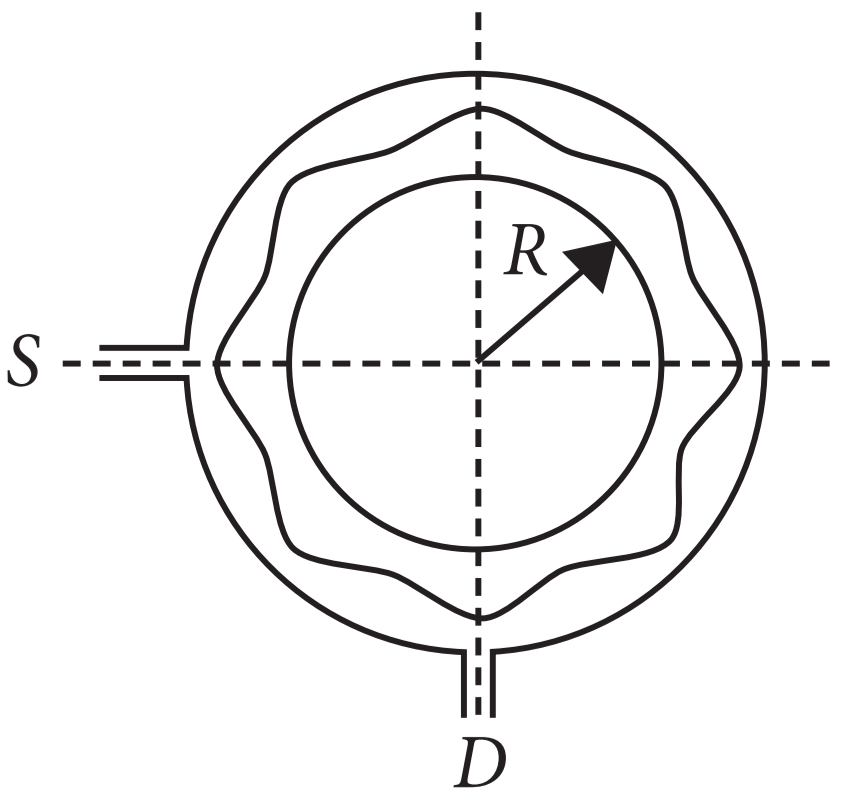
A narrow tube is bent in the form of a circle of radius R, as shown in figure. Two small holes S and D are made in the tube at the positions at right angle to each other. A source placed at S generates a wave of intensity $I_0$ which is equally divided into two parts: one part travels along the longer path, while the other travels along the shorter path. Both the waves meet at point Dwhere a detector is place
  1. If a maxima is formed at a detector, then the magnitude of wavelength $\lambda$ of the wave produced is given by:
  1. $\pi\text{R}$
  2. $\frac{\pi\text{R}}{2}$
  3. $\frac{\pi\text{R}}{4}$
  4. All of these.
  1. If the in tensity ratio of two coherent sources used in Young's double slit experiment is 49 : 1, then the ratio between the maximum and minimum intensities in the interference pattern is:
  1. $1 : 9$
  2. $9 : 16$
  3. $25 : 16$
  4. $16 : 9$
  1. The maximum intensity produced at D is given by:
  1. $4I_0$
  2. $2I_0$
  3. $I_0$
  4. $3I_0$
  1. ln a Young's double slit experiment, the intensity at a point where the path difference is $\frac{\lambda}{6}$ ($\lambda$ - wavelength of the light) is I. If $I_0$ denotes the maximum intensity, then $I/I_0$ is equal to:
  1. $\frac{1}{2}$
  2. $\frac{\sqrt3}{2}$
  3. $\frac{1}{\sqrt2}$
  4. $\frac{3}{4}$
  1. Two identical light waves, propagating in the same direction, have a phase differenced. After they superpose the intensity of the resulting wave will be proportional to:
  1. $\cos\delta$
  2. $\cos\Big(\frac{\delta}{2}\Big)$
  3. $\cos^2\Big(\frac{\delta}{2}\Big)$
  4. $\cos^2\delta$
Photoelectric effect is the phenomenon of emission of electrons from a metal surface, when radiations of suitable frequency fall on them. The emitted electrons are called photoelectrons and the current so produced is called photoelectric current.
  1. With the increase of intensity of incident radiations on photoelectrons emitted by a photo tube, the number of photoelectrons emitted per unit time is:
  1. Increases.
  2. Decreases.
  3. Remains same.
  4. None of these.
  1. It is observed that photoelectron emission stops at a certain time t after the light source is switched on. The stopping potential (V) can be represented as:
  1. $2(KE_{max}/e)$
  2. $(KE_{max}/e)$
  3. $(KE_{max}/3e)$
  4. $(KE_{max}/2e)$
  1. A point source of light of power $3.2 \times 10^{-3} W$ emits monoenergetic photons of energy 5.0eV and work function 3.0eV. The efficiency of photoelectron emission is 1 for every $10^6$ ncident photons. Assume that photoelectrons are instantaneously swept away after emission. The maximum kinetic energy of photon is:
  1. 4eV
  2. 5eV
  3. 2eV
  4. Zero
  1. Which of the following device is the application of Photoelectric effect?
  1. Light emitting diode.
  2. Diode.
  3. Photocell.
  4. Transistor.
  1. If the frequency of incident light falling on a photosensitive metal is doubled, the kinetic energy of the emitted photoelectron is:
  1. Unchanged.
  2. Halved.
  3. Doubled.
  4. More than twice its initial value.
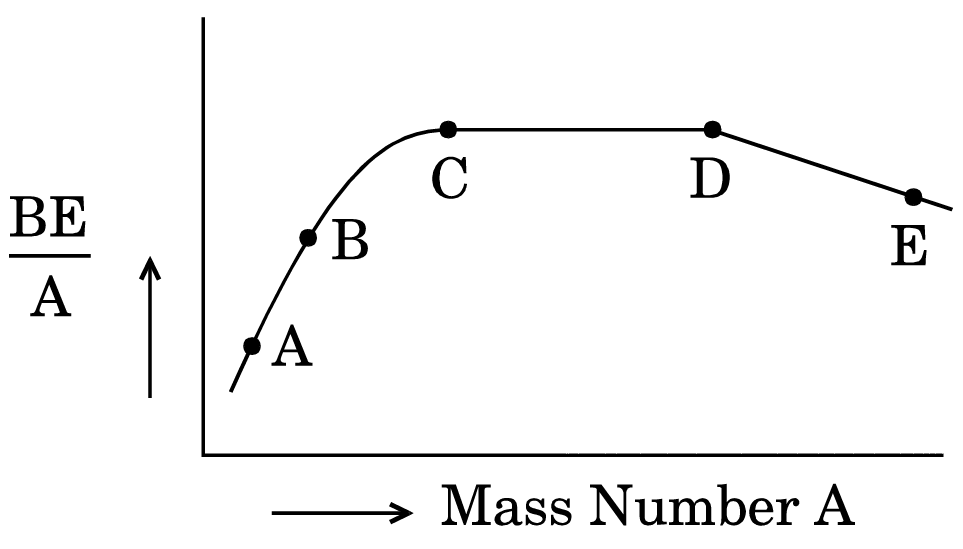
  1. The figure shows the plot of binding energy (BE) per nucleon as a function of mass number A. The letters A, B, C, D and E represent the positions of typical nuclei on the curve. Point out, giving reasons, the two processes (in terms of A, B, C, D and E), one of which can occur due to nuclear fission and the other due to nuclear fusion.
  1. Identify the nature of the radioactive radiations emitted in each step of the decay process given below.
$^{A}_{Z}\text{X}\rightarrow ^{A-4}_{Z-2}\text{Y}\rightarrow ^{A-4}_{Z-1}\text{W}$.
Photoelectric effect
It is the phenomenon of emission of electrons from a metallic surface when light of a suitable frequency is incident on it. The emitted electrons are called photoelectrons.
Nearly all metals exhibit this effect with ultraviolet light but alkali metals like lithium, sodium, potassium, cesium etc. show this effect even with visible light. It is an instantaneous process i.e. photoelectrons are emitted as soon as the light is incident on the metal surface. The number of photoelectrons emitted per second is directly proportional to the intensity of the incident radiation.
The maximum kinetic energy of the photoelectrons emitted from a given metal surface is independent of the intensity of the incident light and depends only on the frequency of the incident light. For a given metal surface there is a certain minimum value of the frequency of the incident light below which emission of photoelectrons does not occur. 
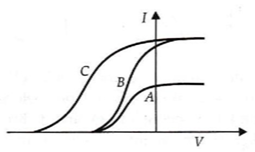
(I) In a photoelectric experiment plate current is plotted against anode potential.


Image

(A) A and B will have same intensities while B and C will have different frequencies.
(B) B and C will have different intensities while A and B will have different frequencies.
(C) A and B will have different intensities while B and C will have equal frequencies.
(D) B and C will have equal intensities while A and B will have same frequencies

(II) Photoelectrons are emitted when a zinc plate is
(A) Heated (B) hammered (C) Irradiated by ultraviolet light (D) subjected to a high pressure

(III) The threshold frequency for photoelectric effect on sodium corresponds to a wavelength of 500 nm. Its work function is about
(A) $4 \times 10^{-19} J$ (B) $2 \times 10^{-19} J$ (D) $3 \times 10^{-19} J$

(IV) The maximum kinetic energy of photoelectrons emitted from a surface when photons of energy 6 eV fall on it is 4 eV. The stopping potential is
(A) 2 V (B) 4 V (C) 6 V (D) 10 V

OR

The minimum energy required to remove an electron from a substance is called its
(A) work function (B) kinetic energy (C) stopping potential (D) potential energy
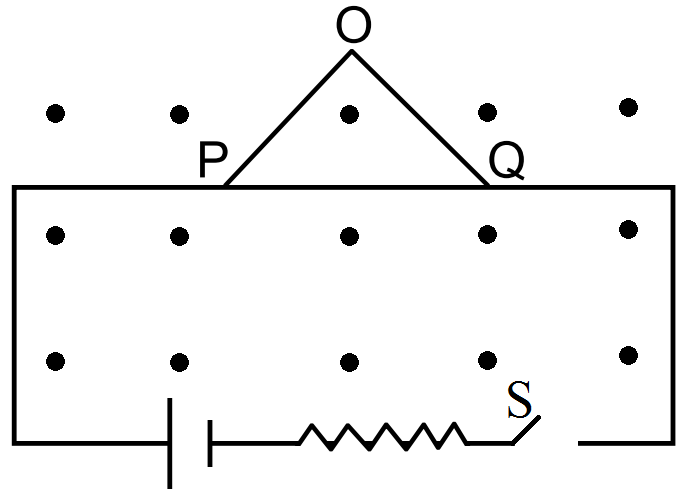
Shows a rod PQ of length 20.0cm and mass 200g suspended through a fixed point O by two threads of lengths 20.0cm each. A magnetic field of strength 0.500T exists in the vicinity of the wire PQ, as shown in the figure. The wires connecting PQ with the battery are loose and exert no force on PQ.
  1. Find the tension in the threads when the switch S is open.
  2. A current of 2.0A is established when the switch S is closed. Find the tension in the threads now.
To keep valuable instruments away from the earth's magnetic field, they are enclosed in iron boxes. Explain.
The magnetic moment of the assumed dipole at the earth's centre is $8.0 \times 10^{22}A-m^2$. Calculate the magnetic field B at the geomagnetic poles of the earth. Radius of the earth is 6400km.
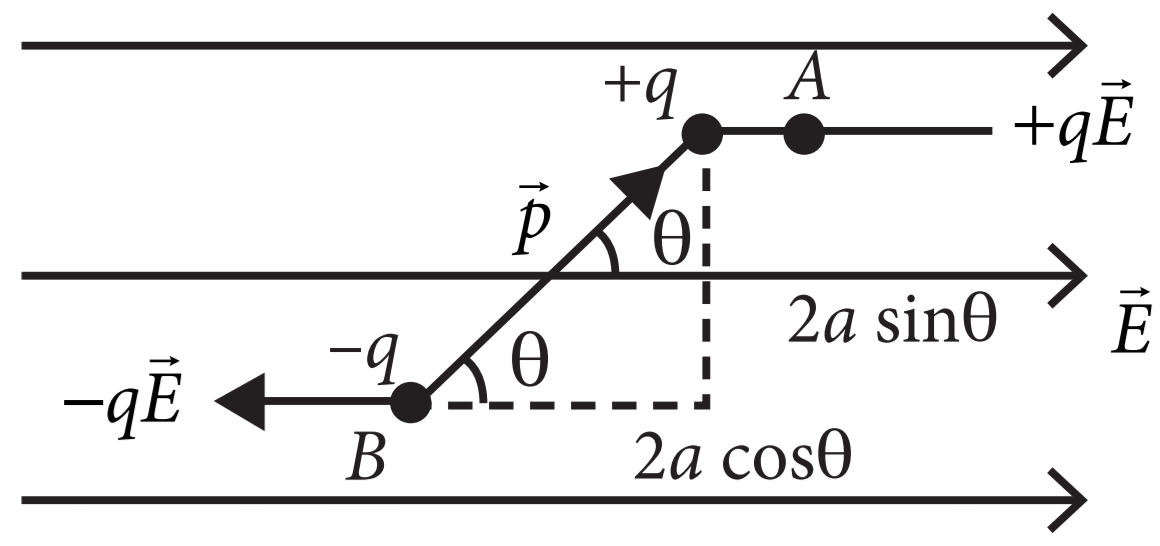
When electric dipole is placed in uniform electric field, its two charges experience equal and opposite forces, which cancel each other and hence net force on electric dipole in uniform electric field is zero. However, these forces are not collinear, so they give rise to some torque on the dipole. Since net force on electric dipole in uniform electric field is zero, so no work is done in moving the electric dipole in uniform electric field. However, some work is done in rotating the dipole against the torque acting on it.
  1. The dipole moment of a dipole in a uniform external field $\vec{\text{E}}$ is $\vec{\text{P}}.$ Then the torque 'i acting on the dipole is:
  1. $\vec{\tau}=\vec{\text{P}}\times\vec{\text{E}}$
  2. $\vec{\tau}=\vec{\text{P}}\cdot\vec{\text{E}}$
  3. $\vec{\tau}=2(\vec{\text{P}}+\vec{\text{E}})$
  4. $\vec{\tau}=(\vec{\text{P}}+\vec{\text{E}})$
  1. An electric dipole consists of two opposite charges, each of magnitude $1.0\mu\text{C}$ separated by a distance of 2.0cm. The dipole is placed in an external field of $10^5N C^{-1}$. The maximum torque on the dipole is:
  1. $0.2 \times 10^{-3}Nm$
  2. $1 \times 10^{-3}Nm$
  3. $2 \times 10^{-3}Nm$
  4. $4 \times 10^{-3}Nm$
  1. Torque on a dipole in uniform electric field is minimum when $\theta$ is equal to:
  1. 90º
  2. 180º
  3. Both (a) and (c)
  1. When an electric dipole is held at an angle in a uniform electric field, the net force F and torque t on the dipole are:
  1. $\text{F}=0, \tau=0$
  2. $\text{F}\not=0, \tau\not=0$
  3. $\text{F}=0, \tau\not=0$
  4. $\text{F}\not=0, \tau=0$
  1. An electric dipole of moment pis placed in an electric field of intensity E. The dipole acquires a position such that the axis of the dipole makes an angle $\theta$ with the direction of the field. Assuming that the potential energy of the dipole to be zero when $\theta=90^\circ$ the torque and the potential energy of the dipole will respectively be:
  1. $\text{pE}\sin\theta,-\text{pE}\cos\theta$
  2. $\text{pE}\sin\theta,-2\text{pE}\cos\theta$
  3. $\text{pE}\sin\theta,2\text{pE}\cos\theta$
  4. $\text{pE}\cos\theta,-2\text{pE}\sin\theta$
A bar magnet whose area of cross-section is $0.25 cm^2$ is kept in a magnetising field of intensity of $5000 A / m$. If magnitude of magnetic flux passing through the bar is $2.5 \times 10^{-5}$ weber, then calculate :(a) Magnetic induction (b) Magnetic susceptibility (c) Intensity of magnetisation.