Question
When electric dipole is placed in uniform electric field, its two charges experience equal and opposite forces, which cancel each other and hence net force on electric dipole in uniform electric field is zero. However, these forces are not collinear, so they give rise to some torque on the dipole. Since net force on electric dipole in uniform electric field is zero, so no work is done in moving the electric dipole in uniform electric field. However, some work is done in rotating the dipole against the torque acting on it.
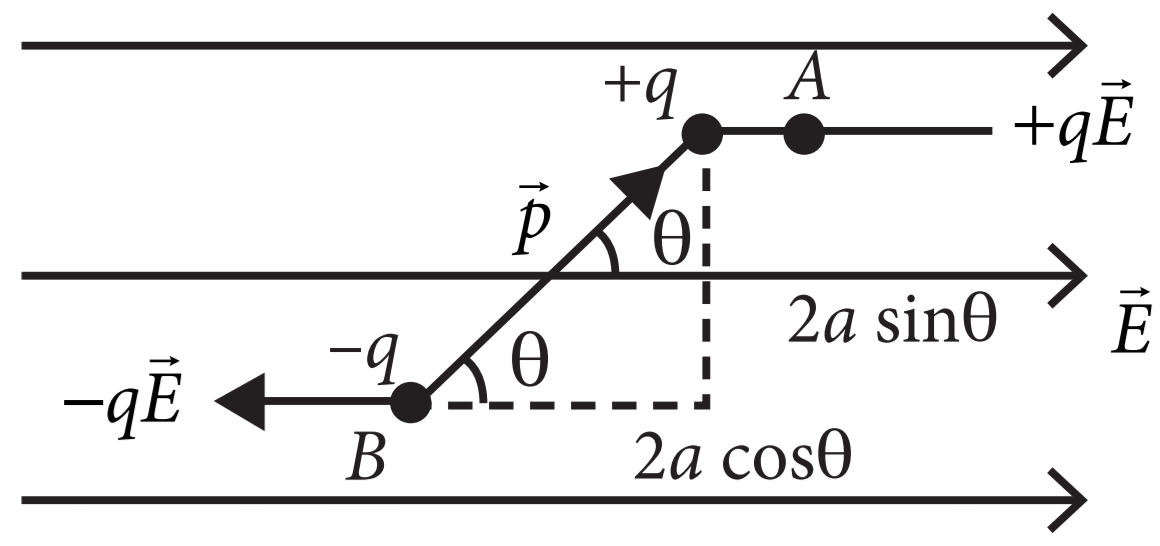
  1. The dipole moment of a dipole in a uniform external field $\vec{\text{E}}$ is $\vec{\text{P}}.$ Then the torque 'i acting on the dipole is:
  1. $\vec{\tau}=\vec{\text{P}}\times\vec{\text{E}}$
  2. $\vec{\tau}=\vec{\text{P}}\cdot\vec{\text{E}}$
  3. $\vec{\tau}=2(\vec{\text{P}}+\vec{\text{E}})$
  4. $\vec{\tau}=(\vec{\text{P}}+\vec{\text{E}})$
  1. An electric dipole consists of two opposite charges, each of magnitude $1.0\mu\text{C}$ separated by a distance of 2.0cm. The dipole is placed in an external field of $10^5N C^{-1}$. The maximum torque on the dipole is:
  1. $0.2 \times 10^{-3}Nm$
  2. $1 \times 10^{-3}Nm$
  3. $2 \times 10^{-3}Nm$
  4. $4 \times 10^{-3}Nm$
  1. Torque on a dipole in uniform electric field is minimum when $\theta$ is equal to:
  1. 90º
  2. 180º
  3. Both (a) and (c)
  1. When an electric dipole is held at an angle in a uniform electric field, the net force F and torque t on the dipole are:
  1. $\text{F}=0, \tau=0$
  2. $\text{F}\not=0, \tau\not=0$
  3. $\text{F}=0, \tau\not=0$
  4. $\text{F}\not=0, \tau=0$
  1. An electric dipole of moment pis placed in an electric field of intensity E. The dipole acquires a position such that the axis of the dipole makes an angle $\theta$ with the direction of the field. Assuming that the potential energy of the dipole to be zero when $\theta=90^\circ$ the torque and the potential energy of the dipole will respectively be:
  1. $\text{pE}\sin\theta,-\text{pE}\cos\theta$
  2. $\text{pE}\sin\theta,-2\text{pE}\cos\theta$
  3. $\text{pE}\sin\theta,2\text{pE}\cos\theta$
  4. $\text{pE}\cos\theta,-2\text{pE}\sin\theta$
Answer

  1. (a) $\vec{\tau}=\vec{\text{P}}\times\vec{\text{E}}$
Explanation:
As $\tau=$ either force × perpendicular distance between the two forces.
$=\text{qaE}\sin\theta\text{ or }\tau=\text{PE}\sin\theta$
$(\because\text{qa}=\text{P})$
Or $\vec{\tau}=\vec{\text{P}}\times\vec{\text{E}}$
  1. (c) $2 \times 10^{-3}Nm$
Explanation:
The maximum torque on the dipole in an external electric field is given by
$\tau=\text{pE}=\text{q}(\text{2a})\times\text{E}$
Here, $\text{q}=1\mu\text{C}=10^{-6}\text{C,}$
$2a = 2cm = 2 \times 10^{-2}m,$
$E = 10^5N C^{-1},$
$\tau=?$
$\therefore\tau=10^{-6}\times2\times10^{-2}\times10^5$
$=2\times10^{-3}\text{Nm}$
  1. (d) Both (a) and (c)
Explanation:
When $\theta$ is 0 or 180º, the $\tau$ minimum, which means the dipole moment should be parallel to the direction of the uniform electric field.
  1. (c) $\text{F}=0, \tau\not=0$
Explanation:
Net force is zero and torque acts on the dipole, trying to align p with E.
  1. (a) $\text{pE}\sin\theta,-\text{pE}\cos\theta$
Explanation:
Torque, $\tau=\text{pE}\sin\theta$ and potential energy, $\text{U}=-\text{pE}\cos\theta.$​​​​​​​

Need a full question paper?

Generate a complete, print-ready paper with questions like this in minutes — across 16+ boards, with answer keys.

Start Generating Free

Similar questions

Power (P) of a lens is given by reciprocal of focal length (f) of the lens i.e. $\text{p}=\frac{1}{\text{f}},$ where f is in metre and P is in dioptre. For a convex lens, power is positive and for a concave lens, power is negative. When a number of thin lenses of powers $P_1, P_2, P_3, ...... $ are held in contact with one another, the power of the combination is given by algebraic sum of the powers of all the lenses i.e., $P = P_1 + P_2 + P_3 +......$
  1. A convex and a concave lens separated by distance d are then put in contact. The focal length of the combination.
  1. Becomes 0.
  2. Remains the same.
  3. Decreases.
  4. Increases.
  1. If two lenses of power +1.5D and +1.0D are placed in contact, then the effective power of combination will be.
  1. 2.5D
  2. 1.5D
  3. 0.5D
  4. 3.25D
  1. If the power of a lens is +5 dioptre, what is the focal length of the lens?
  1. 10cm
  2. 20cm
  3. 15cm
  4. 5cm
  1. Two thin lenses of focal lengths +10cm and -5cm are kept in contact. The power of the combination is:
  1. -10D
  2. -20D
  3. 10D
  4. 15D
  1. A convex lens of focal length 25cm is placed coaxially in contact with a concave lens of focal length 20cm. The system will be.
  1. Converging in nature.
  2. Diverging in nature.
  3. Can be converging or divergin.
  4. None of the above.
A deflection magnetometer is placed with its arms in north-south direction. How and where should a short magnet having $\frac{\text{M}}{\text{B}_\text{H}}=40\text{A-m}^2\text{T}$ be placed so that the needle can stay in any position?
A capacitor is a device to store energy. The process of charging up a capacitor involves the transferring of electric charges from its one place to another. This work done in charging the capacitor is stored as its electrical potential energy.
If q is the charge and V is the potential difference across a capacitor at any instant during its charging, then small work done in storing an additional small charge dq against the repulsion of charge q already stored on it is $\text{dW}=\text{V.dq}=(\frac{\text{q}}{\text{C}})\text{dq}.$
  1. A system of 2 capacitors of capacitance $2\mu\text{F}$ and $4\mu\text{F}$ is connected in series across a potential difference of 6 V. The energy stored in the system is:
  1. $3\mu\text{J}$
  2. $24\mu\text{J}$
  3. $30\mu\text{J}$
  4. $108\mu\text{J}$
  1. A capacitor of capacitance of $10\mu\text{F}$ is charged to 10V. The energy stored in it is:
  1. $100\mu\text{J}$
  2. $500\mu\text{J}$
  3. $1000\mu\text{J}$
  4. $1\mu\text{J}$
  1. A parallel plate air capacitor has capacity C farad, potential V volt and energy E joule. When the gap between the plates is completely filled with dielectric:
  1. Both V and E increase.
  2. Both V and E decrease.
  3. V decreases, E increases.
  4. V increases, E decreases.
  1. A capacitor with capacitance $5\mu\text{F}$ s charged to $5\mu\text{C}.$ If the plates are pulled apart to reduce the capacitance to $2\mu\text{F},$ how much work is done?
  1. $6.25 \times 10^{-6}J$
  2. $3.75 \times 10^{-6}J$
  3. $2.16 \times 10^{-6}J$
  4. $2.55 \times 10^{-6}J$
  1. A metallic sphere ofradius 18cm has been given a charge of $5 \times 10^{-6}C$. The energy of the charged conductor is:
  1. 0.2J
  2. 0.6J
  3. 1.2J
  4. 2.4J
An electric dipole of length 2 cm is placed in an electric field of intensity $10^5$ Newton/Coulomb in such a way that its axis makes an angle of $30^{\circ}$ with the direction of the field. A torque of $10 \sqrt{3}$ Newton meter acts on it. Find the magnitude of charge on the electric diple.
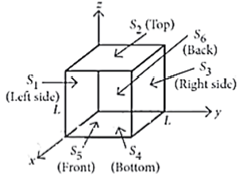
Net electric flux through a cube is the sum of fluxes through its six faces. Consider a cube as shown in figure, having sides of length $L =10.0 \ cm$. The electric field is uniform, has a magnitude $E =4.00 \times 10^3 NC ^{-1}$ and is parallel to the $xy$ plane at an angle of $37^{\circ}$ measured from the $+ x -$axis towards the $+ y -$axis.
Image
$(i)$ Electric flux passing through surface $S_6$ is
$(a) \ -24 \ Nm ^2 C ^{-1}$
$(b) \ 32 \ Nm ^2 C ^{-1}$
$(c) \ -32 \ Nm ^2 C ^{-1}$
$(d)\  24 \ Nm ^2 C ^{-1}$
$(ii)$ Electric flux passing through surface $S_1$ is
$(a)-32 \ Nm ^2 C ^{-1}$
$(b) -24 \ Nm ^2 C ^{-1}$
$(c)\ 32 \ Nm ^2 C ^{-1}$
$(d)\ 24 \ Nm ^2 C ^{-1}$
$(iii)$ The surfaces that have zero flux are
$(a) S _2$ and $S _4  \ (b)  S_3$ and $S_6  \ (c)  S _1$ and $S _2  \ (d)  S _1$ and $S _3$
$(iv)$ he total net electric flux through all faces of the cube is $a) 24 \ Nm^2 C-1 c)-8 \ Nm^2 C-1$
$(a) \ 24 \ Nm ^2 C ^{-1}  \ (b) \  8 \ Nm ^2 C ^{-1}  \ (c)  \ -8 \ Nm ^2 C ^{-1}  \ (d)$ zero
OR
The dimensional formula of surface integral $\oint \vec{E} \cdot d \vec{S}$ of an electric field is
$(a) \ \left[ M ^{-1} L^3 T^{-3} A\right]$
$(b)\  \left[ M L ^2 T^{-2} A^{-1}\right]$
$(c) \ \left[ ML ^3 T^{-3} A^{-1}\right]$
$(d) \ \left[ M L ^{-3} T^{-3} A^{-1}\right]$
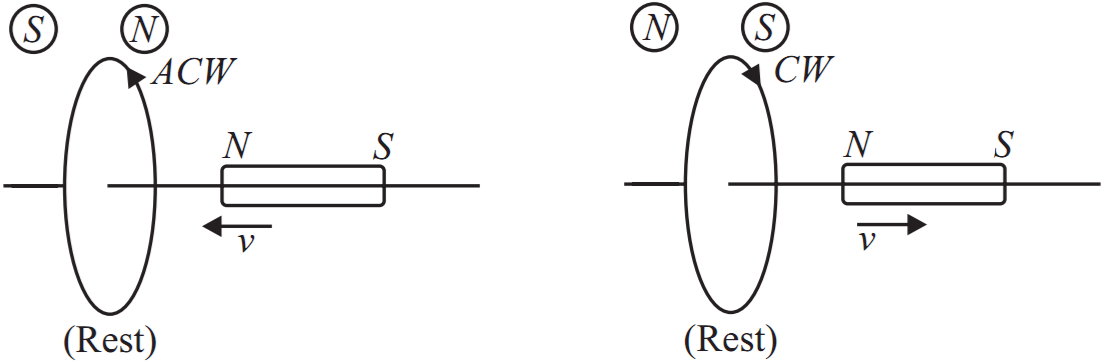
Lenz's law states that the direction of induced current in a circuit is such that it opposes the change which produces it. Tims, if the magnetic flux linked with a closed circuit increases, the induced current flows in such a direction that a magnetic flux is created in the opposite direction of the original magnetic flux. If the magnetic flux linked with the closed circuit decreases, the induced current flows in such a direction so as to create a magnetic flux in the direction of the original flux.
  1. Which of the following statements is correct?
  1. The induced e.m.f is not in the direction opposing the change in magnetic flux so as to oppose the cause which produces it.
  2. The relative motion between the coil and magnet produces change in magnetic flux.
  3. Emf is induced only if the magnet is moved towards coil.
  4. Emf is induced only if the coil is moved towards magnet.
  1. The polarity of induced emf is given by:
  1. Ampere's circuital law.
  2. Biot-Savart law.
  3. Lenz's law.
  4. Fleming's right hand rule.
  1. Lenz's law is a consequence of the law of conservation of:
  1. Charge.
  2. Mass.
  3. Momentum.
  4. Energy.
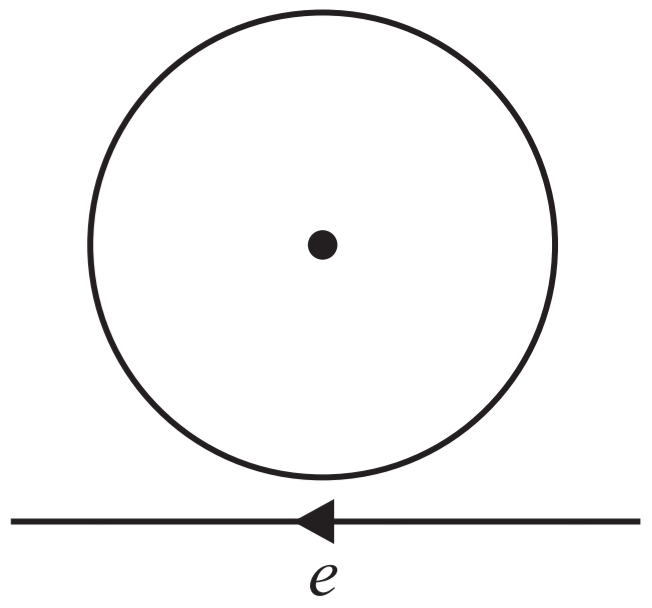
  1. Near a circular loop of conducting wire as shown in the figure, an electron moves along a straight line. The direction of the induced current if any in the loop is:
  1. Variable.
  2. Clockwise.
  3. Anticlockwise.
  4. Zero.
  1. Two identical circular coils A and Bare kept in a horizontal tube side by side without touching each other. If the current in the coil A increases with time, in response, the coil B:
  1. Is attracted by A.
  2. Remains stationary.
  3. Is repelled.
  4. Rotates.
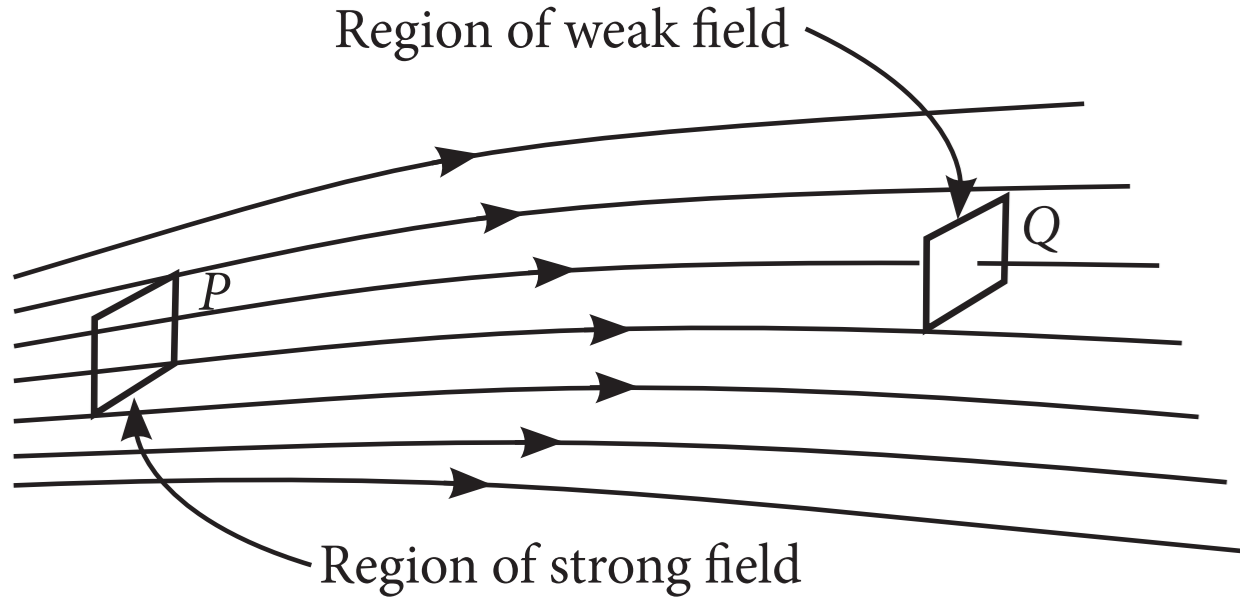
Electric field strength is proportional to the density of lines of force i.e., electric field strength at a point is proportional to the number of lines of force cutting a unit area element placed normal to the field at that point. As illustrated in the given figure, the electric field at P is stronger that at Q.
  1. Electric lines of force about a positive point charge are:
  1. Radially outwards.
  2. Circular clockwise.
  3. Radially inwards.
  4. Parallel straight lines.
  1. Which of the following is false for electric lines of force?
  1. They always start from positive charges and terminate on negative charges.
  2. They are always perpendicular to the surface of a charged conductor.
  3. They always form closed loops.
  4. They are parallel and equally spaced in a region of uniform electric field.
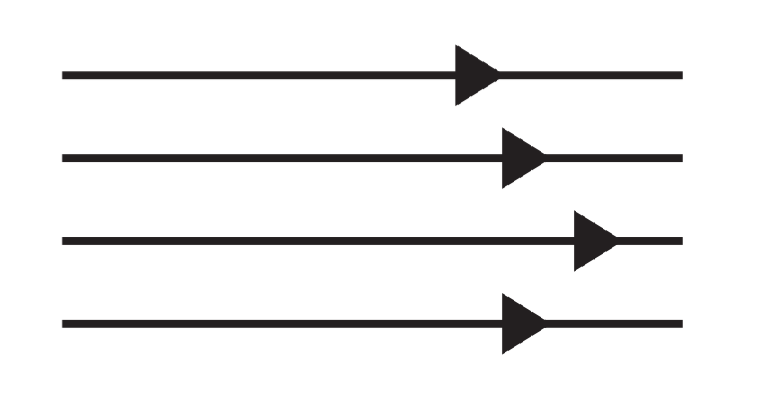
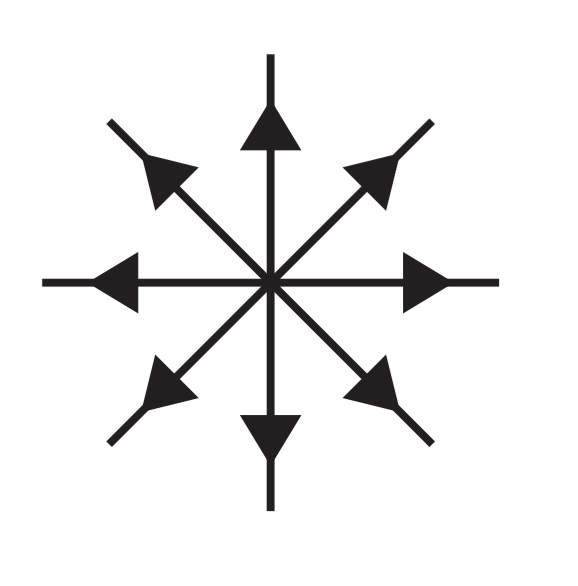
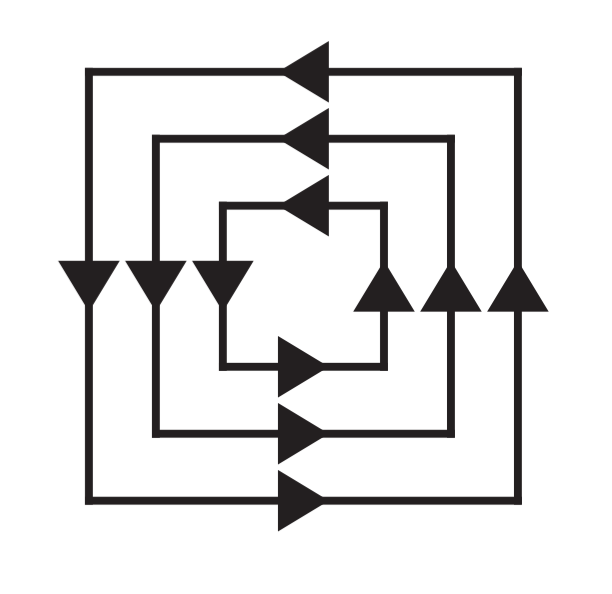
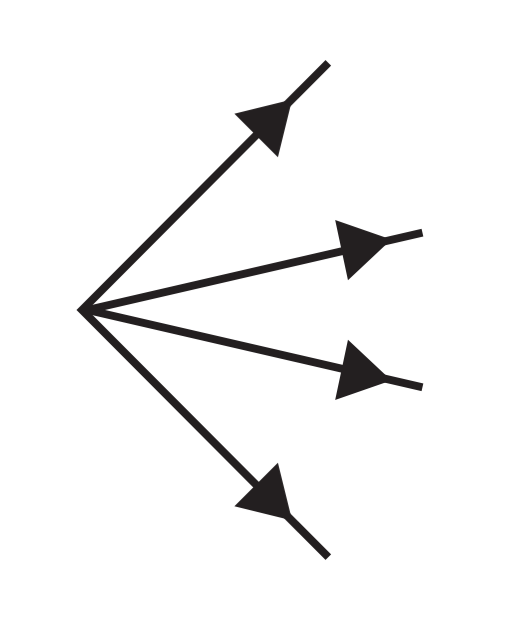
  1. Which one of the following pattern of electric line of force in not possible in filed due to stationary charges?
  1.  
  1.  
  1.  
  1.  
  1. Electric lines of force are curved:
  1. In the field of a single positive or negative charge.
  2. In the field of two equal and opposite charges.
  3. In the field of two like charges.
  4. Both (b) and (c).
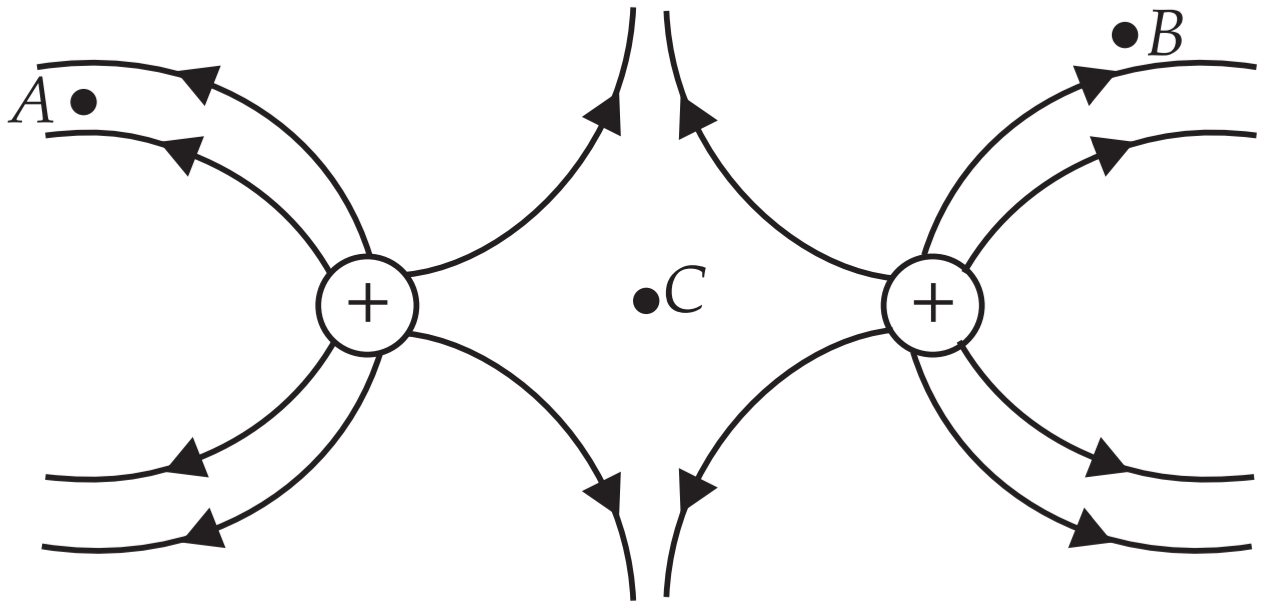
  1. The figure below shows the electric field lines due to two positive charges. The magnitudes $E_A, E_B$ and $E_C$ of the electric fields at points A, Band C respectively are related as:
  1. $E_A > E_B > E_C$
  2. $E_B > E_A > E_C$
  3. $E_A = E_B > E_C$
  4. $E_A > E_B = E_C$
  1. A small compass needle of magnetic moment ‘m’ is free to turn about an axis perpendicular to the direction of uniform magnetic field ‘B’. The moment of inertia of the needle about the axis is ‘I’. The needle is slightly disturbed from its stable position and then released. Prove that it executes simple harmonic motion. Hence deduce the expression for its time period.
  2. A compass needle, free to turn in a vertical plane orients itself with its axis vertical at a certain place on the earth. Find out the values of (i) horizontal component of earth’s magnetic field and (ii) angle of dip at the place.
The electron beam in a colour TV is accelerated through 32kV and then strikes the screen. What is the wavelength of the most energetic X-ray photon?
Total internal reflection is the phenomenon of reflection of light into denser medium at the interface of denser medium with a rarer medium. For this phenomenon to occur necessary condition is that light must travel from denser to rarer and angle of incidence in denser medium must be greater than critical angle (C) for the pair of media in contact. Critical angle depends on nature of medium and wavelength of tight. We can show that $\mu=\frac{1}{\sin\text{C}}.$
  1. Critical angle for glass air interface, where ft of glass is $\frac{3}{2}$ is,
  1. 41.8
  2. 60º
  3. 30º
  4. 15º
  1. Critical angle for water air interface is 48.6º. What is the refractive index of water?
  1. $1$
  2. $\frac{3}{2}$
  3. $\frac{4}{3}$
  4. $\frac{3}{4}$
  1. Critical angle for air water interface for violet colour is 49º. Its value for red colour would be:
  1. 49º
  2. 50º
  3. 48º
  4. Cannot say.
  1. Which of the following is not due to total internal reflection?
  1. Working of optical fibre.
  2. Difference between apparent and real depth of a pond.
  3. Mirage on hot summer days.
  4. Brilliance of diamond.
  1. Critical angle of glass is $\theta_1$ and that of water is $\theta_2$The critical angle for water and glass surface would be $(\mu_\text{g}=\frac{3}{2},\ \mu_\text{w}=\frac{4}{3})$
  1. Less than $\theta_2$
  2. Between $\theta_1$ and $\theta_2$
  3. Greater than $\theta_2$
  4. Less than $\theta_1$