Question
A tuning fork A, marked 512Hz, produces 5 beats per second, where sounded with another unmarked tuning fork B. If B is loaded with wax the number of beats is again 5 per second. What is the frequency of the tuning fork B when not loaded?

Answer

When the prong of B is loaded with wax, its frequency becomes less than the original frequency.
If we assume that the original frequency of B is 507, then on loading its frequency will be less than 507. The beats between A and B will be more than 5.
If we assume that the original frequency of B is 517, then on loading its frequency will be less than 517. The beats between A and B may be equal to 5.
Hence the frequency of the tuning fork B when not loaded should be 517.

Need a full question paper?

Generate a complete, print-ready paper with questions like this in minutes — across 16+ boards, with answer keys.
Start Generating Free

Similar questions

When we stir a liquid vigorously, it becomes warm. Is it a reversible process?
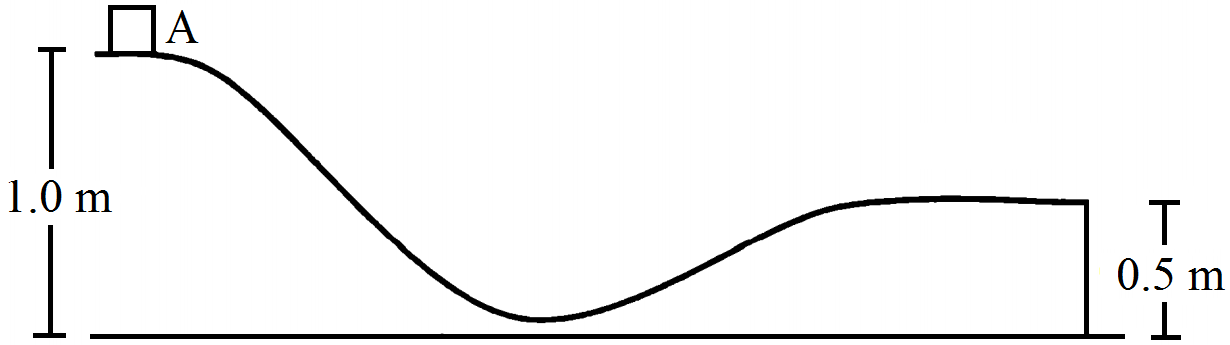
Figure shows a particle sliding on a frictionless track which terminates in a straight horizontal section. If the particle starts slipping from the point A, how far away from the track will the particle hit the ground?

The speed of sound in air is 332m/s. Is it advisable to define the length 1m as the distance travelled by sound in $\frac{1}{332}\text{s}$?
Consider the situation of the previous problem. Suppose the production of the radioactive isotope starts at t = 0. Find the number of active nuclei at time t.
It is a common observation that rain clouds can be at about a kilometre altitude above the ground.
If a rain drop falls from such a height freely under gravity, what will be its speed? Also calculate in km/h. (g = 10m/s2)
A square coil of edge l and with n turns carries a current i. It is kept on a smooth horizontal plate. A uniform magnetic field B exists parallel to an edge. The total mass of the coil is M. What should be the minimum value of B for which the coil will start tipping over?
Suppose the rod in the previous problem has a mass of 1kg distributed uniformly over its length:
  1. Find the initial angular acceleration of the rod.
  2. Find the tension in the supports to the blocks of mass 2kg and 5kg.
The sum of the magnitude of two forces acting at a point is 18N and the magnitude of their resultant is 12N. If the resultant is at 90° with the force of smaller magnitude, what are the magnitude of forces?
A police van moving on a highway with a speed of $30$ $km h ^{-1}$ fires a bullet at a thief's car speeding away in the same direction with a speed of $192$ $km h ^{-1}$. If the muzzle speed of the bullet is $150$ $m s ^{-1}$, with what speed does the bullet hit the thief's car?
Two neutral particles are kept 1m apart. Suppose by some mechanism some charge is transferred from one particle to the other and the electric potential energy lost is completely converted into a photon. Calculate the longest and the next smaller wavelength of the photon possible.