MCQ
A tuning fork gives $5$ beats with another tuning fork of frequency $100\,Hz.$ When the first tuning fork is loaded with wax, then the number of beats remains unchanged, then what will be the frequency of the first tuning fork ..... $Hz$
  • A
    $95$
  • B
    $100$
  • $105$
  • D
    $110$

Answer

Correct option: C.
$105$
c
(c) Suppose $n_A$ = known frequency $= 100\, Hz,$ $n_B = ?$
$x = 5\, bps,$ which remains unchanged after loading
Unknown tuning fork is loaded so $n_B\downarrow$
Hence $n_A -n_B \downarrow = x $... $(i)$ $\rightarrow$ correct
$n_B \downarrow -n_A = x $... $(ii)$ $\rightarrow$ wrong
From equation $ (i),$ it is clear that as $n_B$ decreases, beat frequency. (i.e.$ n_A -(n_B)_{new}$) can never be $x$ again.
From equation $(ii),$ as$ n_B\downarrow$, beat frequency (i.e. $(n_B)_{new} -n_A$) decreases as long as $(n_B)_{new}$ remains greater than $n_A$, If $(n_B)_{new}$ become lesser than $n_A$ the beat frequency will increase again and will be $x.$

Hence this is correct.
So, $n_B = n_A + x = 100 + 5 = 105 Hz.$

Need a full question paper?

Generate a complete, print-ready paper with questions like this in minutes — across 16+ boards, with answer keys.

Start Generating Free

Similar questions

In forced oscillation of a particle the amplitude is maximum for a frequency $\omega_{1}$ of the force, while the energy is maximum for a frequency $\omega_{2}$ of the force, then
When the displacement of a simple harmonic oscillator is one third of its amplitude, the ratio of total energy to the kinetic energy is $\frac{x}{8}$, where $x=$_____________.
A sonometer wire oflength $1.5\ m$ is made of steel. The tension in it produces an elastic strain of $1 \%$. What is the fundamental frequency of steel if density and elasticity of steel are $7.7 \times 10^3 $ $kg/m^3$ and $2.2 \times 10^{11}$ $N/m^2$ respectively?
A car of mass $800 \,kg$ moves on a circular track of radius $40\, m$. If the coefficient of friction is $0.5$, then maximum velocity with which the car can move is ......... $m/s$
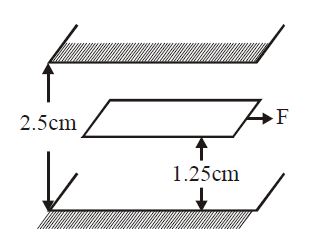
A space $2.5\ cm$ wide between two large plane surfaces is filled with oil. Force required to drag very thin plate of area $0.5\ m^2$ just midway the surfaces at a speed of $0.5\ m/sec$ is $1\ N$ The coefficient of viscosity in $kg-s/m^2$ is :
A cricketer catches a ball of mass $150\; gm$ in $0.1$ second moving with speed $20\, m/s$. Then he experiences force of ..... $N$
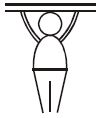
A boy is hanging from branch of a tree as shown. Angle between his arm, for tension to be maximum in arms must be ............ $^o$
If the measurement errors in all the independent quantities are known, then it is possible to determine the error in any dependent quantity. This is done by the use of series expansion and truncating the expansion at the first power of the error. For example, consider the relation $z=x / y$. If the errors in $x, y$ and $z$ are $\Delta x, \Delta y$ and $\Delta z$, respectively, then

$z \pm \Delta z=\frac{x \pm \Delta x}{y \pm \Delta y}=\frac{x}{y}\left(1 \pm \frac{\Delta x}{x}\right)\left(1 \pm \frac{\Delta y}{y}\right)^{-1} .$

The series expansion for $\left(1 \pm \frac{\Delta y}{y}\right)^{-1}$, to first power in $\Delta y / y$, is $1 \mp(\Delta y / y)$. The relative errors in independent variables are always added. So the error in $z$ will be $\Delta z=z\left(\frac{\Delta x}{x}+\frac{\Delta y}{y}\right)$.

The above derivation makes the assumption that $\Delta x / x \ll<1, \Delta y / y \ll<1$. Therefore, the higher powers of these quantities are neglected.

($1$) Consider the ratio $r =\frac{(1- a )}{(1+ a )}$ to be determined by measuring a dimensionless quantity a.

If the error in the measurement of $a$ is $\Delta a (\Delta a / a \ll<1)$, then what is the error $\Delta r$ in

$(A)$ $\frac{\Delta a }{(1+ a )^2}$  $(B)$ $\frac{2 \Delta a }{(1+ a )^2}$  $(C)$ $\frac{2 \Delta a}{\left(1-a^2\right)}$  $(D)$ $\frac{2 a \Delta a}{\left(1-a^2\right)}$

($2$) In an experiment the initial number of radioactive nuclei is $3000$ . It is found that $1000 \pm$ 40 nuclei decayed in the first $1.0 s$. For $|x|<1$, In $(1+x)=x$ up to first power in $x$. The error $\Delta \lambda$, in the determination of the decay constant $\lambda$, in $s ^{-1}$, is

$(A) 0.04$  $(B) 0.03$  $(C) 0.02$  $(D) 0.01$

Give the answer or quetion ($1$) and ($2$)
Resonance is an example of
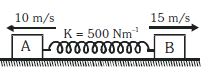
Two blocks $A$ and $B$ are joined together with a compressed spring. When the system is released, the two blocks appear to be moving with unequal speeds in opposite directions as shown in figure. Select the correct statement