A tuning fork is vibrating at $250\, {Hz}$. The length of the shortest closed organ pipe that will resonate with the tuning fork will be ..... ${cm}$
(Take speed of sound in air as $340\, {ms}^{-1}$ )
JEE MAIN 2021, Medium
Download our app for free and get started
$\frac{\lambda}{4}=\ell \Rightarrow \lambda=4 \ell$
${f}=\frac{{V}}{\lambda}=\frac{{V}}{4 \ell}$
$\Rightarrow 250=\frac{340}{4 \ell}$
$\Rightarrow \ell=\frac{34}{4 \times 25}=0.34\, {m}$
$\ell=34\, {cm}$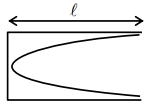

Download our appand get started for free
Experience the future of education. Simply download our apps or reach out to us for more information. Let's shape the future of learning together!No signup needed.*
Similar Questions
- 1A transverse wave of amplitude $0.5\, m$ and wavelength $1\, m$ and frequency $2\, Hz$ is propagating in a string in the negative $x-$direction. The expression for this wave isView Solution
- 2Transverse wave propagates in a medium with a velocity of $1450\,m/s$ . The distance between the nearest points at which the oscillations of the particles carried in the opposite phase $\pi $ is $0.1\,m$ . What is the frequency of the wave ..... $Hz$ ?View Solution
- 3If the tension of sonometer’s wire increases four times then the fundamental frequency of the wire will increase by .... $ times$View Solution
- 4An open organ pipe of length $L$ vibrates in second harmonic mode. The pressure vibration is maximumView Solution
- 5The equation of a travelling wave is $y = 60\cos (1800t - 6x)$ where $y$ is in microns, $t$ in seconds and $x$ in metres. The ratio of maximum particle velocity to velocity of wave propagation isView Solution
- 6A transverse wave is represented by the equation $y = {y_0}\sin \frac{{2\pi }}{\lambda }(vt - x)$ For what value of $\lambda$, the maximum particle velocity equal to two times the wave velocityView Solution
- 7The equation of a transverse wave is given by $y = 10\sin \pi (0.01x - 2t)$ where $x$ and $y$ are in $cm$ and $t$ is in second. Its frequency is .... ${\sec ^{ - 1}}$View Solution
- 8A closed orgain pipe has length $'l’$. The air in it is vibrating in $3^{rd}$ overtone with maximum displacement amplitude $'a’$. The displacement amplitude at distance $l / 7$ from closed end of the pipe is:View Solution
- 9The pressure wave, $P = 0.01\,sin\,[1000t -3x]\,Nm^{-2},$ corresponds to the sound produced by a vibrating blade on a day when atmospheric temperature is $0\,^oC.$ On some other day when temperature is $T,$ the speed of sound produced by the same blade and at the same frequency is found to be $336 \,ms^{-1}$. Approximate value of $T$ is .... $^oC$View Solution
- 10View SolutionA transverse wave is travelling along a stretched string from right to left. The figure shown represents the shape of the string at a given instant. At this instant