An open organ pipe of length $L$ vibrates in second harmonic mode. The pressure vibration is maximum
Medium
Download our app for free and get started
For an open organ pipe, the length $L$ is given as
$L=\frac{n \lambda}{2}$
where, $\lambda$ is the wavelength of wave and $n$ is an integer and by putting $n=1,2,3……….$
we get the modes of vibration.
n=1 gives first harmonics, $n=2$ gives second harmonics and so on.
Here, an open organ pipe of length $L$ vibrates in second harmonic mode,
hence the length of pipe is
$L=\frac{2 \lambda}{2}$
$L=\lambda$
Hence, the length of pipe is equal to the distance between two consecutive antinodes
at both open ends. The nodes are at distance $\frac{\lambda}{4}$ from the antinodes. since there is no
displacement of particles at nodes the pressure vibration is maximum there.
Hence, in open organ pipe the pressure vibration is maximum at a distance
$\frac{L}{4}(\text { since }, L=\lambda)$ from either end inside the tube as shown in figure.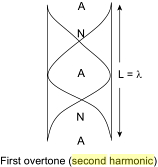

Download our appand get started for free
Experience the future of education. Simply download our apps or reach out to us for more information. Let's shape the future of learning together!No signup needed.*
Similar Questions
- 1View SolutionThe ratio of frequencies of fundamental harmonic produced by an open pipe to that of closed pipe having the same length is
- 2View SolutionAt a certain instant a stationary transverse wave is found to have maximum kinetic energy. The appearance of string at that instant is
- 3A string is stretched between two fixed points separated by $75\,cm$ . It is observed to have resonant frequencies of $420\,Hz$ and $315\,Hz$ . There are no other resonant frequencies between these two. Then, the lowest resonant frequency for this string is ..... $Hz$View Solution
- 4A speeding motorcyclist sees traffic jam ahead him. He slows down to $36\,\, km\,\,hour^{-1}$ He finds that traffic has eased and a car moving ahead of him at $18 \,\, km\,\,hour^{-1}$ is honking at a frequency of $1392\,\, Hz.$ If the speed of sound is $343\, m s^{-1}$, the frequency of the honk as heard by him will be .... $Hz$View Solution
- 5An open pipe resonates with a tuning fork of frequency $500 Hz$. it is observed that two successive nodes are formed at distances $16$ and $46 cm $ from the open end. The speed of sound in air in the pipe is ..... $m/s$View Solution
- 6When an air column at $15\,^oC$ and a tunning fork are sounded together then $4$ beats per second are produced, the frequency of the fork is less then that of air column. When the temperature falls to $10\,^oC$ , then the beat frequency decreases by one. The frequency of the fork will be ..... $Hz$ $[V_{sound}$ at $0\,^oC = 332\,m/s]$View Solution
- 7Three similar wires of frequency $n_1, n_2$ and $n_3$ are joined to make one wire. Its frequency will beView Solution
- 8A tuning fork gives $5$ beats with another tuning fork of frequency $100\,Hz.$ When the first tuning fork is loaded with wax, then the number of beats remains unchanged, then what will be the frequency of the first tuning fork ..... $Hz$View Solution
- 9Which of the following curves represents correctly the oscillation given by $y = {y_0}\sin (\omega \,t - \phi )$, where $0 < \phi < 90$View Solution
- 10A train moving at a speed of $220\,\, m s^{-1}$ towards a stationary object, emits a sound of frequency $1000\,\, Hz.$ Some of the sound reaching the object gets reflected back to the train as echo. The frequency of the echo as detected by the driver of the train is ...... $Hz$View Solution
(Speed of sound in air is $330 \,\, m s^{-1}$)