A tuning fork of frequency $340\,\, Hz$ is vibrated just above a cylindrical tube of length $120 \,\,cm$. Water is slowly poured in the tube. If the speed of sound is $340\,\, ms^{-1}$ then the minimum height of water required for resonance is .... $cm$
Medium
Download our app for free and get started
The wavelength of the wave is
$\lambda=\frac{v}{\nu}$
$\lambda=\frac{340}{340}=1 m$
Therefore for different resonances, the required lengths of the air column are
$\frac{\lambda}{4}, \frac{3 \lambda}{4}, \frac{5 \lambda}{4}$ i.e. $25 \mathrm{cm}, 75 \mathrm{cm}, 125 \mathrm{cm}$
As the length of pipe is120cm, the resonance corresponding to $125 \mathrm{cm}$ is not possible.
So, when the water is slowly poured, the first resonance will occur at length
$75 \mathrm{cm}$ of air column. Hence, the height of water is
$h=120-75=45 \mathrm{cm}$

Download our appand get started for free
Experience the future of education. Simply download our apps or reach out to us for more information. Let's shape the future of learning together!No signup needed.*
Similar Questions
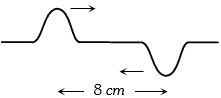
- 1Two pulses in a stretched string whose centres are initially $8 cm$ apart are moving towards each other as shown in the figure. The speed of each pulse is $2 cm/s$. After $2$ seconds, the total energy of the pulses will beView Solution
- 2It is found that an increase in pressure of $100\, kPa$ causes a certain volume of water to decrease by $5 × 10^{-3}$ percent of its original volume. Then the speed of sound in the water is about .... $m/s$ (density of water $10^3 \,kg/m^3$)View Solution
- 3An observer moves towards a stationary source of sound, with a velocity one-fifth of the velocity of sound. What is the percentage increase in the apparent frequency ... $\%$View Solution
- 4Following statements are given for a stationary waveView Solution
$(a)$ Every particle has a fixed amplitude which is different from the amplitude of its nearest particle.
$(b)$ All the particles cross their mean position at the same time.
$(c)$ All the particles are oscillating with same amplitude.
$(d)$ There is no net transfer of energy across any plane.
$(e)$ There are some particles which are always at rest.
Which of the following is correct
- 5An observer starts moving with uniform acceleration $a$ toward a stationary sound source emitting a whistle of frequency $n.$ As the observer approaches source, the apparent frequency, heard by the observer varies with time asView Solution
- 6If the length of stretched string is shortened by $40\%$ and the tension is increased by $44\%$, then the ratio of the final and initial fundamental frequencies isView Solution
- 7A wave is represented by the equation $y = 7\sin \{ \pi (2t - 2x)\} $ where $x$ is in metres and $t$ in seconds. The velocity of the wave is ..... $m/s$View Solution
- 8In Melde's experiment, the string vibrates in $4$ loops when a $50 \,gram$ weight is placed in the pan of weight $15\, gram.$ To make the string to vibrates in $6$ loops the weight that has to be removed from the pan isView Solution
- 9Following are expressions for four plane simple harmonic wavesView Solution
$(i)\,\,\,\,\,{y_1} = A\,\cos \,\,2\pi \,\left( {{n_1}t\, + \,\frac{x}{{{\lambda _1}}}} \right)$
$(ii)\,\,\,\,\,{y_2} = A\,\cos \,\,2\pi \,\left( {{n_1}t\, + \,\frac{x}{{{\lambda _1}}} + \pi } \right)$
$(iii)\,\,\,\,\,{y_3} = A\,\cos \,\,2\pi \,\left( {{n_2}t\, + \,\frac{x}{{{\lambda _2}}}} \right)$
$(iv)\,\,\,\,\,{y_4} = A\,\cos \,\,2\pi \,\left( {{n_2}t\, - \,\frac{x}{{{\lambda _2}}}} \right)$
The pairs of waves which will produce destructive interference and stationary waves respectively in a medium, are
- 10The string of a violin emits a note of $205 \,Hz$ at its correct tension. The string is tightened slightly and then it produces six beats in two seconds with a tuning fork of frequency $205 Hz$. The frequency of the note emitted by the taut string is .......... $Hz$View Solution