MCQ
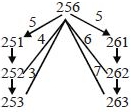
A tuning fork of known frequency $256\,Hz$ makes $5$ beats per second with the vibrating string of a guitar. The beat frequency decreases to $2$ beats per second when the tension in the guitar string slightly increased. The frequency of the guitar string before increasing the tension was ..... $Hz$
  • A
    $257$
  • B
    $261$
  • C
    $254$
  • $251$

Answer

Correct option: D.
$251$
d
On increasing tension frequency of wire increases

So,

So beat frequency is decreases in case of $251$ $\mathrm{\,Hz}$

Need a full question paper?

Generate a complete, print-ready paper with questions like this in minutes — across 16+ boards, with answer keys.

Start Generating Free

Similar questions

body moves with constant angular velocity on a circle. Magnitude of angular acceleration
A liquid drop of diameter $D$ breaks into $27$ tiny drops. The change in energy is
Two rods one made of copper and other made of steel of the same length and same cross sectional area are joined together. The thermal conductivity of copper and steel are $385\,J\,s ^{-1}\,K ^{-1}\,m ^{-1}$ and $50\,J\,s ^{-1}\,K ^{-1}\,m ^{-1}$ respectively. The free ends of copper and steel are held at $100^{\circ}\,C$ and $0^{\circ}\,C$ respectively. The temperature at the junction is, nearly $.......^{\circ}\,C$
A hollow sphere has radius $6.4 \,m$. Minimum velocity required by a motor cyclist at bottom to complete the circle will be ........... $m/s$
A body of mass $10$ kg slides along a rough horizontal surface. The coefficient of friction is $1/\sqrt 3 $. Taking $g = 10\,m/{s^2}$, the least force which acts at an angle of $30^o $ to the horizontal is ...... $N$
The phenomenon of beats can take place:
  1. For longitudinal waves only.
  2. For transverse waves only.
  3. For both longitudinal and transverse waves.
  4. For sound waves only.
The equation of a travelling wave is given by$y = 0.5\sin (20x - 400t)$ where $x$ and $y$ are in meter and $t$ is in second. The velocity of the wave is .... $m/s$
The intensity of sound increases at night due to
The average distance a molecule can travel without colliding is called as:
If two waves of same frequency and same amplitude respectively, on superimposition produced a resultant disturbance of the same amplitude, the waves differ in phase by