Question
A tuning fork of unknown frequency makes 5 beats per second with another tuning fork which can cause a closed organ pipe of length 40cm to vibrate in its fundamental mode. The beat frequency decreases when the first tuning fork is slightly loaded with wax. Find its original frequency. The speed of sound in air is 320m/s.
Answer

Given length of the closed organ pipe, $\text{l}=40\text{cm}=40\times10^{-2}\text{m}$

$\text{V}_\text{air}=320$

So, its frequency $\rho=\frac{\text{V}}{4\text{l}}=\frac{320}{4\times40\times10^{-2}}=200\ \text{Hertz}.$

As the tuning fork produces 5 beats with the closed pipe, its frequency must be 195Hz or 205Hz. Given that, as it is loaded its frequency decreases.

So, the frequency of tuning fork = 205Hz.

Need a full question paper?

Generate a complete, print-ready paper with questions like this in minutes — across 16+ boards, with answer keys.

Start Generating Free

Similar questions

(i) Whatement is position vector $\cos ^2 \alpha+\cos ^2 \beta+\cos ^2 \gamma=1$(ii) Explain the displacvector
Two wires are kept tight between the same pair of supports. The tensions in the wires are in the ratio 2 : 1, the radii are in the ratio 3 : 1 and the densities are in the ratio 1 :2. Find the ratio of their fundamental frequencies.
A particle executes simple harmonic motion of amplitude A.
i. At what distance from the mean position is its kinetic energy equal to its potential energy?
ii. At what points is its speed half the maximum speed?
Suppose the space between the two inner shells of the previous problem is filled with a dielectric of dielectric coastant K. Find the capacitance of the system between A and B.
A double convex lens has focal length 25cm. The radius of curvature of one of the surfaces is double of the other. Find the radii, if the refractive index of the material of the lens is 1.5.
Find the magnetic field B at the centre of a rectangular loop of length l and width b, carrying a current i.
Two starts each of one solar mass (= 2 × 1030 kg) are approaching each other for a head on collision. When they are a distance 109 km, their speeds are negligible. What is the speed with which they collide? The radius of each start is 104 km. Assume the stars to remain undistorted until they collide. (Use the known value of G).
A force $3\hat{\text{i}}+2\hat{\text{j}}$ displaces a 1kg mass from $\hat{\text{i}}+\hat{\text{j}}$  to $-\hat{\text{i}}+2\hat{\text{j}}$. Find the work done.
A pin of length 2.0cm lies along the principal axis of a converging lens, the centre being at a distance of 11cm from the lens. The focal length of the lens is 6cm. Find the size of the image.
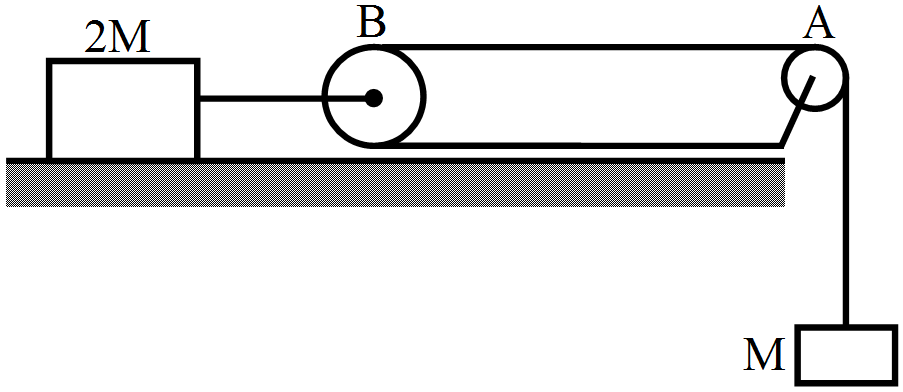
Consider the situation shown in figure. Both the pulleys and the string are light and all the surfaces are frictionless.
  1. Find the acceleration of the mass M.
  2. Find the tension in the string.
  3. Calculate the force exerted by the clamp on the pulley A in the figure.
​​​​​​​