Question
A U-shaped wire is dipped in a soap solution, and removed. The thin soap film formed between the wire and the light slider supports a weight of 1.5 × 10⁻²N (which includes the small weight of the slider). The length of the slider is 30cm. What is the surface tension of the film?
Answer

The weight that the soap film supports, W = 1.5 × 10⁻²N

Length of the slider, l = 30cm = 0.3m

A soap film has two free surfaces.

$\therefore$ Total length = 2l = 2 × 0.3 = 0.6m

Surface tension, $\text{S}=\frac{\text{Force of Weight}}{2\text{l}}$

$= 1.5 \times\frac{10^{-2}}{0.6}=  2.5\times10-2\text{N/m}$

Therefore, the surface tension of the film is 2.5 × 10-2N m-1.

Need a full question paper?

Generate a complete, print-ready paper with questions like this in minutes — across 16+ boards, with answer keys.

Start Generating Free

Similar questions

State the law of conservation of momentum. Establish the same for a 'n' body system.
A bulb rated 60W at 220V is connected across a household supply of alternating voltage of 220V. Calculate the maximum instantaneous current through the filament.
The radius of the earth is reduced by 4%. The mass of the earth remains unchanged. What will be the change in escape velocity?
If three helium nuclei combine to form a carbon nucleus, energy is liberated. Why can't helium nuclei combine on their own and minimise the energy?
A force of $(2500 \pm 5)$ N is applied over an area of $(0.32 \pm 0.02) \text{m}^2.$ Calculate the pressure exerted over the area.
Using $\text{B}=\mu_0\text{H},$ find the ratio $\frac{\text{E}_0}{\text{H}_0}$ for a plane electromagnetic wave propagating through vacuum. Show that it has the dimensions of electric resistance. This ratio is a universal constant called the impedance of free space.
Show that the total linear momentum of an isolated system of interacting particles is conserved.
Consider a head-on collision between two particles of masses m1 and m2. The initial speeds of the particles are u1 and u2 in the same direction. The collision starts 2 at t = 0 and the particles interact for a time interval $\triangle\text{t}.$ During the collision, the speed of the first particle varies as.

$\text{v}(\text{t})=\text{u}_1+\frac{\text{t}}{\triangle\text{t}}(\text{v}_1-\text{u}_1).$

Find the speed of the second particle as a function of time during the collision.

A new unit of length is chosen such that the speed of light in vacuum is unity. What is the distance between the Sun and the Earth in terms of the new unit if light takes 8min and 20s to cover this distance?
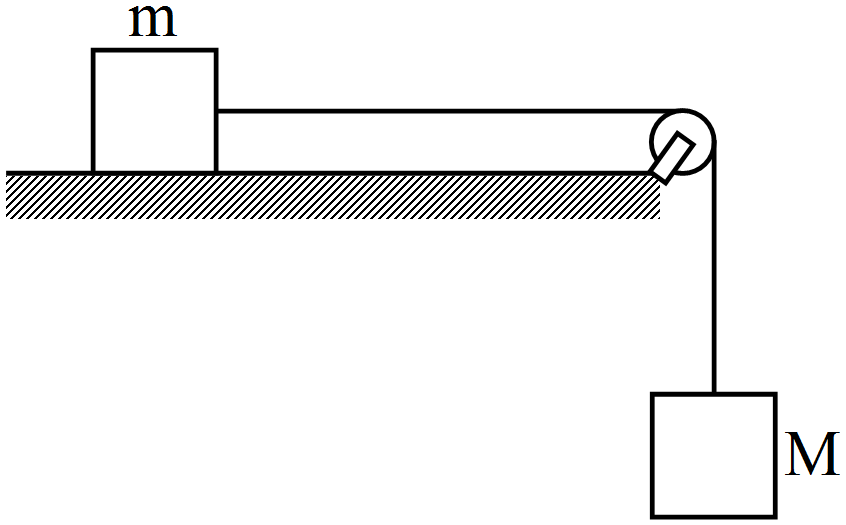
Figure shows two blocks of masses m and M connected by a string passing over a pulley. The horizontal table over which the mass m slides is smooth. The pulley has a radius r and moment of inertia I about its axis and it can freely rotate about this axis. Find the acceleration of the mass M assuming that the string does not slip on the pulley.