MCQ
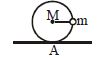
A uniform body of mass $M$  radius $R$ has a small mass $m$ attached at edge as shown in the figure. The system is placed on a perfectly rough horizontal surface such that mass $m$ is at the same horizontal level as the centre of body. It is assumed that there is no slipping at point $A$. If $I_A$ is the moment of the inertia of combined system about point of contact $A$ then the normal reaction at point $A$ just after the system is released from rest is ........ $N$. ($M = 6\ kg$, $m = 2\ kg,$ $I_A = 4\ kg\ m^2$, $R = 1\ m$, $g=10\ m/s^2$)
  • A
    $60$
  • B
    $80$
  • C
    $75$
  • $70$

Answer

Correct option: D.
$70$
d

Need a full question paper?

Generate a complete, print-ready paper with questions like this in minutes — across 16+ boards, with answer keys.

Start Generating Free

Similar questions

${g_e}$ and ${g_p}$ denote the acceleration due to gravity on the surface of the earth and another planet whose mass and radius are twice as that of earth. Then
The phase difference between two points separated by $0.8 m$ in a wave of frequency is $120 Hz$ is $\frac{\pi }{2}.$ The velocity of wave is .....  $m/s$
A block of mass $m$ is moving with a constant acceleration a on a rough plane. If the coefficient of friction between the block and ground is $\mu $, the power delivered by the external agent after a time $t$ from the beginning is equal to
We have three beakers $A, B$ and $C$ containing three different liquids. They are stirred vigorously and placed on a table. Then, liquid which is:
Two vibrating tuning forks produce progressive waves given by ${Y_1} = 4\sin 500\pi t$ and ${Y_2} = 2\sin 506\pi t.$ Number of beats produced per minute is
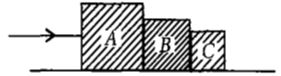
Three blocks $A, B$ and $C,$ of masses $4\, kg, \,2 \,kg$ and $1\, kg$ respectively, are in contact on a frictionless surface, as shown. If a force of $14\, N$ is applied on the $4 \,kg$ block, then the contact force between $A$ and $B$ is  .......... $N$
$A$ particle is moving along a circular path of radius $R$ in such a way that at any instant magnitude of radial acceleration & tangential acceleration are equal. If at $t = 0$ velocity of particle is $V_0$, the time period of first revolution of the particle is 
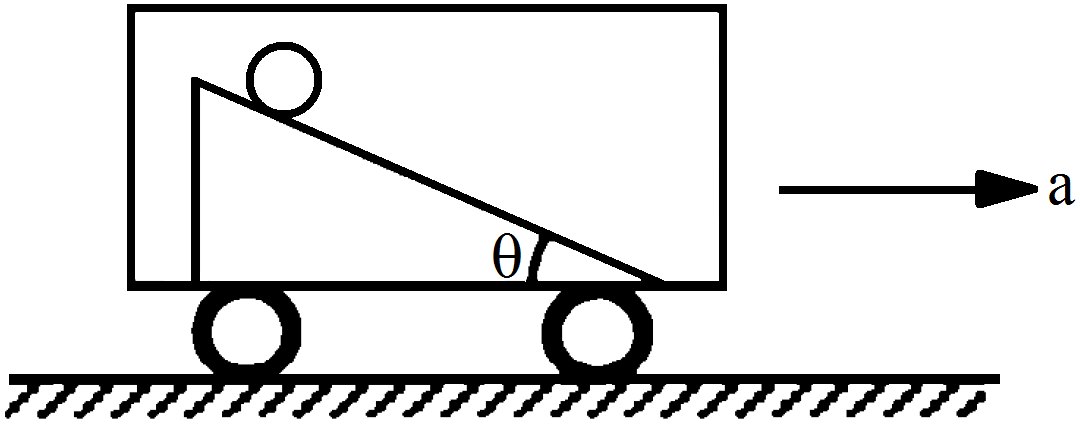
Figure shows a smooth inclined plane fixed in a car accelerating on a horizontal road. The angle of incline 0 is related to the acceleration a of the car as a = g tan°. If the sphere is set in pure rolling on the incline:
A body of mass $m$ is projected with velocity $\lambda v_{e}$ in vertically upward direction from the surface of the earth into space. It is given that $v _{ e }$ is escape velocity and $\lambda<1$. If air resistance is considered to the negligible, then the maximum height from the centre of earth, to which the body can go, will be. ( $R$ : radius of earth)
A projectile is fired with $KE$ of $1\,kJ$. If the range is maximum, .......... $J$ is its $KE$ at the highest point.