MCQ
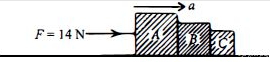
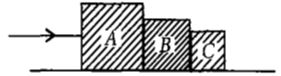
Three blocks $A, B$ and $C,$ of masses $4\, kg, \,2 \,kg$ and $1\, kg$ respectively, are in contact on a frictionless surface, as shown. If a force of $14\, N$ is applied on the $4 \,kg$ block, then the contact force between $A$ and $B$ is  .......... $N$
  • A
    $2$
  • $6$
  • C
    $8$
  • D
    $18$

Answer

Correct option: B.
$6$
b
$\begin{array}{l}
Here,\,{M_A} = 4\,kg,\,{M_B} = 2kg,\,{M_c} = 1\,kg,\,F = 14\,N\\
Net\,mass,\,M = {M_A} + {M_B} + {M_C} = 4 + 2 + 1 = 7kg\\
Let\,a\,be\,the\,acceleration\,of\,the\,system.\\
{\rm{Using}}\,Newton's\,{\rm{second}}\,law\,of\,motion,\\
\,\,\,\,\,\,\,\,\,\,\,F = Ma\\
\,\,\,\,\,\,\,\,\,\,\,14\, = 7a\,\,\,\,\therefore \,\,\,\,a = 2\,\,m{s^{ - 2}}
\end{array}$

$\begin{array}{l}
Let\,\,F\,be\,the\,force\,applied\,on\,block\,A\,by\,block\,B\\
i.e,.\,the\,constact\,force\,between\,A\,and\,B.\,Free\,body\,\\
diagram\,for\,block\,A\\
Again\,u{\rm{sing Netwton's}}\,{\rm{second}}\,{\rm{law}}\,{\rm{of}}\,{\rm{motion,}}\\
\,\,\,\,\,\,\,\,\,\,{\rm{F - F' = 4a}}\\
\,\,\,\,\,\,14 - F'\, = 4 \times 2\,\, \Rightarrow 14 - 8 = F\,\,\,\therefore F = 6N
\end{array}$
Need a full question paper?

Generate a complete, print-ready paper with questions like this in minutes — across 16+ boards, with answer keys.

Start Generating Free

Similar questions

A cubical box of side $a$ sitting on a rough table-top is pushed horizontally with a gradually increasing force until the box moves. If the force is applied at a height from the table top which is greater than a critical height $H$, the box topples first. If it is applied at a height less than $H$, the box starts sliding first. Then, the coefficient of friction between the box and the table top is
What is the torque of the force $\mathop F\limits^ \to   = (2\hat i - 3\hat j + 4\hat k)N$ acting at the pt. $\mathop r\limits^ \to   = (3\hat i + 2\hat j + 3\hat k)\,m$ about the origin
A man sitting in a moving train hears the whistle of the engine. The frequency of the whistle is $600 Hz$
Under elastic limit the stress is 
A block of mass $m$ lying on a rough horizontal plane is acted upon by a horizontal force $P$ and another force $Q$ inclined an at an angle $\theta $ to the vertical. The minimum value of coefficient of friction between the block and the surface for which the block will remain in equilibrium is
The wave length of light in visible part $({\lambda _V})$ and for sound $({\lambda _S})$ are related as
A body of mass $m$ is allowed to fall with the help of string with downward acceleration $\frac{g}{6}$ to a distance $x$. The work done by the string is .............
Two projectiles are fired from the same point with the same speed at angles of projection $60^o$ and $30^o$ respectively. Which one of the following is true?
Choose the correct option/s.
A raindrop falling from a height h above ground, attains a near terminal velocity when it has fallen through a height $(3/4)h.$ Which of the diagrams shown in correctly shows the change in kinetic and potential energy of the drop during its fall up to the ground?