MCQ
A uniform chain of length $L$ which hanges partially from a table, is kept in equilibrium by friction. The maximum length that can withstand without slipping is $l$ , then coefficient of friction between the table and the chain is
  • A
    $\frac{l}{L}$
  • B
    $\frac{l}{{L + l}}$
  • $\frac{l}{{L - l}}$
  • D
    $\frac{L}{{L + l}}$

Answer

Correct option: C.
$\frac{l}{{L - l}}$
c
$\mathrm{m}_{1} \mathrm{g}=\mu \mathrm{m}_{2} \mathrm{g} \quad \mathrm{m}_{1} \rightarrow$ mass of hanged part

$\mathrm{m}_{2} \rightarrow$ mass of remaining part

$\mu=\frac{m_{1}}{m_{2}}=\frac{\frac{M}{L} \times \ell}{\frac{M}{L}(L-\ell)}=\frac{\ell}{L-\ell}$

Need a full question paper?

Generate a complete, print-ready paper with questions like this in minutes — across 16+ boards, with answer keys.

Start Generating Free

Similar questions

The acceleration $a$ (in $ms ^{-2}$ ) of a body, starting from rest varies with time $t$ (in second) according to the relation $a=3 t+4$. The velocity of the body starting from rest at time $t=2 s$ will be $........ms ^{-1}$
The pressure of a gas kept in an isothermal container is 200kPa. If half the gas is removed from it, the pressure will be:
The wave equation is $y = 0.30\sin (314t - 1.57x)$ where $t, x$ and $y$ are in second, meter and centimeter respectively. The speed of the wave is ..... $m/s$
A black body is at $727^o C$. It emits energy at a rate which is proportional to
A gas is compressed adiabatically, which one of the following statement is NOT true.
A disc rotates about its axis of symmetry in a hoizontal plane at a steady rate of $3.5$ revolutions per second. A coin placed at a distance of $1.25\,cm$ from the axis of rotation remains at rest on the disc. The coefficient of friction between the coin and the disc is $(g\, = 10\,m/s^2)$
In producing a pure spectrum, the incident light is passed through a narrow slit placed in the focal plane of an achromatic lens because a narrow slit:
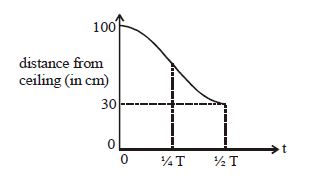
A spring hangs vertically from the ceiling and a mass is attached to its free end. When the mass is pulled down and released, it oscillates vertically with simple harmonic motion of period $T$ . The variation with time $t$ of its distance from the ceiling is as shown. Which statement gives a correct deduction from this graph?
A long cylindrical vessel is half filled with a liquid. When the vessel is rotated about its own vertical axis, the liquid rises up near the wall. If the radius of vessel is $5\,cm$ and its rotational speed is $2$ rotations per second, then the difference in the heights between the centre and the sides, in $cm,$ will be
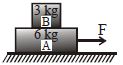
Two blocks $A$ and $B$ of masses $6\, kg$ and $3\, kg$ rest on a smooth horizontal surface as shown in the figure. If coefficient of friction between $A$ and $B$ is $0.4$, the maximum horizontal force which can make them without separation is ........ $N$