MCQ
The wave equation is $y = 0.30\sin (314t - 1.57x)$ where $t, x$ and $y$ are in second, meter and centimeter respectively. The speed of the wave is ..... $m/s$
  • A
    $100$
  • $200$
  • C
    $300$
  • D
    $400$

Answer

Correct option: B.
$200$
b
(b) $\omega = 314$, $k = 1.57$ and $v = \frac{\omega }{k} = \frac{{314}}{{1.57}} = 200\,m/s.$

Need a full question paper?

Generate a complete, print-ready paper with questions like this in minutes — across 16+ boards, with answer keys.
Start Generating Free

Similar questions

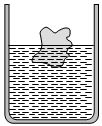
A body floats in a liquid contained in a beaker. If the whole system as shown in figure falls freely under gravity, then the upthrust on the body due to liquid is
Two particles of equal masses are revolving in circular paths of radii ${r_1}$ and ${r_2}$ respectively with the same speed. The ratio of their centripetal forces is
A liquid drop at temperature $t,$ isolated from its surroundings, breaks into a number of droplets. The temperature of the droplets will be
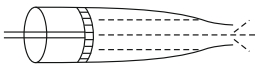
Figure below shows a liquid being pushed out of the tube by a piston having area of cross section $2.0\,cm ^2$. The area of cross section at the outlet is $10\,mm ^2$. If the piston is pushed at a speed of $4\,cm s ^{-1}$, the speed of outgoing fluidis $.........\,cm s ^{-1}$.
A car is moving along a straight line, say $OP$ in given figure. It moves from $O$ to $P$ in $18\; s$ and returns from $P$ to $\mathrm{Q}$ in $6.0\; s$. What are the average velocity and average speed of the car in going from $O$ to $P$?
Two tuning forks $A$ and $B$ give $4$ beats per second. The frequency of $A$ is $256 Hz$. On loading $B$ slightly, we get $5$ beats in $2$ seconds. The frequency of $B$ after loading is .... $Hz$
$Assertion :$ Falling raindrops acquire a terminal velocity.
$Reason :$ A constant force in the direction of motion and a velocity dependent force opposite to the direction of motion, always result in the acquisition of terminal velocity.
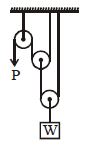
The ideal mechanical advantage of the combination of pulleys shown is
The equation $\overrightarrow {\phi \,} (x,\,t) = \overrightarrow {j\,} \sin \,\left( {\frac{{2\pi }}{\lambda }v\,t} \right)\cos \,\left( {\frac{{2\pi }}{\lambda }x} \right)$ represents
A lift is moving downwards with an acceleration equal to acceleration due to gravity. $A$ body of mass $M$ kept on the floor of the lift is pulled horizontally. If the coefficient of friction is $\mu $, then the frictional resistance offered by the body is