Question
A uniform circular motion is an accelerated motion. Justify it.

Answer

In uniform circular motion, a particle travels equal distances along the circular path in equal intervals of time, so the speed of particle is uniform. But the direction of motion of the particle changes at each point of circular path. Due to continuous change in direction of motion, the velocity of the particle is not uniform (or velocity is variable) i.e., the motion is accelerated.
Need a full question paper?

Generate a complete, print-ready paper with questions like this in minutes — across 16+ boards, with answer keys.

Start Generating Free

Similar questions

(a) What are radio-isotopes?
(b) A radioactive substance is oxidized. Will there be any change in the nature of its radioactivity? Give a reason for your answer.
(a) Name the colour code of the wire which is connected to the metallic body of an appliance.
(b) Why is it not advisable to use a piece of copper wire as fuse wire in an electric circuit?
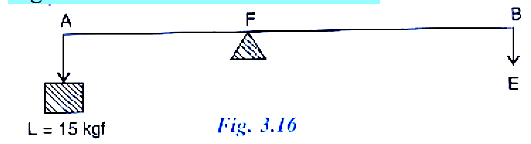
\text { Fig } 3.16 \text { below shows a lever in use. }


(a) To which class of lever does it belong?
(b) If $A B=1 m , A F=0.4 m$, find its mechanical advantage,
(c) calculate the value of $E$.
Draw a neat diagram for the verification of Ohm’s law by voltmeter-ammeter method. By another diagram show the relation between p.d. and current.
(a) The heat capacity of a vessel is $150 JK ^{-1}$. Calculate the heat energy required to raise its temperature from 293 K to 373 K .
(b) Calculate the mass of ioe required to lower the temperature of 300 g of water at $40^{\circ} C$ to water at $0^{\circ} C$. (Specific latent heat of ice $=336 J / g$, Specific heat capacity of water $=4.2 J / g ^{\circ} C$ )
Name the colour code of the wire which is connected to (i) metallic body of an appliance, (ii) switch for the appliance.
(a) What type of a lens can be used as a magnifying glass?
(b) Show by a ray diagram the formation of a real image by simple magnifying lens.
If the lens is of focal length 25 cm. Calculate the power of the lens.
Name and define the characteristic which enables one to distinguish two sounds of same loudness, but of different frequencies, given by the same instrument.
The ore of Uranium found in nature contains ${ }_{92} U ^{238}$ and ${ }_{92} U ^{235}$. Although both the isotopes are fissionable, it is found out experimentally that one of the two isotopes is more easily fissionable.
(a) Name the isotope of Uranium which is easily fissionable.
(b) Give a reason for your answer.
(c) Write a nuclear reaction when Uranium 238 emits an alpha particle to form a Thorium (Th) nucleus.