Questions · Page 1 of 3

[2 Mark Question Answer]

🎯

Test yourself on this topic

50 questions · timed · auto-graded

Question 12 Marks
Class I lever can have M.A. = 1, M.A. < 1 and M.A. > 1. Explain each giving examples.

Answer
E.g. of class I lever with M.A. = 1: A physical balance has both arms equal (i.e. effort arm = load arm), thus its M.A. = 1
E.g. of class I lever with M.A. = 1: A pair of scissors used to cut a piece of cloth has blades longer than the handle (i.e. effort arm is shorter than the load arm), thus its M.A. = 1.
E.g. of class I lever with M.A. = 1: Shears used for cutting thin metal sheets have much longer handles as compared to the blades (i.e. effort arm is longer than the load arm), thus its M.A. = 1 and it serves as a force multiplier.
View full question & answer
Question 22 Marks
Define Efficiency
Answer
Efficiency: Efficiency of a machine is the ratio of the useful work done by the machine to the work put into the machine by the effort. In other words, it is the ratio of the work output to the work input.
View full question & answer
Question 32 Marks
Define Velocity Ratio
Answer
The ratio of the velocity of effort to the velocity of the load is called the velocity ratio of the machine.
It is also defined as the ratio of the displacement of effort to the displacement of the load.
Velocity Ratio (V.R.) $=\frac{ d _{ E }}{ d _{ L }}$
View full question & answer
Question 42 Marks
Define Simple machine
Answer
Simple machine: A machine is a device by which we can either overcome a large resistive force at some point by applying a small force at a convenient point and in a desired direction or by which we can obtain a gain in speed.
View full question & answer
Question 52 Marks
Find the kinetic energy of a car of mass 1000 kg traveling at 72 km/h.
Answer
Given mass $m=1000 \mathrm{~kg}$
velocity $\mathrm{v}=72 \mathrm{~km} / \mathrm{hr}=20 \mathrm{~m} / \mathrm{s}$
Now K.E $=\frac{1}{2} m v^2=\frac{1}{2}(1000)(20)^2$
or, $\mathrm{K} . \mathrm{E}=2 \times 10^5 \mathrm{~J}$
View full question & answer
Question 62 Marks
How fast should a boy weighting 30 kg run so that his kinetic energy is 375 joule?
Answer
We know that,
$\mathrm{K} . \mathrm{E}=\frac{1}{2} \mathrm{mv}^2$ $375=\frac{1}{2} \times 30 \times v^2$
or $\mathrm{v}^2=\frac{375 \times 2}{30}=25 \mathrm{~m} / \mathrm{s}$
or $v=5 \mathrm{~m} / \mathrm{s}$
View full question & answer
Question 72 Marks
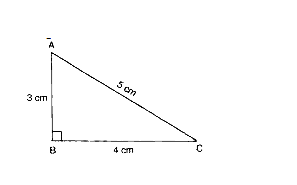
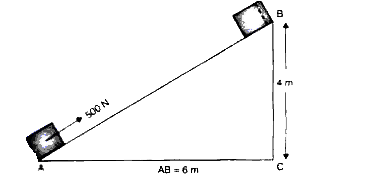
A block of mass 20 kg is pulled up a slope (fig.12) with a constant speed by applying a force of 500 N parallel to the slope. A and B are initial and final positions of the block.
(a) Calculate the work done by the force in moving the block from A and B.
(b) Calculate the potential energy gained by the block.
Answer
(a) given force = 500N

Vertical displacement = Final position - initial position = BC = 4m

work done = force x displacement = 500 x 4 = 2000J

(b) P.E gained = mgh = (mg) h = 500 x 4 = 2000J

View full question & answer
Question 82 Marks
Define energy and name its unit.
Answer
The energy of a body is its capacity to do work.
The SI unit of work is 'joules' and the CGS unit is 'erg'.
View full question & answer
Question 92 Marks
(a) Define power and name its unit.
(b) A girl weighting 50 kg climbs up 60 steps each of 20 cm height in 5 minutes. Calculate the power developed.
Answer
(a) The rate of doing work is called power.Sl unit of power $=$ watt
CGS unit of power $=$ erg per second
(b) Given mass $=50 \mathrm{~kg}$Total height traveled $=60 \times 20 \mathrm{~cm}=1200 \mathrm{~cm}=12 \mathrm{~m}$
$
\mathrm{g}=10 \mathrm{~ms}^{-2}
$
time taken $=5 \mathrm{~min}=5 \times 60 \mathrm{~s}=300 \mathrm{~s}$
Work done $=\mathrm{mgh}=50 \times 10 \times 12=6000 \mathrm{~J}$
Power $=\frac{\text { work done }}{\text { time taken }}=\frac{6000}{300}=20$ watt
View full question & answer
Question 102 Marks
Calculate the amount of work done by a child carrying a bag of 20 kg when he moves a distance of 40 m in
(a) Vertical direction, and
(b) Horizontal direction
Answer
Given, mass = 20kg

displacement = 40m

(a) In vertical direction work is done against gravity

Work done = mgh = 20 x 9.8 x 40 = 7840J

(b) In horizontal direction

Work done = Fs cos0 = (mg)s cos 0° = 20 x 9.8 x 40 = 7840J

View full question & answer
Question 112 Marks
A boy pulls a box up to $10\ m$ with a force of $5\ kgf$. Calculate the work done by him.
Answer
Given, force $=5 kgf =5 kgf \times 10 ms^{-2}=50 Ndisplacement =10 m$
Work done $=$ force $\times$ displacement $=50 \times 10=500 J$
View full question & answer
Question 122 Marks
Define the term work. Name the CGS and SI unit of work.
Answer
Work' is said to be done when the applied force makes the body move i.e., there is a displacement of body.
It is equal to the product of force and the displacement of the point of application of the force in the direction of force.
The SI unit of work is 'joules' and the CGS unit is 'erg'.
View full question & answer
Question 132 Marks
A block of iron of mass $400$ kg is used as a pile driver. If it is raised to a height of $20$ meters, calculate the potential energy possessed by the iron block. (Assume $g =10 ms^{-2}$ ).
Answer
Given, mass $m = 400 kg, height = 20 m, g = 10ms^{-2}P.E = mgh = (400) (10) (20) = 80000 J$
View full question & answer
Question 142 Marks
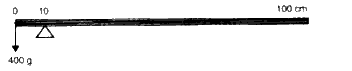
A meter scale is provided at 10 cm mark and is balanced by suspending 400 g from 0 cm mark (fig. ). Calculate the mass of meter scale.
Answer
Let m be the mass of the metre scale

In balancedcondition, sum of clockwise moments = sum of anticlockwise moments

400 x 10 = m x 90

or 4000 = 90m

or m = 44.4g

the mass of the scale is 44.4g

View full question & answer
Question 152 Marks
Give scientific reason for the following:
In a doubled decker bus passengers are not allowed to stand in the upper deck.
Answer
Passengers are usually advised not to stand in the upper deck of the double deck bus. When the passengers are standing, the C.G. rises. This decreases the stability of the bus. When the passengers are sitting, the C.G. gets lowered and stability of the bus increases.
View full question & answer
Question 162 Marks
Give scientific reason for the following:
While climbing a hill you will try to bend your body forward.
Answer
We bend forward in order to keep ourselves in a stable equilibrium while climbing up a hill. By bending forward we increases the base of the support, so that the vertical line passing through our centre of gravity still falls within the base.
View full question & answer
Question 172 Marks
Even though the Tower of Pisa is leaning through an angle it does not fall.
Answer
Leaning tower of Pisa is stable because a line through the centre of gravity falls within the structure's base. If the line falls outside the structure's base then there is a possibility that overturning will occur. This structure could be classified as unstable.
View full question & answer
Question 182 Marks
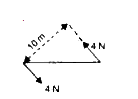
(i) What do you understand by the term couple of forces?
(ii) Calculate the moment of a couple shown in fig.
Answer
(i) Two equal and opposite parallel forces acting along different lines on a body constitute a couple.

(ii) Moment of couple = either force x perpendicular distance

= 4 x 10

= 40 Nm

View full question & answer
Question 192 Marks
Give scientific reason for the following:
Passengers in a bus are pushed backward when it starts suddenly.
Answer
This is due to the fact that the body of the passenger is in the state of rest as long as the bus is at rest. When the bus starts, his feet acquire the velocity of the bus and come to motion with the moving bus, while the upper portion of his body due to inertia of rest tends to remain in the state of rest, resulting in his tendency to fall backwards.
View full question & answer
Question 202 Marks
Give scientific reason for the following:
A man runs in the direction of train while getting down from a moving train.
Answer
When a man gets down from a moving train, his feet come to rest immediately, while the upper part of his body due to inertia of motion still remains in motion and consequently he leans in forward direction. The person while getting down of a train should run forward in the direction of the moving train to avoid fall.
View full question & answer
Question 212 Marks
Give scientific reason for the following:
There are chances of toppling when a truck takes a sharp turn especially when it is not fully loaded
Answer
When a truck is not fully loaded, its COG is at a high point and hence the turning moment of the weight is much greater, thus, the truck will be quite unstable and there are chances of toppling, when a truck takes a sharp turn.
View full question & answer
Question 222 Marks
Give scientific reason for the following:
When a man climbs a slope he bends forward.
Answer
A man bends forward in order to keep himself in a stable equilibrium while climbing up a slope. By bending forward he increases the base of the support, so that the vertical line passing through his centre of gravity may still fall within the base.
View full question & answer
Question 232 Marks
Give scientific reason for the following:
It is easier to push a boy standing on one leg than on both legs.
Answer
(i) We keep our body balanced on two feet by keeping the center of gravity of our body between our feet. It acts normal to the sea level vertically downwards. If COG goes out we fall or we get unbalanced.
A boy standing on both legs has his COG in balanced position and is thus in stable equilibrium but a boy standing on one leg has his COG in unbalanced position which makes him quite unstable and hence it is easier to push him.
View full question & answer
Question 242 Marks
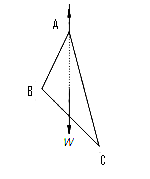
A right-angled triangle cardboard piece is placed as shown in fig. 7. Redraw the diagram showing the relative position of the vertices of the triangle when it is suspended by a pin from the hole A. Explain why the position changes
Answer
Diagram showing the relative position of vertices of the triangle when it is suspended by a pin from the hole A:

The position of vertices changes the triangle is in equilibrium and the centre of gravity lies on the vertical line through the point of suspension as the weight acts along this same line.
View full question & answer
Question 252 Marks
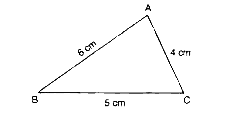
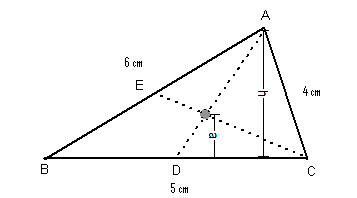
Fig. shows the dimensions of an acute angled triangle. By geometrical construction mark the C.G. of the triangle.
Answer

The center of gravity is at intersection of lines BE and AD. The distance a can be calculated as a = h/3
 
View full question & answer
Question 262 Marks
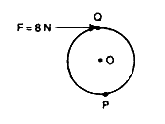
A wheel of diameter 3 m is shown in fig. 2 with axle at 0. A force F = 8 N is applied at Q in the direction shown in figure. Calculate the moment of force about:
(i) centre o, and
(ii) point p.
Answer
(i) Moment of force = applied force x perpendicular distance from the line of action

Moment of force at O = 8 x 1.5 = 12 Nm

(ii) Momemnt of force = applied force x perpendicular distance from the line of line

Moment of force at P = 8 x 3 = 24 Nm

View full question & answer
Question 272 Marks
A body is acted upon by two forces, each of magnitude F, but in opposite directions. State the effect of the forces when
(a) Both forces act at the same point of the body.
(b) The two forces act at two different points of the body at a separation d.
Answer
(a) If both the forces act at the same point of the body, they have the same line of action, and then the moment becomes zero.
(b) If both the forces act at two different points of the body at a separation d then they constitute a torque whose value is given F x d.
View full question & answer
Question 282 Marks
Name the physical quantity whose unit is kgfm. Define it.
Answer
The physical quantity is 'torque'.
Torque may be defines as the turning effect produced by a force on a rigid body about a point, pivot or fulcrum. It is measured by the product of force and the perpendicular distance of the pivot from the line of action of force.
View full question & answer
Question 292 Marks
What is meant by the principle of moments?
Answer
Principle of moments: If a body is in equilibrium under the action of number of force, then the sum of clockwise moments is equal to the sum of anticlockwise moments.
View full question & answer
Question 302 Marks
What is meant by equilibrium?
Answer
A body is said to be in equilibrium under the action of a number of forces, if the forces are not able to produce any change in the state of rest or of uniform motion or uniform rotation.
View full question & answer
Question 312 Marks
A body is pivoted at a point. A force of $10\ N$ is applied at a distance of $30\ cm$ from the pivot. Find the moment of force about the pivot.
Answer
Moment of force $=$ applied force $\times$ perpendicular distance from the pivot $=10 \times 30 \times 10^{-2}$ $=3 Nm$
View full question & answer
Question 322 Marks
What is meant by a torque?
Answer
The turning effect produced by a force on a rigid body about a point, pivot or fulcrum is called the moment of force or torque. It is measured by the product of force and the perpendicular distance of the pivot from the line of action of force.
View full question & answer
Question 332 Marks
What do you mean by the turning effect of a force?
Answer
The turning effect produced by a force on a rigid body about a point, pivot or fulcrum is called the moment of force or torque. It is measured by the product of force and the perpendicular distance of the pivot from the line of action of force.
Moment of a force = Force x perpendicular distance of the pivot from the force.
Its SI unit is newton-metre (Nm).
View full question & answer
Question 342 Marks
Following Fig shows piece of cardboard of uniform thickness cut into different shapes. Draw two lines to indicate the position of centre of gravity G.
View full question & answer
Question 352 Marks
Following Fig shows piece of cardboard of uniform thickness cut into different shapes. Draw two lines to indicate the position of centre of gravity G.
View full question & answer
Question 362 Marks
Following Fig shows piece of cardboard of uniform thickness cut into different shapes. Draw two lines to indicate the position of centre of gravity G.
View full question & answer
Question 372 Marks
Following Fig shows piece of cardboard of uniform thickness cut into different shapes. Draw two lines to indicate the position of centre of gravity G.
View full question & answer
Question 382 Marks
Following Fig shows piece of cardboard of uniform thickness cut into different shapes. Draw two lines to indicate the position of centre of gravity G.
View full question & answer
Question 392 Marks
State the factors on which the centre of gravity of a body depends.
Answer
The centre of gravity of a body depends upon:
(i) Body's weight
(ii) Body's shape
View full question & answer
Question 402 Marks
The moment of a force of 20 N about a fixed point 0 is 10 Nm. Calculate the distance of the point 0 from the line of action of the force.
Answer
Moment of force = applied force x perpendicular distance from the line of action

10 = 20 x perpendicular distance from the line of action

or perpendicular distance from the line of action = 0.5m

View full question & answer
Question 412 Marks
What are the physical parameters on which the kinetic energy of a body depends?
Answer
Kinetic energy of a body depends upon:
(i) Mass of the body
(ii) Speed of the body
View full question & answer
Question 422 Marks
A cricket ball is thrown up from the earth's surface. What happens to its P.E.
(a) during the motion
(b) at the highest point?
Answer
(a) As the height above the ground increases, the potential energy also increases.
(b) At the highest point, the height of the cricket ball is maximum and hence the potential energy is also maximum.
View full question & answer
Question 432 Marks
What is the P.E. of a body of mass M at a height H above the earth's surface?
Answer
P.E. of a body of mass M and at a height H above the earth's surface is:
P.E. = MgH ; here, g = acceleration due to gravity.
View full question & answer
Question 442 Marks
Name the parameters that can change the K.E.
Answer
The parameters that can change the kinetic energy are:
(i) Mass
(ii) Speed
View full question & answer
Question 452 Marks
A body is thrown vertically upwards. Its velocity keeps on changing. What happens to its K.E. when does its velocity become zero?
Answer
Its kinetic energy changes with the change in velocity.
Velocity becomes zero at the highest point.
View full question & answer
Question 462 Marks
If the speed of a particle is increased four times, how will its kinetic energy be affected?
Answer
$K . E, K=\frac{1}{2} m v^2$
If speed is doubled
$K . E, K^{\prime}=\frac{1}{2} m\left(2 v^2\right) $
$\text { or } K^{\prime}=4 \times \frac{1}{2} m v^2=4 K$
Thus K.E becomes four times.
View full question & answer
Question 472 Marks
A moving object of mass 30 kg has 60 J of kinetic energy. What is its speed?
Answer
$ \begin{aligned} & K . E=\frac{1}{2} \mathrm{mv}^2 \\ & 60=\frac{1}{2}(30)(v)^2 \end{aligned} $
or $\mathrm{v}^2=4 \mathrm{~m} / \mathrm{s}$
or $\mathrm{v}=2 \mathrm{~m} / \mathrm{s}$
View full question & answer
Question 482 Marks
A body of mass $2\ kg$ is moving with a speed of $20\ ms^{-1}$. What is its $K.E$.?
Answer
$ \begin{aligned} & K . E=\frac{1}{2} m v^2 \\ & K . E=\frac{1}{2}(2)(20)^2 \end{aligned} $
or K.E $=400 \mathrm{~J}$
Thus K.E is $400 \mathrm{~J}$
 
View full question & answer
Question 492 Marks
State the law of conservation of energy.
Answer
The law of conservation of energy states that energy cannot be created or destroyed; the sum total of energy in a closed system remains unchanged. Energy only changes from one form to another.
View full question & answer
Question 502 Marks
What is meant by the transformation of energy?
Answer
Whenever one form of energy dissipates or disappears, another form of equivalent amount of energy is produced; this is referred to as transformation of energy.
E.g. when a particular switch is pressed electric lamps light up owing to the heat produced in the filament. This is the transformation of electrical energy to heat and light energy.
View full question & answer
[2 Mark Question Answer] - Physics STD 10 Questions - Vidyadip