A uniform cube is subjected to volume compression. If each side is decreased by $1\%,$ then bulk strain is
Medium


Download our appand get started for free
Experience the future of education. Simply download our apps or reach out to us for more information. Let's shape the future of learning together!No signup needed.*
Similar Questions
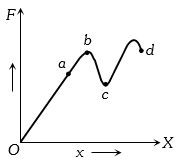
- 1The graph is drawn between the applied force $F$ and the strain $(x)$ for a thin uniform wire. The wire behaves as a liquid in the partView Solution
- 2$Assertion :$ Solids are least compressible and gases are most compressible.View Solution
$Reason :$ solids have definite shape and volume but gases do not have either definite shape or definite volume. - 3A uniform rod of length $L$ has a mass per unit length $\lambda$ and area of cross-section $A$. If the Young's modulus of the rod is $Y$. Then elongation in the rod due to its own weight is ...........View Solution
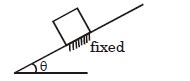
- 4View SolutionAssume that a block of very low shear modulus is fixed on an inclined plane as shown. Due to elastic forces it will deform. What will be the shape of the block ?
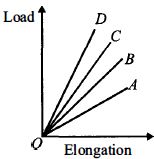
- 5View SolutionThe load versus elongation graphs for four wires of same length and made of the same material are shown in the figure. The thinnest wire is represented by the line
- 6Compressibility per unit atm. pressure of water is $'\sigma '$ and if due to pressure $P$ there is decrement in volume $V$, find change is volumeView Solution
- 7Two wires are made of the same material and have the same volume. The first wire has cross-sectional area $A$ and the second wire has cross-sectional area $3A$. If the length of the first wire is increased by $\Delta l$ on applying a force $F$, how much force is needed to stretch the second wire by the same amount?View Solution
- 8A cube of metal is subjected to a hydrostatic pressure of $4\;GPa.$ The percentage change in the length of the side of the cube is close to.......$\%$View Solution
(Given bulk modulus of metal, $B =8 \times 10^{10}\, Pa$ ) - 9View SolutionAfter effects of elasticity are maximum for
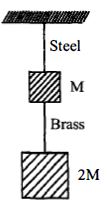
- 10If the ratio of lengths, radii and Young's moduli of steel and brass wires in the figure are $a, b$ and $c$ respectively, then the corresponding ratio of increase in their lengths isView Solution