MCQ
$A$ uniform cube of side $‘b’$ and mass $M$ rest on a rough horizontal table.$ A$ horizontal force $F$ is applied normal to one of the face at $a$ point, at $a$ height $3b/4$ above the base. What should be the coefficient of friction $(\mu )$ between cube and table so that is will tip about an edge before it starts slipping? 
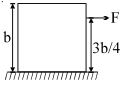
  • $\mu > \frac{2}{3}$
  • B
    $\mu > \frac{1}{3}$
  • C
    $\mu > \frac{3}{2}$
  • D
    none

Answer

Correct option: A.
$\mu > \frac{2}{3}$
a
$\mathrm{mg} \frac{\mathrm{b}}{2}=\mathrm{F} \frac{3 \mathrm{b}}{4}$

$\mathrm{F}=\mathrm{f}<\mu \mathrm{mg} \ldots(2)$

From equation $(1)$ and $( 2)$

$\mathrm{F}<\mu \mathrm{mg}$

$\frac{2 m g}{3}<\mu g$

or $\mu>\frac{2}{3}$

Need a full question paper?

Generate a complete, print-ready paper with questions like this in minutes — across 16+ boards, with answer keys.

Start Generating Free

Similar questions

A ball of mass $'m'$ moving with a speed $'u'$ under goes a head-on elastic collision with a ball of mass $(nm)$  initially at rest. The fraction of the incident energy transferred to the heaveir ball is
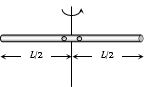
A smooth uniform rod of length $L$ and mass $M$ has two identical beads of negligible size, each of mass $m$, which can slide freely along the rod. Initially the two beads are at the centre of the rod and the system is rotating with angular velocity ${\omega _0}$ about an axis perpendicular to the rod and passing through the mid point of the rod (see figure). There are no external forces. When the beads reach the ends of the rod, the angular velocity of the system is
The speed of a projectile at its maximum height is half of its intial speed. The angle of projection is ......... $^o$
A hot black body emits the energy at the rate of $16\ J\ m^{-2}\ s^{-1}$ and its most intense radiation corresponds to $20,000\ Å$ . When the temperature of this body is further increased and its most intense radiation corresponds to $10,000\ Å$ , then the energy radiated in $Jm^{-2}\ s^{-1}$ will be
The distance of two planets (neptune and saturn) from sun are 1013 and 1012m respectively. The ratio of time period of the planets is:
Consider a point $P$ on the circumference of a disc rolling along a horizontal surface. If $R$ is the radius of the disc, the distance through which $P$ moves in one full rotation of the disc is
The surface tension of soap solution is $3.5 \times 10^{-2}\,Nm ^{-1}$. The amount of work done required to increase the radius of soap bubble from $10\,cm$ to $20\,cm$ is $.....\times 10^{-4}\,J$
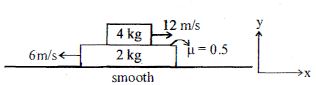
The blocks are given velocity in the direction shown in figure. Co-efficient of friction between two blocks shown in figure is $μ = 0.5$. Take $g = 10\  m/s^2$

(considering $4\ kg$ block doesn't fall on ground)

Consider the following statements

$(i)$  Time when relative motion between them is stopped is $1.4\  second$.

$(ii)$  Time when relative motion between them is stopped in $1.2\  second$

$(iii)$  The common velocity of the two blocks is $8\  m/s$, towards right.

$(iv)$  The displacement of the $4\, kg$ block when relative motion stopped is$10.8\  m$.

Which of the fstatements is/are correct

A hollow sphere of mass $1 \,kg$ and radius $10 \,cm$ is free to rotate about its diameter. If a force of $30 \,N$ is applied tangentially to it, its angular acceleration is (in $rad / s ^2$ )
If $\vec{P}+\vec{Q}=\vec{P}-\vec{Q}$, then