MCQ
If $\vec{P}+\vec{Q}=\vec{P}-\vec{Q}$, then
  • A
    $\vec{P}=\overrightarrow{0}$
  • $\vec{Q}=\overrightarrow{0}$
  • C
    $|\vec{P}|=1$
  • D
    $|\vec{Q}|=1$

Answer

Correct option: B.
$\vec{Q}=\overrightarrow{0}$
b
(b) $\vec{P}+\vec{Q} =\vec{P}-\vec{Q}$

$\Rightarrow \vec{Q} =0$

Need a full question paper?

Generate a complete, print-ready paper with questions like this in minutes — across 16+ boards, with answer keys.

Start Generating Free

Similar questions

There is rod of length $l$. The velocities of its two ends are $v_1$ and $v_2$ in opposite directions normal to the rod. The distance of the instantaneous axis of rotation from $v_1$ is:
A body is projected from the ground at an angle of $45^{\circ}$ with the horizontal. Its velocity after $2s$ is $20 \,ms ^{-1}$. The maximum height reached by the body during its motion is $m$. (use $g =10\, ms ^{-2}$ )
A particle moving with a uniform acceleration travels 24 metre and 64 metre in first two consecutive intervals of 4 seconds each. Its initial velocity is:
Which of the following relations is true for two unit vectors $\hat{ A }$ and $\hat{ B }$ making an angle $\theta$ to each other$?$
Find out the work done (in $ \times 10^{-3}\;J$) to expand the soap bubble to radius $R =5\, cm$ (Surface tension of water $=0.1\; N / m )$ 
Three simple harmonic motions in the same direction having the same amplitude a and same period are superposed. If each differs in phase from the next by ${45^o}$, then
Three rods each of mass $m$ and length $L$ are joined to form an equilateral triangle as shown in the figure. What is the moment of inertia about an axis passing through the centre of mass of the system and perpendicular to the plane?
$Assertion$: A rigid disc rolls without slipping on a fixed rough horizontal surface with uniform angular velocity. Then the acceleration of lowest point on the disc is zero.
$Reason$ : For a rigid disc rolling without slipping on a fixed rough horizontal surface, the velocity of the lowest point on the disc is always zero
A tuning fork is used to produce resonance in a glass tube. The length of the air column in this tube can be adjusted by a variable piston. At room temperature of $27\,^o C$ two successive resonances are produced at $20\, cm$ and $73\, cm$ of column length. If the frequency of the tuning fork is $320\, Hz,$ the velocity of sound in air at $27\,^o C$ is .... $m/s$
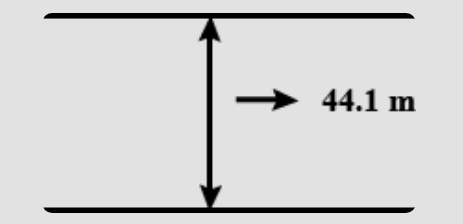
A stone is dropped into the water from a bridge 44.1m above the water. another stone is thrown vertically downward 1second later. both strike the water simultaneously. then initial speed of the second stone is: