MCQ
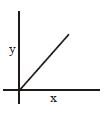
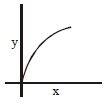
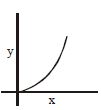
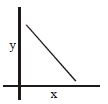
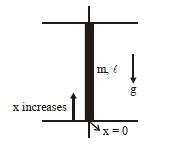
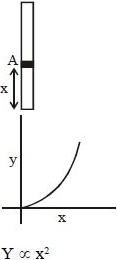
A uniform dense rod with non uniform young's modulus is hanging from ceiling under gravity. If elastic energy density at every point is same then young's modulus with $x$ will change as which of the shown graph
  • A

  • B


  • D

Answer

Correct option: C.

c
Elastic energy density at

$A=\frac{1}{2} \frac{(\text { stress })^{2}}{Y}=$ constant

$\frac{_{1}}{2} \frac{\left(\frac{M}{L} \frac{x}{A} g\right)^{2}}{Y}=$ constant
Need a full question paper?

Generate a complete, print-ready paper with questions like this in minutes — across 16+ boards, with answer keys.
Start Generating Free

Similar questions

Consider the following two statements:
$A.$ Linear momentum of the system remains constant.
$B.$ Centre of mass of the system remains at rest.
Consider two physical quantities A and B related to each other as $E=\frac{B-x^2}{A t}$ where $E, x$ and $t$ have dimensions of energy, length and time respectively. The dimension of $A B$ is
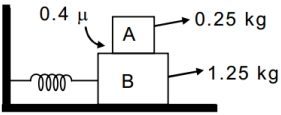
Maximum amplitude(in $cm$) of $SHM$ so block A will not slip on block $B , K =100 N / m$
A ball is launched from the top of Mt. Everest which is at elevation of $9000 \,m$. The ball moves in circular orbit around earth. Acceleration due to gravity near the earth's surface is $g$. The magnitude of the ball's acceleration while in orbit is
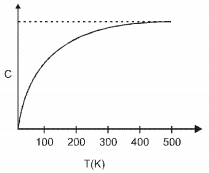
The figure below shows the variation of specific heat capacity $(C)$ of a solid as a function of temperature $(T)$. The temperature is increased continuously from $0$ to $500 \ K$ at a constant rate. Ignoring any volume change, the following statement$(s)$ is (are) correct to a reasonable approximation.$Image$

$(A)$ the rate at which heat is absorbed in the range $0-100 \ K$ varies linearly with temperature $T$.

$(B)$ heat absorbed in increasing the temperature from $0-100 \ K$ is less than the heat required for increasing the temperature from $400-500 \ K$.

$(C)$ there is no change in the rate of heat absorbtion in the range $400-500 \ K$.

$(D)$ the rate of heat absorption increases in the range $200-300 \ K$.
The $\text{rms}$ speed of oxygen at room temperature is about $500\ m/ s.$ The rms speed of hydrogen at the same temperature is about:
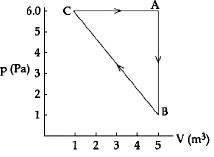
For the given cyclic process $CAB$ as shown for a gas, the work done is ..... $J$
The nature of sound waves in gases is
An engine pumps water continuously through a hose. Water leaves the hose with velocity $v$ and $m$ is mass per unit length of the water jet. If this jet hits a surface and came to rest instantaneously, the force on the surface is
The ratio of escape velocity at earth $(v_e)$ to the escape velocity at a planet $(v_p)$ whose radius and mean density are twice as that of earth is