Question
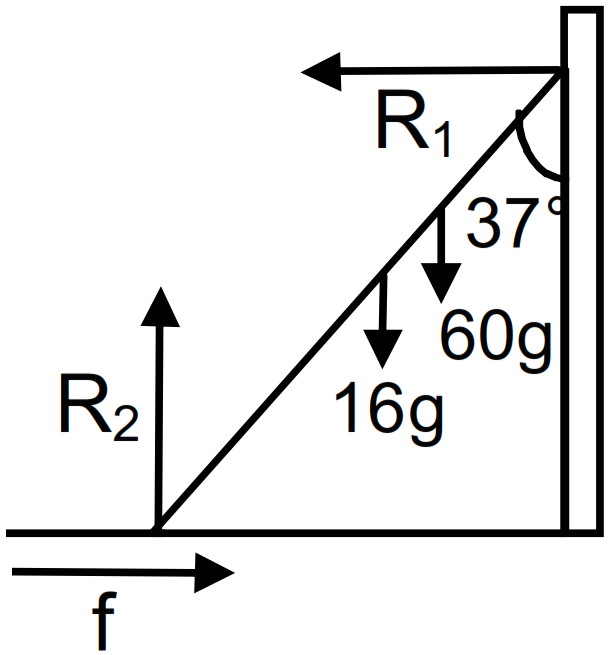
A uniform ladder of length 10.0m and mass 16.0kg is resting against a vertical wall making an angle of 37° with it. The vertical wall is frictionless but the ground is rough. An electrician weighing 60.0kg climbs up the ladder. If he stays on the ladder at a point 8.00m from the lower end, what will be the normal force and the force of friction on the ladder by the ground? What should be the minimum coefficient of friction for the elctrician to work safely?
Answer


$\text{R}_1=\mu\text{R}_2,\ \text{R}_2=16\text{g}+60\text{g}=745\text{N}$
$\text{R}_1\times10\cos37^\circ=16\text{g}\times5\sin37^\circ+60\text{g}\times8\times\sin37^\circ$
$\Rightarrow8\text{R}_1=\text{48g}+288\text{g}$
$\Rightarrow\text{R}_1=\frac{336\text{g}}{8}=412\text{N}=\text{f}$
Therefore $\mu=\frac{\text{R}_1}{\text{R}_2}=\frac{412}{745}=0.53$

Need a full question paper?

Generate a complete, print-ready paper with questions like this in minutes — across 16+ boards, with answer keys.

Start Generating Free

Similar questions

When an electron goes from the valence band to the conduction band in silicon, its energy is increased by 1.1eV. The average energy exchanged in a thermal collision is of the order of kT which is only 0.026eV at room temperature. How is a thermal collision able to take some of the electrons from the valence band to the conduction band?
A body weighs 63N on the surface of the earth. What is the gravitational force on it due to the earth at a height equal to half the radius of the earth?
Explain the experimental demonstration of in- terference by making a labelled diagram of a quinke tube.
Define the following international units and supplementary units : (i) Meter (ii) Kilogram (iii) Second (iv) Ampere (v) Kelvin (vi) Candela (vii) Mole (viii) Radian (ix) Steradian.
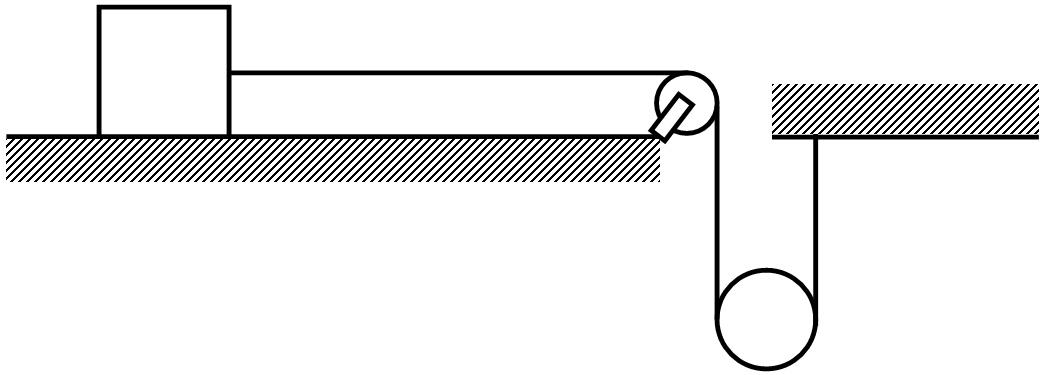
The descending pulley shown in figure has a radius $20cm$ and moment of inertia $0.20kg-m^2$. The fixed pulley is light and the horizontal plane frictionless. Find the acceleration of the block if its mass is $1.0kg$.
A rocket is fired ‘vertically’ from the surface of mars with a speed of $2km\ s^{-1}$. If $20\%$ of its initial energy is lost due to martian atmospheric resistance, how far will the rocket go from the surface of mars before returning to it? Mass of mars $= 6.4 \times 10^{23}kg;$ radius of mars $= 3395km;\ G = 6.67 \times 10^{-11}N\ m^2\ kg^{-2}.$
Use Moseley's law with $b=1$ to find the frequency of the $\mathrm{K}_\alpha \mathrm{X}$-ray of $\mathrm{La}(\mathrm{Z}=57)$ if the frequency of the $\mathrm{K}_\alpha \mathrm{X}$-ray of $\mathrm{Cu}(\mathrm{Z}=29)$ is known to be $1.88 \times 10^{18} \mathrm{~Hz}$.
The $\text{K}_\alpha$ and $\text{K}_\beta$ X-rays of molybdenum have wavelengths 0.71A and 0.63A respectively. Find the wavelength of $\text{L}_\alpha$ X-ray of molybdenum.
A block of mass $2.0kg$ is pushed down an inclined plane of inclination $37^\circ$ with a force of $20N$ acting parallel to the incline. It is found that the block moves on the incline with an acceleration of $10m/s^2$. If the block started from rest, find the work done.
  1. By the applied force in the first second.
  2. By the weight of the block in the first second.
  3. By the frictional force acting on the block in the first second. Take $g = 10m/s^2$.
The intensities due to two sources of sound are $I_0$ and $4I_0$. What is the intensity at a point where the phase difference between two waves is:
  1. $0^\circ$
  2. $\frac{\pi}{2}$
  3. $\pi?$