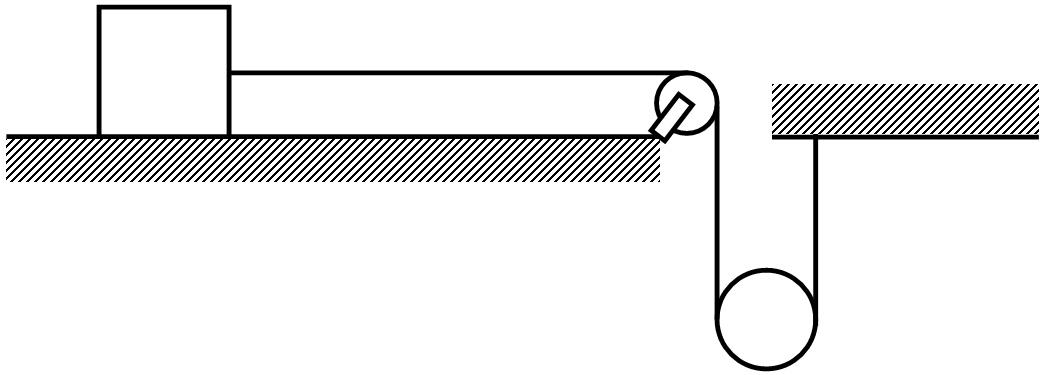
The descending pulley shown in figure has a radius $20cm$ and moment of inertia $0.20kg-m^2$. The fixed pulley is light and the horizontal plane frictionless. Find the acceleration of the block if its mass is $1.0kg$.
Download our app for free and get started
A is light pulley and B is the descending pulley having $I = 0.20kg-m^2$ and $r = 0.2m$ Mass of the block = 1kg According to the equation
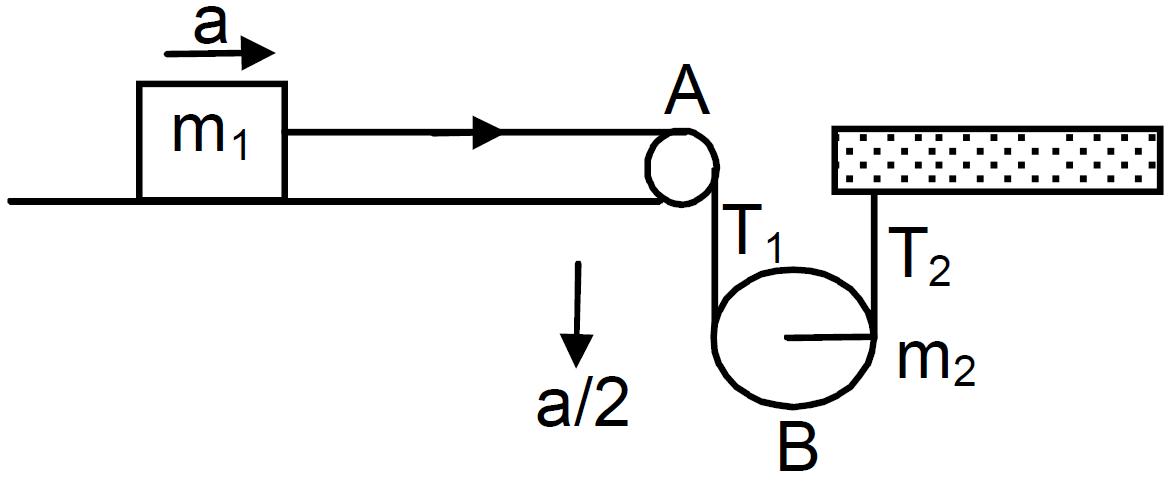
$\text{T}_1=\text{m}_1\text{a}\ \dots(1)$
$(\text{T}_2-\text{T}_1)\text{r}=\text{l}\alpha\ \dots(2)$
$\text{m}_2\text{g}-\frac{\text{m}_2\text{a}}{2}=\text{T}_1+\text{T}_2\ \dots(3)$
$\text{T}_2-\text{T}_1=\frac{\text{la}}{2\text{R}^2}=\frac{\text{5a}}2{}$ and $\text{T}_1=\text{a}\ \Big($because $\alpha=\frac{\text{a}}{2\text{R}}\Big)$
$\Rightarrow\text{T}_2=\frac{7}{2}\text{a}$
$\Rightarrow\text{m}_2\text{g}=\frac{\text{m}_2\text{a}}{2}+\frac{7}{2}\text{a}+\text{a}$
$\Rightarrow\frac{2\text{l}}{\text{r}^2\text{g}}=\frac{\frac{\text{2l}}{\text{r}^2}\text{a}}{2}+\frac{9}{2}\text{a}$
$\Big(\frac{1}{2}\text{mr}^2=\text{l}\Big)$
$\Rightarrow98=\text{5a}+4.5\text{a}$
$\Rightarrow\text{a}=\frac{98}{9.5}=10.3\text{ms}^2$
$\text{T}_1=\text{m}_1\text{a}\ \dots(1)$
$(\text{T}_2-\text{T}_1)\text{r}=\text{l}\alpha\ \dots(2)$
$\text{m}_2\text{g}-\frac{\text{m}_2\text{a}}{2}=\text{T}_1+\text{T}_2\ \dots(3)$
$\text{T}_2-\text{T}_1=\frac{\text{la}}{2\text{R}^2}=\frac{\text{5a}}2{}$ and $\text{T}_1=\text{a}\ \Big($because $\alpha=\frac{\text{a}}{2\text{R}}\Big)$
$\Rightarrow\text{T}_2=\frac{7}{2}\text{a}$
$\Rightarrow\text{m}_2\text{g}=\frac{\text{m}_2\text{a}}{2}+\frac{7}{2}\text{a}+\text{a}$
$\Rightarrow\frac{2\text{l}}{\text{r}^2\text{g}}=\frac{\frac{\text{2l}}{\text{r}^2}\text{a}}{2}+\frac{9}{2}\text{a}$
$\Big(\frac{1}{2}\text{mr}^2=\text{l}\Big)$
$\Rightarrow98=\text{5a}+4.5\text{a}$
$\Rightarrow\text{a}=\frac{98}{9.5}=10.3\text{ms}^2$

Download our appand get started for free
Experience the future of education. Simply download our apps or reach out to us for more information. Let's shape the future of learning together!No signup needed.*
Similar Questions
- 1View SolutionObtain an expression for linear acceleration of a cylinder rolling down an inclined plane and hence find the condition for the cylinder to roll down the inclined plane without slipping.
- 2A disc of mass $5kg$ and radius $50cm$ rolls on the ground at the rate of $10ms^{-1}$. Calculate the K.E. of the disc. $\Big(\text{Given}:\text{I}=\frac{1}{2}\text{MR}^2\Big)$View Solution
- 3View SolutionFig. shows two blocks of masses 5kg and 2kg placed on a frictionless surface and connected by a spring. An external kick gives a velocity 14 m/ s to the heavier block in the direction of lighter one. Deduce (i) the velocity gained by the centre of mass and (ii) the separate velocities of the two blocks in the centre of mass coordinates just after the kick.
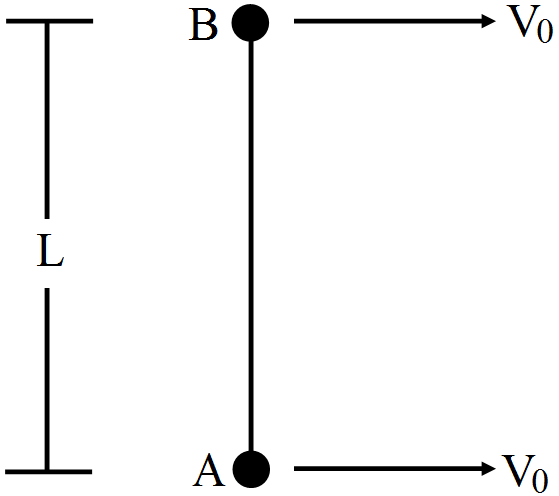
- 4View SolutionTwo small balls A and B, each of mass m, are joined rigidly to the ends of a light rod of lengh L (figure). The system translates on a frictionless horizontal surface with a velocity vo in a direction perpendicular to the rod. A particle P of mass m kept at rest on the surface sticks to the ball A as the ball collides with it. Find:
- The linear speeds of the balls A and B after the collision.
- The velocity of the centre of mass C of the system A + B + P.
- The angular speed of the system about C after the collision.
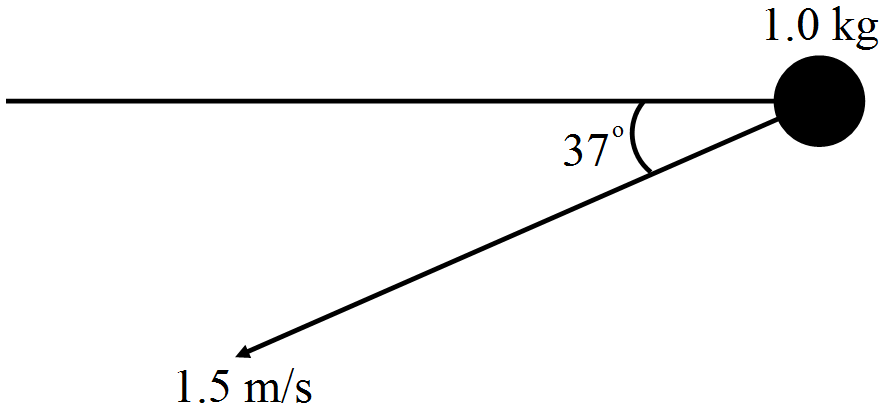
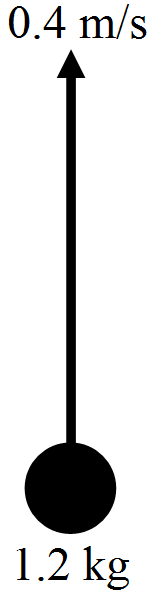
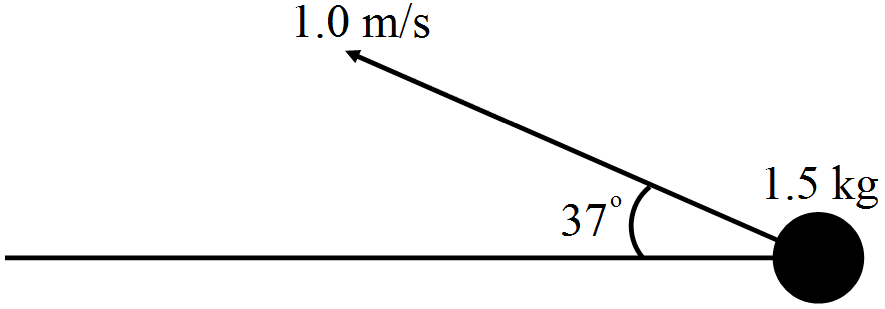
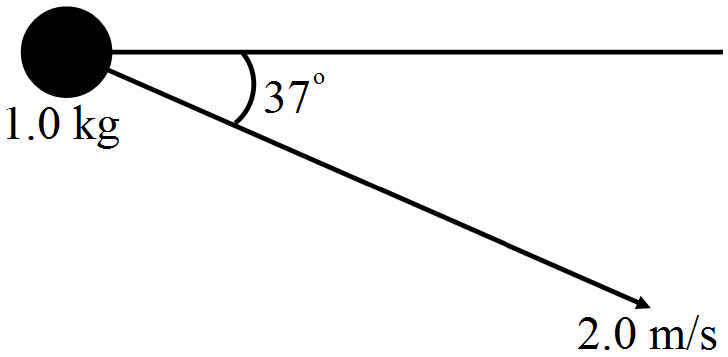
- 5View SolutionCalculate the velocity of the centre of mass of the system of particles shown in figure.

- 6View SolutionA solid sphere rolls down two different inclined planes of the same heights but different angles of inclination.
- Will it reach the bottom with the same speed in each case?
- Will it take longer to roll down one plane than the other?
- If so, which one and why?
- 7A cylinder of mass $5kg$ and radius $30cm$ and free to rotate about its axis, receives an angular impulse of $3kgm^2 s^{-1}$ followed by a similar impulse after every $4$ seconds. What is the angular speed of the cylinder $30s$ after the initial impulse? The cylinder is at rest initially.View Solution
- 8Separation of Motion of a system of particles into motion of the centre of mass and motion about the centre of mass: Show $\text{L}=\text{L}'+\text{R}\times\text{MV}$ where $\text{L}'=\sum\text{r}'_\text{i}\times\text{p}'_\text{i}$ is the angular momentum of the system about the centre of mass with velocities taken relative to the centre of mass. Remember $\text{r}'_\text{i}=\text{r}_\text{i}-\text{R},$ rest of the notation is the standard notation used in the chapter. Note: $\text{L}'$ and $\text{MR}\times\text{V}$ can be said to be angular momenta, respectively, about and of the centre of mass of the system of particles.View Solution
- 9View SolutionThe door of an almirah is 6ft high, 1.5ft wide and weighs 8kg. The door is supported by two hinges situated at a distance of 1ft from the ends. If the magnitudes of the forces exerted by the hinges on the door are equal, find this magnitude.
- 10Separation of Motion of a system of particles into motion of the centre of mass and motion about the centre of mass: Show $\text{K}=\text{K}'+\frac{1}{2}\text{M}\text{V}^2$ where K' is the total kinetic energy of the system of particles, K′ is the total kinetic energy of the system when the particle velocities are taken with respect to the centre of mass and $\frac{\text{MV}^2}{2}$ is the kinetic energy of the translation of the system as a whole (i.e. of the centre of mass motion of the system). The result has been used in $\sec7.14$View Solution