A uniform magnetic field $B$ exists in the region between $x=0$ and $x=\frac{3 R}{2}$ (region $2$ in the figure) pointing normally into the plane of the paper. A particle with charge $+Q$ and momentum $p$ directed along $x$-axis enters region $2$ from region $1$ at point $P_1(y=-R)$. Which of the following option(s) is/are correct?
$[A$ For $B>\frac{2}{3} \frac{p}{QR}$, the particle will re-enter region $1$
$[B]$ For $B=\frac{8}{13} \frac{\mathrm{p}}{QR}$, the particle will enter region $3$ through the point $P_2$ on $\mathrm{x}$-axis
$[C]$ When the particle re-enters region 1 through the longest possible path in region $2$ , the magnitude of the change in its linear momentum between point $P_1$ and the farthest point from $y$-axis is $p / \sqrt{2}$
$[D]$ For a fixed $B$, particles of same charge $Q$ and same velocity $v$, the distance between the point $P_1$ and the point of re-entry into region $1$ is inversely proportional to the mass of the particle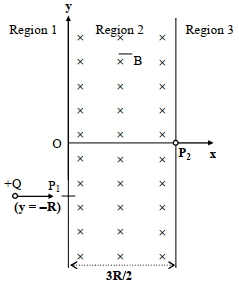
IIT 2017, Advanced
Download our app for free and get started
$R^{\prime}=\frac{p}{q B}$
$\left(R^{\prime}-R\right)^2+R^2=R^{\prime}$
$\Rightarrow R^{\prime}=\frac{13}{8} R$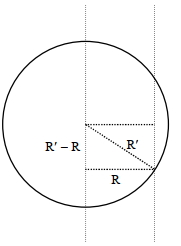

Download our appand get started for free
Experience the future of education. Simply download our apps or reach out to us for more information. Let's shape the future of learning together!No signup needed.*
Similar Questions
- 1Given below are two statements: One is labelled as Assertion $(A)$ and the other is labelled as Reason $(R).$View Solution
Assertion $(A)$ : In an uniform magnetic field, speed and energy remains the same for a moving charged particle.
Reason $(R)$ : Moving charged particle experiences magnetic force perpendicular to its direction of motion.
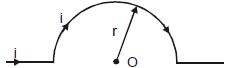
- 2A portion of a conductive wire is bent in the form of a semicircle of radius $r$ as shown below in fig. At the centre of semicircle, the magnetic induction will beView Solution
- 3Magnetic fields at two points on the axis of a circular coil at a distance of $0.05\,m$ and $0.2\,m$ from the centre are in the ratio $8 : 1$. The radius of the coil is.....$m$View Solution
- 4A galvanometer having a coil resistance of $100\ \Omega$. gives a full scale deflection, when a currect of $I\ mA$ is passed through it. The value of the resistance, which can convert this galvanometer into ammeter giving a full scale deflection for a current of $10\ A$, is :......$Ω$View Solution
- 5If two protons are moving with speed $v=4.5 \times 10^{5} \,m / s$ parallel to each other then the ratio of electrostatic and magnetic force between themView Solution
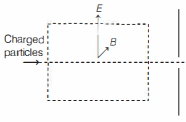
- 6View SolutionA stream of charged particles enter into a region with crossed electric and magnetic fields as shown in the figure below. On the other side is a screen with a hole that is right on the original path of the particles. Then,
- 7An electron accelerated through a potential difference $V$ enters a uniform transverse magnetic field and experiences a force $F$. If the accelerating potential is increased to $2V$, the electron in the same magnetic field will experience a forceView Solution
- 8The sensitivity of a Galvenometer of resistance $171\,\Omega $ becomes $20\,times$ when we used shunt of $x \,\Omega .$ Find $x$ ................. $\Omega$View Solution
- 9A coil having $N$ turns is wound tightly in the form of a spiral with inner and outer radii $a$ and $b$ respectively. When a current $i$ passes through the coil, the magnetic field at the centre isView Solution
- 10A uniform magnetic field acts at right angles to the direction of motion of electrons. As a result, the electron moves in a circular path of radius $2\, cm$. If the speed of the electrons is doubled, then the radius of the circular path will be.....$cm$View Solution