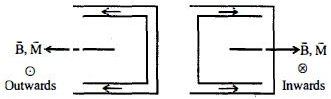
A uniform magnetic field $B$ of $0.3\, T$ is along the positive $Z-$ direction . A rectangular loop $(abcd)$ of sides $10\, cm\times5\, cm$ carries a current $I$ of $12\, A$. Out of the following different orientations which one corresponds to stable equilibrium ?
- A
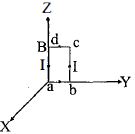
- B
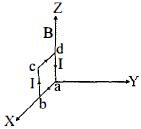
- C
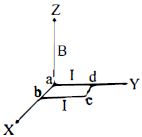
- D
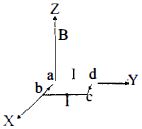
JEE MAIN 2017, Diffcult


Download our appand get started for free
Experience the future of education. Simply download our apps or reach out to us for more information. Let's shape the future of learning together!No signup needed.*
Similar Questions
- 1An electron moving in a circular orbit of radius $r$ makes $n$ rotation per second. The magnetic field produced at the centre has a magnitude ofView Solution
- 2In the productView Solution
$\overrightarrow{\mathrm{F}} =\mathrm{q}(\vec{v} \times \overrightarrow{\mathrm{B}})$
$=\mathrm{q} \vec{v} \times\left(\mathrm{B} \hat{i}+\mathrm{B} \hat{j}+\mathrm{B}_{0} \hat{k}\right)$
For $\mathrm{q}=1$ and $\vec{v}=2 \hat{i}+4 \hat{j}+6 \hat{k}$ and
$\overrightarrow{\mathrm{F}}=4 \hat{i}-20 \hat{j}+12 \hat{k}$
What will be the complete expression for $\vec{B}$ ?
- 3View SolutionAn electron is travelling in east direction and a magnetic field is applied in upward direction then electron will deflect in
- 4A galvanometer, having a resistance of $50 \,\Omega$ gives a full scale deflection for a current of $0.05\, A$. The length in meter of a resistance wire of area of cross-section $2.97× 10^{-2} \,cm^2$ that can be used to convert the galvanometer into an ammeter which can read a maximum of $5\, A$ current is (Specific resistance of the wire = $5 × {10^{ - 7}}\,\Omega m$)View Solution
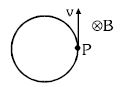
- 5A particle having charge of $10\,\mu C$ and $1\,\mu g$ mass moves along circular path of $10\, cm$ radius in the effect of uniform magnetic field of $0.1\, T$. When charge is at point $'P'$, a uniform electric field applied in the region so charge moves tangentially with constant speed. The value of electric field is......$V/m$View Solution
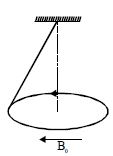
- 6A uniform current carrying ring of mass $m$ and radius $R$ is connected by a massless string as shown. A uniform magnetic field $B_0$ exist in the region to keep the ring in horizontal position, then the current in the ring is ($l =$ length of string)View Solution
- 7The radius of a circular current carrying coil is $R$. At what distance from the centre of the coil on its axis, the intensity of magnetic field will be $\frac{1}{2 \sqrt{2}}$ times that at the centre?View Solution
- 8A $2\, MeV$ proton is moving perpendicular to a uniform magnetic field of $2.5\, tesla$. The force on the proton isView Solution
- 9Consider two identical galvanometers and two identical resistors with resistance $R$. If the internal resistance of the galvanometers $R_{ C } < R / 2$View Solution
($A$) The maximum voltage range is obtained when all the components are connected in series
($B$) The maximum voltage range is obtained when the two resistors and one galvanometer are connected in series, and the second galvanometer is connected in parallel to the first galvanometer
($C$) The maximum current range is obtained when all the components are connected in parallel
($D$) The maximum current range is obtained when the two galvanometers are connected in series and the combination is connected in parallel with both the resistors
- 10A thin flexible wire of length $\mathrm{L}$ is connected to two adjacent fixed points and carries a current $\mathrm{I}$ in the clockwise direction, as shown in the figure. When the system is put in a uniform magnetic field of strength $B$ going into the plane of the paper, the wire takes the shape of a circle. The tension in the wire isView Solution