Question
A uniform magnetic field of $0.20 \times 10^{-3} \mathrm{~T}$ exists in the space. Find the change in the magnetic scalar potential as one moves through 50 cm along the field.

Answer

$\text{B}=-\frac{\text{dv}}{\text{dt}}\Rightarrow\text{dv}=-\text{B dt}$$=-0.2\times10^{-3}\times0.5=-0.1\times10^{-3}\text{T-m}$
Since the sigh is-ve therefore potential decreases.

Need a full question paper?

Generate a complete, print-ready paper with questions like this in minutes — across 16+ boards, with answer keys.
Start Generating Free

Similar questions

Why do marine animals live deep inside a lake when the surface of the lake freezes?
If a mosquito is dipped into water and released, it is not able to fly till it is dry again. Explain.
Find the acceleration due to gravity of the moon at a point 1000 km above the moon's surface. The mass of the moon is $7.4 \times 10^{22} \mathrm{~kg}$ and its radius is 1740 km .
An isolated metal sphere is heated to a high temperature. Will it become positively charged due to thermionic emission?
Two blocks of unequal masses are tied by a spring. The blocks are pulled stretching the spring slightly and the system is released on a frictionless horizontal platform. Are the forces due to the spring on the two blocks equal and opposite? If yes, is it an example of Newton's third law?
Read the passage given below and answer the following questions from 1 to 5. Acceleration due to gravity The acceleration for any object moving under the sole influence of gravity is known as acceleration due to gravity. So, for an object of mass m, the acceleration experienced by it is usually denoted by the symbol g which is related to F by Newton’s second law by relation F = mg Thus, $\text{g}=\frac{\text{F}}{\text{m}}=\frac{{\text{Gm}_\text{e}}}{\text{R}^2_\text{e}}$ Acceleration g is readily measurable as Re is a known quantity. The measurement ofG by Cavendish’s experiment (or otherwise), combined with knowledge of g and Re enables one to estimate $M_e$ from the above equation. This is the reason why there is a popular statement regarding Cavendish “Cavendish weighed the earth”. The value of g decrease as we go upwards from the earth’s surface or downwards, but it is maximum at its surface.
  1. If g is the acceleration due to gravity at the surface of the earth, the force acting on the particle of mass m placed at the surface is:
  1. mg
  2. $\frac{\text{GmM}\theta}{\text{R}^2_\text{e}}$
  3. Data insufficient
  4. Both (a) and (b)
  1. The weight of a body at the centre of earth is:
  1. same as on the surface of earth
  2. same as on the poles
  3. same as on the equator
  4. None of the above
  1. If the mass of the sun is ten times smaller and gravitational constant G is ten times larger in magnitude, then for earth:
  1. walking on ground would become more easy
  2. acceleration due to gravity on the earth will not change
  3. raindrops will fall much slower
  4. airplanes will have to travel much faster
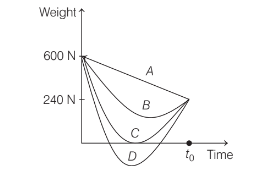
  1. Suppose, the acceleration due to gravity at the earth’s surface is $10 ms^{-2}$ and at the surface of mars, it is $4.0 ms ^{-2}$ 60kg passenger goes from the earth to the mars in a spaceship moving with a constant velocity. Neglect all other objects in the sky. Which curve best represents the weight (net gravitational force) of the passenger as a function of time?
  1. A
  2. B
  3. C
  4. D
  1. If the mass of the earth is doubled and its radius halved, then new acceleration due to the gravity $\acute{\text{g}}$ is:
  1. $\acute{\text{g}}=4\text{g}$
  2. $\acute{\text{g}}=8\text{g}$
  3. $​​\acute{g}=\text{g}$
  4. $\acute{\text{g}}=16\text{g}$
Read the case study given below and answer any four subparts:
Potential energy is the energy stored within an object, due to the object's position, arrangement or state. Potential energy is one of the two main forms of energy, along with kinetic energy. Potential energy depends on the force acting on the two objects.
  1. A body is falling freely under the action of gravity alone in vacuum. Which of the following quantities remain constant during the fall?
    1. kinetic energy
    2. potential energy
    3. mechanical energy
    4. none of these
  2. Work done by a conservative force is positive, if
    1. potential energy decreases
    2. potential energy increases
    3. kinetic energy decreases
    4. kinetic energy increases
  3. When does the potential energy of a spring increases?
    1. only when spring is stretched
    2. only when spring is compressed
    3. both a and b
    4. none of these
  4. Dimension of k/m is, here k is force constant
    1. $T^2$
    2. $T^{-2}$
    3. $T^1$
    4. $T^{-1}$
  5. A vehicle of mass 5000kg climbs up a hill of 10 m. The potential energy gained by it
    1. 5J
    2. 500J
    3. $5 \times 10^4J$
    4. $5 \times 10^5J$
$\int\frac{\text{dx}}{\sqrt{2\text{ax}-\text{x}^2}}=\text{a}^{\text{n}}\sin^{-1}\Big[\frac{\text{x}}{\text{a}}-1\Big].$ The value of n is:
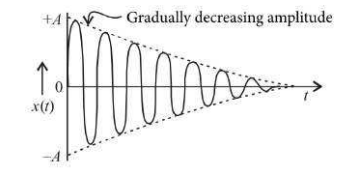
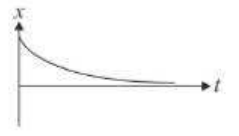
Read the passage given below and answer the following questions from 1 to 4. Damped Simple Harmonic Motion The oscillations in presence of dissipative force where the amplitude decreases gradually with the passage of time are called damped oscillations. A part of the energy of the oscillating system is lost in the form of heat, in overcoming these resistive forces, As a result, the amplitude of such oscillations decreases exponentially with time, as shown in figure. Eventually, these oscillations die out. In these oscillations, the amplitude of oscillation decreases exponentially due to damping forces like frictional force, viscous force, etc. Due to decrease in amplitude, the energy of the oscillator also goes on decreasing exponentially.

 The force producing a resistance to the oscillation is called damping force.
  1. particle oscillating under force $\overrightarrow{\text{F}}=-\text{k}\overrightarrow{\text{x}}-\text{b}\overrightarrow{\text{v}}$ is a (k and b are constants)
  1. Simple harmonic oscillator
  2. Linear oscillator
  3. Damped oscillator
  4. Forced oscillator
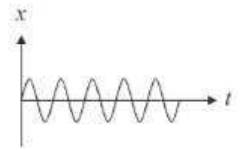
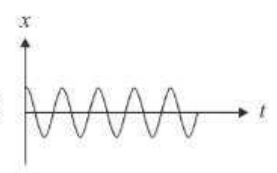
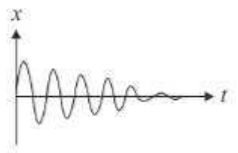
  1. Which of the following displacement-time graphs represent damped harmonic oscillation?
  1. In case of a force vibration, the resonance wave becomes very sharp when the
  1. Applied periodic force is small
  2. Quality factor is small
  3. Damping force is small
  4. Restoring force is small
  1. The S.I. unit of damping constant is:
  1. $kg s$
  2. $kg^2s$
  3. $kg m/s$
  4. $kg/s$
A closed bottle contains some liquid. The bottle is shaken vigorously for 5 minutes. It is found that the temperature of the liquid is increased. Is heat transferred to the liquid? Is work done on the liquid? Neglect expansion on heating.