MCQ
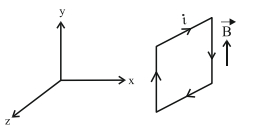
A uniform magnetic field of $2 \times 10^{-3} \mathrm{~T}$ acts along positive $\mathrm{Y}$-direction. A rectangular loop of sides $20$ $\mathrm{cm}$ and $10 \mathrm{~cm}$ with current of $5 \mathrm{~A}$ is $\mathrm{Y}-\mathrm{Z}$ plane. The current is in anticlockwise sense with reference to negative $\mathrm{X}$ axis. Magnitude and direction of the torque is :
  • A
     $2 \times 10^{-4} \mathrm{~N}-\mathrm{m}$ along positive $\mathrm{Z}$-direction
  •  $2 \times 10^{-4} \mathrm{~N}-\mathrm{m}$ along negative $Z$-direction
  • C
     $2 \times 10^{-4} \mathrm{~N}-\mathrm{m}$ along positive $\mathrm{X}$-direction
  • D
    $2 \times 10^{-4} \mathrm{~N}-\mathrm{m}$ along positive $\mathrm{Y}$-direction
Answer

Correct option: B.
 $2 \times 10^{-4} \mathrm{~N}-\mathrm{m}$ along negative $Z$-direction
b
$\overrightarrow{\mathrm{M}}=\mathrm{iA}$

$=5 \times(0.2) \times(0.1)(-\hat{\mathrm{i}})$

$=0.1(-\hat{\mathrm{i}})$

$\vec{\tau}=\overrightarrow{\mathrm{M}} \times \overrightarrow{\mathrm{B}}=0.1(-\hat{\mathrm{i}}) \times\left(2 \times 10^{-3}\right)(\hat{\mathrm{j}})$

$=2 \times 10^{-4}(-\hat{\mathrm{k}}) \mathrm{N}-\mathrm{m}$

Need a full question paper?

Generate a complete, print-ready paper with questions like this in minutes — across 16+ boards, with answer keys.

Start Generating Free

Similar questions

A convex lens of focal length $0.5 m$ and concave lens of focal length $1 m$ are combined. The power of the resulting lens will be
In the visible region of the spectrum the rotation of the place of polarization is given by $\theta = a + \frac{b}{{{\lambda ^2}}}$. The optical rotation produced by a particular material is found to be $30^o $ per mm at $\lambda = 5000$Å and $50^o $ per mm at $\lambda = 4000{\rm{Å}}$. The value of constant $a $ will be
In the Boolean algebra $(\overline {\bar A \cdot \bar B} ) \cdot A$ equals to
A body $A$ starts from rest with an acceleration $a_1$ . After $2\ seconds$ , another body $B$ starts from rest with an acceleration $a_2$ . If they travel equal distance in the $5th\ second$ , after the start of $A$ , then the ratio $a_1$ : $a_2$ is equal to
A person of $80\, kg$ mass is standing on the rim of a circular platform of mass $200\, kg$ rotating about its axis as $5$ revolutions per minute $(rpm).$ The person now starts moving towards the centre of the platform. What will be the rotational speed (in $rpm$ ) of the platform when the person reaches its centre $......rpm$
A liquid enter at point $A_{1}$ with speed $3.5 m / s$ and leaves at point $A _{2} .$ Then find out the height attained by the liquid above point $A _{2}$ (in $cm$)
A uniform rope of length $L$ and mass $m_1$ hangs vertically from a rigid support. A block of mass $m_2$ is attached to the free end of the rope. A transverse pulse of wavelength $\lambda _1$, is produced at the lower end of the rope. The wave length of the pulse when it reaches the top of the rope is $\lambda _2$. The ratio $\lambda _2\,/\,\lambda _1$ is 
A small mass executes linear $SHM$ about $O$ with amplitude $a$ and period $T.$ Its displacement from $O$ at time $T/8$ after passing through $O$ is :
Two beams of red and violet colours are made to pass separately through a prism (angle of the prism is $60^{\circ}$ ). In the position of minimum deviation, the angle of refraction will be
A plane mirror is placed $22.5\; cm$ in front of a concave mirror of focal length $10\; cm$. an object can be placed between the two mirrors, so that the first image in both the mirrors by concave mirror. find out magnification of the image produced by concave mirror.