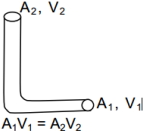
A liquid enter at point $A_{1}$ with speed $3.5 m / s$ and leaves at point $A _{2} .$ Then find out the height attained by the liquid above point $A _{2}$ (in $cm$)
AIIMS 2019, Medium
Download our app for free and get started
Consider the following figure
Here
$A _{1}= A _{2} soV _{1}= V _{2}=3.5 m / s$
Use Bernoulli theorem.
$P _{ atm }+\frac{1}{2} \rho(3.5)^{2}+\rho g (0)= P _{ atm }+\frac{1}{2} \rho(0)^{2}+\rho gh$
$h =\frac{(3.5 \times 3.5)^{2}}{2 g }$
$=0.6125 m$
$=61.25 cm$

Download our appand get started for free
Experience the future of education. Simply download our apps or reach out to us for more information. Let's shape the future of learning together!No signup needed.*
Similar Questions
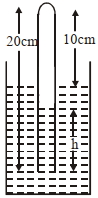
- 1A $20 \,cm$ long tube is closed at one end. It is held vertically, and its open end is dipped in water until only half of it is outside the water surface. Consequently, water rises in it by height $h$ as shown in the figure. The value of $h$ is closest to .............. $\,m / s$ (assume that the temperature remains constant, $P _{\text {armosphere }}=10^5 \,N / m ^2$, density. of water $=10^3 \,kg / m ^3$, and acceleration due to gravity $g =10 \,m / s ^2$ )View Solution
- 2An inverted bell lying at the bottom of a lake $ 47.6 m$ deep has $50$ $cm^3$ of air trapped in it. The bell is brought to the surface of the lake. The volume of the trapped air will be ......... $cm^3$ (atmospheric pressure $ = 70\,cm$ of $Hg$ and density of $Hg = 13.6$ $cm^3$)View Solution
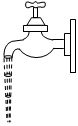
- 3View SolutionWater coming out of the mouth of a tap and falling vertically in streamline flow forms a tapering column, i.e., the area of cross-section of the liquid column decreases as it moves down. Which of the following is the most accurate explanation for this
- 4A flat plate of area $10\,cm^2$ is separated from a large plate by a layer of glycerine $1\, mm$ thick. If the coefficient of viscosity of glycerine is $20$ poise, the force required to keep the plate moving with a velocity of $1\,cm/sec$ is .......... $dyne$View Solution
- 5A beaker containing a liquid of density $\rho $ moves up with an acceleration $a$ ; the pressure due to the liquid at a depth $h$ below the free surface of the liquid isView Solution
- 6Suppose you have taken a dilute solution of oleic acid in such a way that its concentration becomes $0.01 \,cm ^{3}$ of oleic acid per $cm ^{3}$ of the solution. Then you make a thin film of this solution (monomolecular thickness) of area $4\, cm ^{2}$ by considering $100$ spherical drops of radius $\left(\frac{3}{40 \pi}\right)^{\frac{1}{3}} \times 10^{-3}\, cm .$ Then the thickness of oleic acid layer will be $x \times 10^{-14} \,m$. Where $x$ is ...... .View Solution
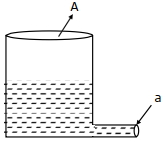
- 7A light cylindrical vessel is kept on a horizontal surface. Area of base is A. A hole of crosssectional area $'a'$ is made just at its bottom side. The minimum coefficient of friction necessary to prevent sliding the vessel due to the impact force of the emerging liquid is $(a\,<\,<\,A)$View Solution
- 8A metallic block of density $5\,gm \,cm^{-3}$ and having dimensions $5 cm × 5 cm × 5 cm$ is weighed in water. Its apparent weight will beView Solution
- 9View SolutionThe venturi-meter works on :
- 10View SolutionIn a laminar flow the velocity of the liquid in contact with the walls of the tube is