A uniform metal rod of $2\, mm^2$ cross section fixed between two walls is heated from $0\,^oC$ to $20\,^oC$. The coefficient of linear expansion of rod is $12\times10^{-6}/^oC$. Its Young's modulus of elasticity is $10^{11} \,N/m^2$. The energy stored per unit volume of rod will be ....... $J/m^3$
Medium
Download our app for free and get started
Energy per unit volume $=\frac{1}{2} \times \mathrm{Y} \times(\text { strain })^{2}$
$=\frac{1}{2} \times Y \times(\alpha \Delta \theta)^{2}$
$=\frac{1}{2} \times 10^{11} \times\left(12 \times 10^{-6} \times 20\right)^{2}=2880 \mathrm{J} / \mathrm{m}^{3}$

Download our appand get started for free
Experience the future of education. Simply download our apps or reach out to us for more information. Let's shape the future of learning together!No signup needed.*
Similar Questions
- 1A material has Poisson's ratio $0.50.$ If a uniform rod of it suffers a longitudinal strain of $2 \times {10^{ - 3}}$, then the percentage change in volume isView Solution
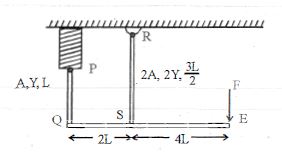
- 2A rigid massless rod of length $6\ L$ is suspended horizontally by means of two elasticrods $PQ$ and $RS$ as given figure. Their area of cross section, young's modulus and lengths are mentioned in figure. Find deflection of end $S$ in equilibrium state. Free end of rigid rod is pushed down by a constant force . $A$ is area of cross section, $Y$ is young's modulus of elasticityView Solution
- 3Join details of Column$-II$ with given information in Column$-I$ appropriatelyView Solution
Column $-I$ Column $-II$ $(a)$ Stress is proportional to strain.
$(i)$ Elastic limit $(b)$ When the load of the wire is removed, the body does regain its original dimension. $(ii)$ Limit of pro-portionality $(iii)$ Plastic deformation - 4A uniform plank of Young’s modulus $Y $ is moved over a smooth horizontal surface by a constant horizontal force $F.$ The area of cross section of the plank is $A.$ The compressive strain on the plank in the direction of the force isView Solution
- 5View SolutionThe work done in stretching an elastic wire per unit volume is
- 6The ratio of Young's modulus of the material of two wires is $2 : 3.$ If the same stress is applied on both, then the ratio of elastic energy per unit volume will beView Solution
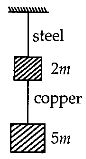
- 7If the ratio of diameters, lengths and Young's modulus of steel and copper wires shown in the figure are $p, q$ and $s$ respectively, then the corresponding ratio of increase in their lengths would beView Solution
- 8Two exactly similar wires of steel and copper are stretched by equal forces. If the difference in their elongations is $0.5$ cm, the elongation $(l)$ of each wire is ${Y_s}({\rm{steel}}) = 2.0 \times {10^{11}}\,N/{m^2}$${Y_c}({\rm{copper}}) = 1.2 \times {10^{11}}\,N/{m^2}$View Solution
- 9A bob of mass $10\, kg$ is attached to wire $0.3\, m$ long. Its breaking stress is $4.8 \times 10^7 N/m^2$. The area of cross section of the wire is $10^{-6} m^2$. The maximum angular velocity with which it can be rotated in a horizontal circle ....... $rad/sec$View Solution
- 10Given below are two statements: one is labelled as Assertion $A$ and the other is labelled as Reason $R$View Solution
Assertion $A$: Steel is used in the construction of buildings and bridges.
Reason $R:$ Steel is more elastic and its elastic limit is high.
In the light of above statements, choose the most appropriate answer from the options given below