A uniform metal rod of $2\,\,mm^2$ cross section fixed between two walls is heated from $0\,^oC$ to $20\,^oC$ . The coefficient of linear expansion of rod is $12\,\,\times\,\,10^{-6}\,/^oC$ . Its Young's modulus of elasticity is $10^{11}\,\,N/m^2$ . The energy stored per unit volume of rod will be ....... $J/m^3$
Medium
Download our app for free and get started
Energy per unit volume $=\frac{1}{2} \times \mathrm{Y} \times(\text { strain })^{2}$
$=\frac{1}{2} \times \mathrm{Y} \times(\alpha \Delta \theta)^{2}$
$=\frac{1}{2} \times 10^{11} \times\left(12 \times 10^{-6} \times 20\right)^{2}=2880 \mathrm{J} / \mathrm{m}^{3}$

Download our appand get started for free
Experience the future of education. Simply download our apps or reach out to us for more information. Let's shape the future of learning together!No signup needed.*
Similar Questions
- 1One end of a metal wire is fixed to a ceiling and a load of $2 \mathrm{~kg}$ hangs from the other end. A similar wire is attached to the bottom of the load and another load of $1 \mathrm{~kg}$ hangs from this lower wire. Then the ratio of longitudinal strain of upper wire to that of the lower wire will be____________.View Solution
[Area of cross section of wire $=0.005 \mathrm{~cm}^2$, $\mathrm{Y}=2 \times 10^{11}\ \mathrm{Nm}^{-2}$ and $\left.\mathrm{g}=10 \mathrm{~ms}^{-2}\right]$
- 2View SolutionThe units of Young ‘s modulus of elasticity are
- 3A bar is subjected to axial forces as shown. If $E$ is the modulus of elasticity of the bar and $A$ is its crosssection area. Its elongation will beView Solution

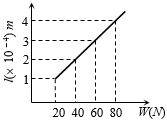
- 4The adjacent graph shows the extension $(\Delta l)$ of a wire of length $1m$ suspended from the top of a roof at one end with a load $W$ connected to the other end. If the cross sectional area of the wire is ${10^{ - 6}}{m^2},$ calculate the young’s modulus of the material of the wireView Solution
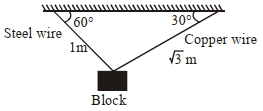
- 5A block of weight $100 N$ is suspended by copper and steel wires of same cross sectional area $0.5 cm ^2$ and, length $\sqrt{3} m$ and $1 m$, respectively. Their other ends are fixed on a ceiling as shown in figure. The angles subtended by copper and steel wires with ceiling are $30^{\circ}$ and $60^{\circ}$, respectively. If elongation in copper wire is $\left(\Delta \ell_{ C }\right)$ and elongation in steel wire is $\left(\Delta \ell_{ s }\right)$, then the ratio $\frac{\Delta \ell_{ C }}{\Delta \ell_{ S }}$ is. . . . . .View Solution
[Young's modulus for copper and steel are $1 \times 10^{11} N / m ^2$ and $2 \times 10^{11} N / m ^2$ respectively]
- 6View SolutionThe longitudinal strain is only possible in
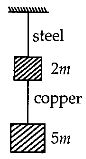
- 7If the ratio of diameters, lengths and Young's modulus of steel and copper wires shown in the figure are $p, q$ and $s$ respectively, then the corresponding ratio of increase in their lengths would beView Solution
- 8A fixed volume of iron is drawn into a wire of length $L.$ The extension $x$ produced in this wire by a constant force $F$ is proportional toView Solution
- 9View SolutionWhich of the following is true for elastic potential energy density
- 10The bulk modulus of rubber is $9.1\times 10^8\,N/m^2$. To ......... $m$ depth a rubber ball be taken in a lake so that its volume is decreased by $0.1\,\%$ .View Solution