The adjacent graph shows the extension $(\Delta l)$ of a wire of length $1m$ suspended from the top of a roof at one end with a load $W$ connected to the other end. If the cross sectional area of the wire is ${10^{ - 6}}{m^2},$ calculate the young’s modulus of the material of the wire
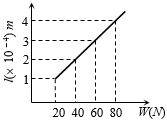
IIT 2003, Medium


Download our appand get started for free
Experience the future of education. Simply download our apps or reach out to us for more information. Let's shape the future of learning together!No signup needed.*
Similar Questions
- 1An increases in pressure required to decreases the $200\,\,litres$ volume of a liquid by $0.004\%$ in container is ........... $kPa$. (Bulk modulus of the liquid $= 2100\,\,MPa$ )View Solution
- 2When a force is applied on a wire of uniform cross-sectional area $3 \times {10^{ - 6}}\,{m^2}$ and length $4m$, the increase in length is $1\, mm.$ Energy stored in it will be $(Y = 2 \times {10^{11}}\,N/{m^2})$View Solution
- 3View SolutionIn the three states of matter, the elastic coefficient can be
- 4View SolutionMark the wrong statement
- 5A ball falling in a lake of depth $200\, m$ shows $0.1\%$ decrease in its volume at the bottom. What is the bulk modulus of the material of the ballView Solution
- 6Steel and copper wires of same length are stretched by the same weight one after the other. Young's modulus of steel and copper are $2 \times {10^{11}}\,N/{m^2}$ and $1.2 \times {10^{11}}\,N/{m^2}$. The ratio of increase in lengthView Solution
- 7View SolutionThe Poisson's ratio cannot have the value
- 8Increase in length of a wire is $1\, mm$ when suspended by a weight. If the same weight is suspended on a wire of double its length and double its radius, the increase in length will be ........ $mm$View Solution
- 9The length of a metal wire is $l_1$, when the tension in it is $T_1$ and is $l_2$ when the tension is $T_2$. The unstretched length of the wire isView Solution
- 10A steel wire is $1 \,m$ long and $1 \,mm ^2$ in area of cross$-$section. If it takes $200 \,N$ to stretch this wire by $1 \,mm$, how much force will be required to stretch a wire of the same material as well as diameter from its normal length of $10 \,m$ to a length of $1002 \,cm$ is $........ N$View Solution