Question
A uniform metallic rod rotates about its perpendicular bisector with constant angular speed. If it is heated uniformly to raise its temperature slightly

Answer

When a metallic rod is heated it expands. Its moment of inertia $(1)$ about a perpendicular bisector increases. Ac cording to law of conservation of angular momentum, its angular speed ( $\omega$ ) decreases, since $\omega \propto 1 / l$ (ac cording to law of conservation of angular momentum).

Need a full question paper?

Generate a complete, print-ready paper with questions like this in minutes — across 16+ boards, with answer keys.
Start Generating Free

Similar questions

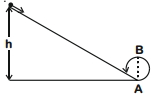
A body initially at rest and sliding along a frictionless track from a height $h$ (as shown in the figure) just completes a vertical circle of diameter $AB =D$ . The height $h$ is equal to 
A charged shell of radius $R$ carries a total charge $Q$. Given $\Phi$ as the flux of electric field through a closed cylindrical surface of height $h$, radius $r$ and with its center same as that of the shell. Here, center of the cylinder is a point on the axis of the cylinder which is equidistant from its top and bottom surfaces. Which of the following option(s) is/are correct ? $\in_0$ is the permittivity of free space]

$(1)$ If $h >2 R$ and $r > R$ then $\Phi=\frac{ Q }{\in_0}$

$(2)$ If $h <\frac{8 R }{5}$ and $r =\frac{3 R }{5}$ then $\Phi=0$

$(3)$ If $h >2 R$ and $r =\frac{4 K }{5}$ then $\Phi=\frac{ Q }{5 \in_0}$

$(4)$ If $h >2 R$ and $r =\frac{3 K }{5}$ then $\Phi=\frac{ Q }{5 \in_0}$
Two identical metallic square loops $L_1$ and $L_2$ are placed next to each other with their sides parallel on a smooth horizontal table. Loop $L_1$ is fixed and a current which increases as a function of time is passed through it. Then, loop $L_2$ is
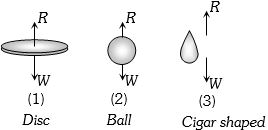
When a body falls in air, the resistance of air depends to a great extent on the shape of the body, $ 3 $ different shapes are given. Identify the combination of air resistances which truly represents the physical situation. (The cross sectional areas are the same).
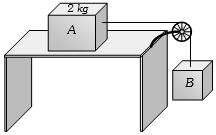
The coefficient of static friction, ${\mu _s},$ between block $A$ of mass $2\, kg$ and the table as shown in the figure is $0.2$. ........ $kg$ would be the maximum mass value of block $B$ so that the two blocks do not move. The string and the pulley are assumed to be smooth and massless. $(g = 10\,m/{s^2})$
A luminous object is placed at a distance of $30 \,cm$ from the convex lens of focal length $20 \,cm$. On the other side of the lens, at what distance from the lens a convex mirror of radius of curvature $10\, cm$ be placed in order to have an upright image of the object coincident with it.....$cm$
A concave mirror of focal length $15\, cm$ forms an image having twice the linear dimensions of the object. The position of the object when the image is virtual will be........$cm$
An ammeter with internal resistance $90\,\Omega $ reads $1.85\, A$ when connected in a circuit containing a battery and two resistors $700\,\Omega $ and $410\,\Omega $ in series. Actual current will be
A body of mass $m_1$ moving with an unknown velocity of $v_1 \hat i$ undergoes a collinear collision with a body of mass $m_2$ moving with a velocity $v_2 \hat i$ . After collision $m_1$ and $m_2$ move with velocities of $v_3 \hat i$ and $v_4 \hat i$ respectively. If $m_2 = 0.5\, m_1$ and $v_3 = 0.5\, v_1$ then $v_1$ is:
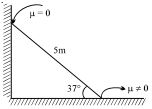
$A\, 5\, m$ long pole of $3\, kg$ mass is placed against a smooth vertical well as shown in the figure. Under equilibrium condition, if the pole makes an angle of $37^o$ with the horizontal, the frictional force between the pole and horizontal surface is